
Central Teacher Eligibility Test
A national-level eligibility test to determine eligibility for appointment as a teacher for classes 1 to 8.
CTET Study Material
Mock Tests
View allCTET English Mock Test
Free
CTET Pedagogy Practice Test
Free
CTET Child Development & Pedagogy Mock Test Series
Free
CTET English Free Practice Tests | Grammar, CDP & Pedagogy
Free
CTET Child Development & Pedagogy Complete Mock Test (60 MCQs) | CDP Concept, Psychology & Teaching Learning Process | 2026 Exam Preparation

₹21
Child Development And Pedagogy Paper
₹100₹50
Study Notes
View allहिन्दी व्याकरण सम्पूर्ण - 100 महत्वपूर्ण MCQs | Hindi Grammar Complete Practice Set for All Competitive Exams
10 pages₹10
CTET Paper 1 2026 Hindi Language-I Notes PDF | Bhasha Bodh Pedagogy
95 pages₹39
Child development and pedagogy 10 MCQ
11 pagesFree
CTET Paper 1 2026 CDP Notes PDF | Child Development Pedagogy
109 pages₹39
English Grammar & Pedagogy Quick Revision Notes | CTET/D.El.Ed PDF with MCQs
20 pages₹21
CTET CDP Complete Notes + 220 MCQs with Answers | UPTET, SuperTET
44 pages₹49
Bundles
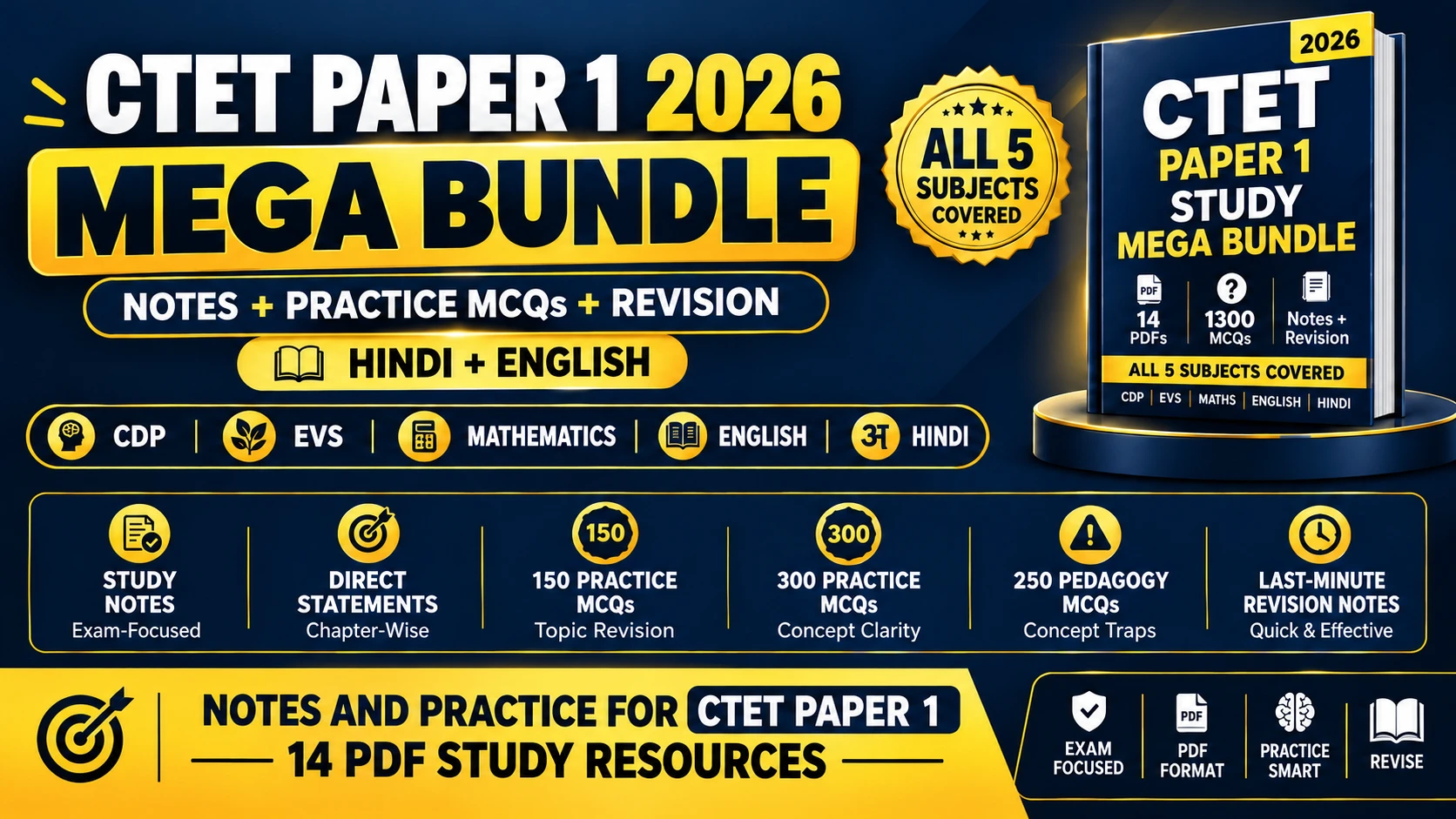
View allCTET Paper-I Notes and Practice Bundle | 14 PDFs, 1300 Practice MCQs
14 itemsSave 32%₹440₹300
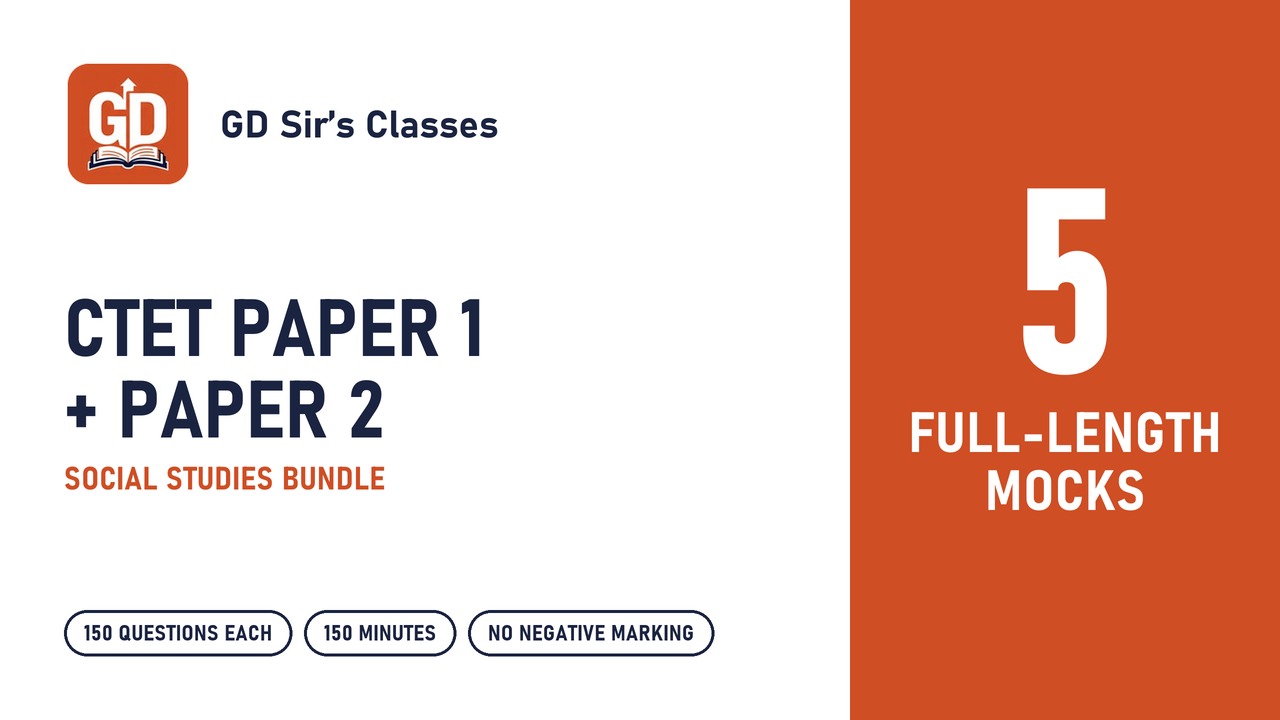
CTET Paper 1 + Paper 2 (Social Studies) Mock Test Bundle - 5 Full-Length Mocks
2 itemsSave 49%₹348₹179
CTET Dec 2026 Paper-I 10 Full Mock Tests Bundle | 1500 Questions
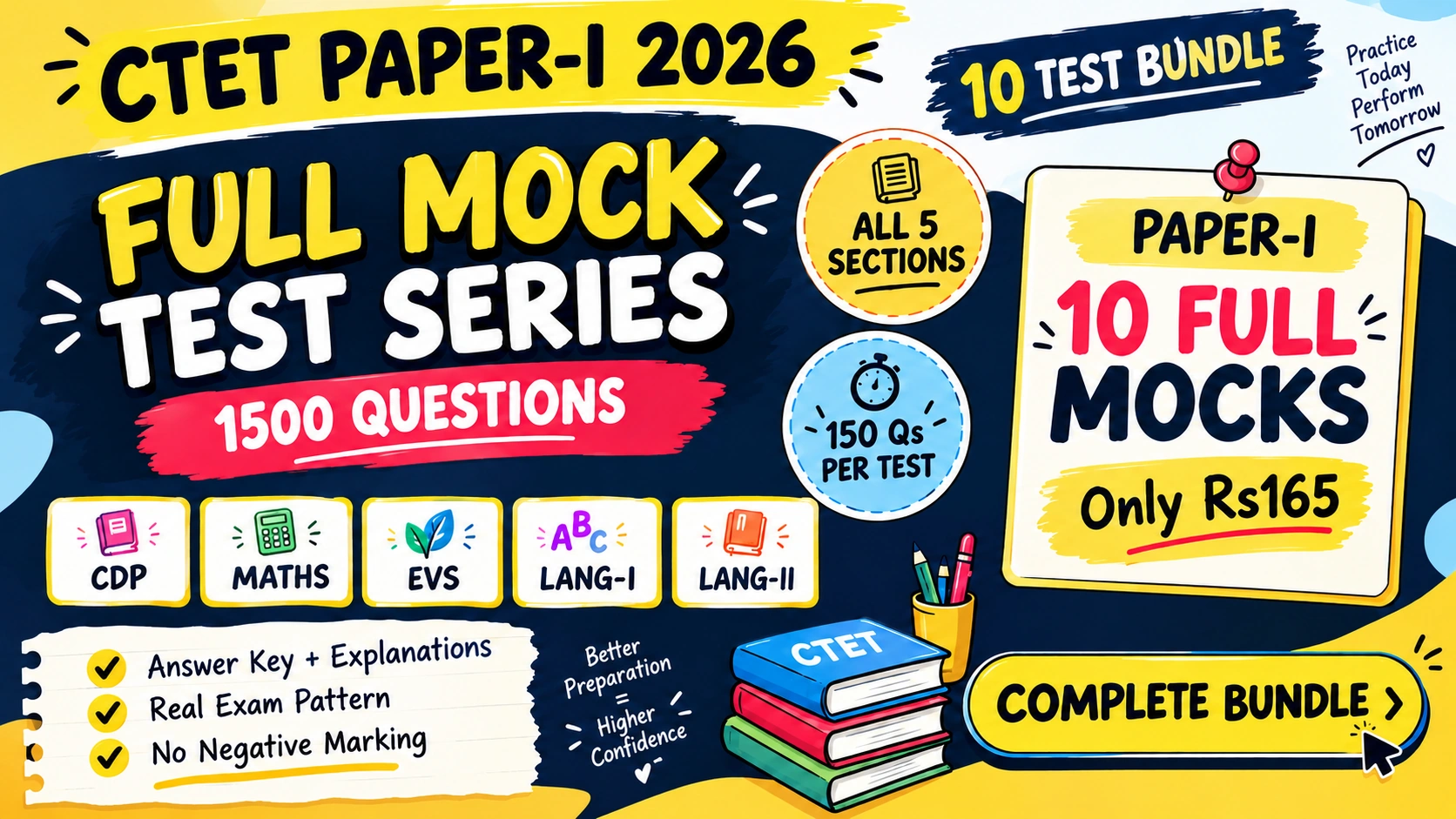
10 itemsSave 21%₹210₹165
CTET Paper 1 + Paper 2 (Maths and Science) Mock Test Bundle - 5 Full-Length Mocks
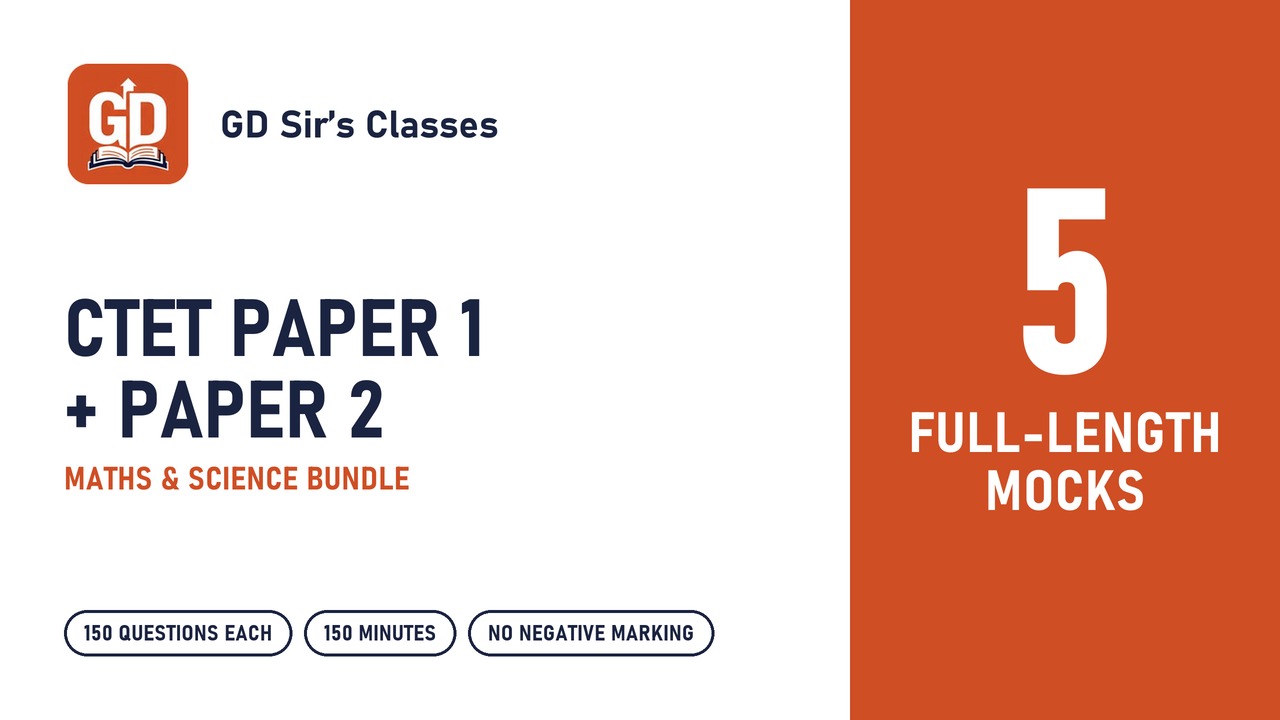
2 itemsSave 46%₹348₹189
All-in-One Exam Preparation Bundle with Notes, Tests & Courses
10 itemsSave 29%₹1,400₹999
English Grammar Notes + MCQ Practice Bundle | CTET/D.El.Ed
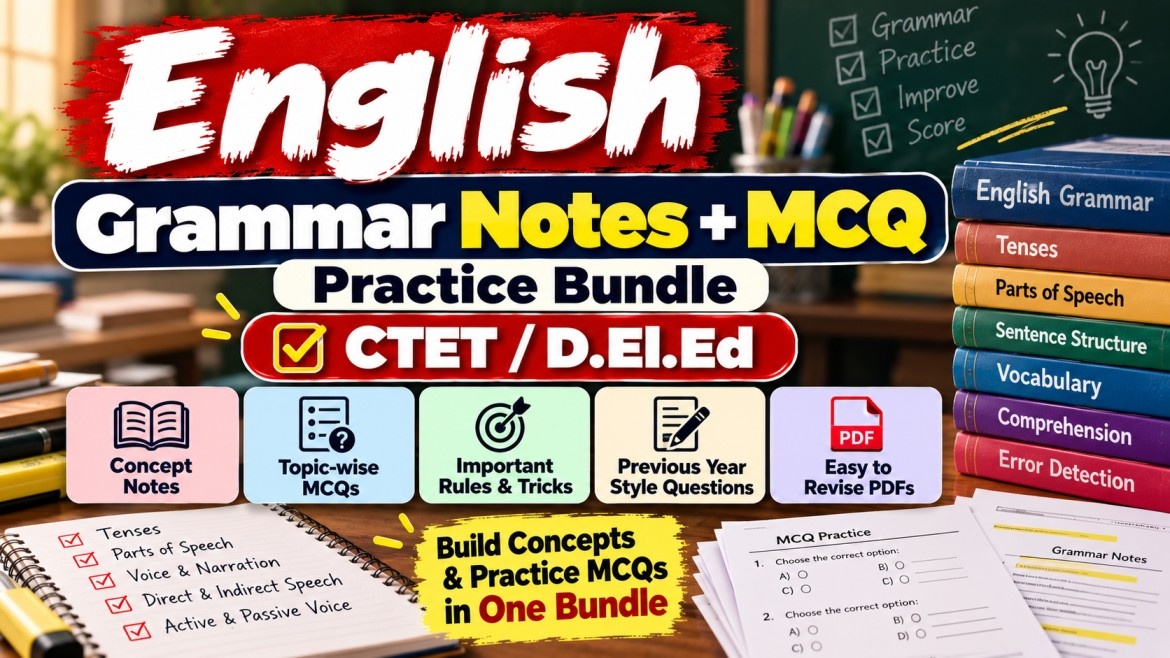
2 itemsSave 7%₹42₹39
The Central Teacher Eligibility Test (CTET) 2026 is conducted by the Central Board of Secondary Education (CBSE) to certify candidates for teaching Classes 1 to 8. The current session's exam is now scheduled for 12 and 13 December 2026, after CBSE reopened applications following a Supreme Court direction. Passing CTET makes you eligible to apply for teaching posts in central government schools such as Kendriya Vidyalayas and Navodaya Vidyalayas, and the certificate is valid for life.
This guide covers the latest updates, important dates, eligibility for both papers, the exam pattern, syllabus, fee, qualifying marks and the result, with every key fact checked against official CBSE information.
CTET Latest Updates (September 2026)
New exam date: The CTET exam will be held on 12 and 13 December 2026. It was earlier scheduled for 6 September 2026.
Applications reopened: CBSE reopened the application window from 25 August to 1 September 2026, in compliance with a Supreme Court direction giving eligible teachers a fair chance to meet the TET requirement.
Correction window: A correction window was reopened from 7 to 10 September 2026.
Existing applicants: Candidates who had already submitted their application do not need to apply again.
Next step: The exam city slip and then the admit card will be released on the official website before the exam.
CTET 2026 Overview
Particular | Details |
|---|---|
Full form | Central Teacher Eligibility Test |
Conducting body | Central Board of Secondary Education (CBSE) |
Frequency | Usually twice a year |
Papers | Paper I (Classes 1–5) and Paper II (Classes 6–8) |
Exam mode | Offline (pen-and-paper, OMR based) |
Duration | 2 hours 30 minutes per paper |
Questions | 150 multiple-choice questions per paper |
Negative marking | None |
Qualifying marks | 60% (90 out of 150) |
Certificate validity | Lifetime |
Official website |
CTET Important Dates 2026
Event | Date |
|---|---|
Notification released | 11 May 2026 |
Original application window | 11 May to 10 June 2026 |
Reopened application window | 25 August to 1 September 2026 |
Reopened correction window | 7 to 10 September 2026 |
Original exam date | 6 September 2026 (rescheduled) |
Revised exam date | 12 and 13 December 2026 |
City slip | Before the exam (to be announced) |
Admit card | A few days before the exam |
Answer key and result | To be announced |
Exam Timings
Shift | Timing | Paper |
|---|---|---|
Morning | 9:30 AM to 12:00 PM | Paper II |
Afternoon | 2:30 PM to 5:00 PM | Paper I |
Why Was the CTET 2026 Application Reopened?
A recent Supreme Court ruling makes TET qualification an important requirement for teachers, including many already in service. To give eligible teachers a reasonable chance to meet this requirement, CBSE reopened the application window and moved the exam to December. If you missed the original deadline, this was your second chance. If you applied earlier, your application remains valid.
What Is CTET?
CTET is a national-level eligibility test, not a recruitment exam. It sets a minimum standard for teachers under the Right to Education Act. Passing CTET does not give you a job directly. Instead, it makes you eligible to apply for teacher posts in schools that accept the CTET certificate.
Paper | For teaching | Who should take it |
|---|---|---|
Paper I | Classes 1 to 5 (Primary) | Candidates who want to teach primary classes |
Paper II | Classes 6 to 8 (Elementary) | Candidates who want to teach upper primary classes |
Both papers | Classes 1 to 8 | Candidates who want to teach at both levels |
CTET Eligibility Criteria 2026
Paper I (Classes 1–5)
A candidate must meet one of these conditions:
Senior Secondary (Class 12) with at least 50% marks and passed or appearing in the final year of a 2-year Diploma in Elementary Education (D.El.Ed), or
Class 12 with at least 50% marks and passed or appearing in the final year of a 4-year Bachelor of Elementary Education (B.El.Ed), or
Class 12 with at least 50% marks and passed or appearing in the final year of a 2-year Diploma in Education (Special Education), or
Graduation and passed or appearing in the final year of a 2-year D.El.Ed.
Important: B.Ed is not an accepted qualification for Paper I. Some websites still list it, but it is no longer valid for primary-level teacher eligibility.
Paper II (Classes 6–8)
A candidate must meet one of these conditions:
Graduation and passed or appearing in the final year of a 2-year D.El.Ed, or
Graduation with at least 50% marks and passed or appearing in a 1-year B.Ed, or
Class 12 with at least 50% marks and passed or appearing in the final year of a 4-year B.El.Ed, or
Class 12 with at least 50% marks and passed or appearing in the final year of a 4-year B.A./B.Sc.Ed or B.A.Ed/B.Sc.Ed.
Other routes recognised by NCTE, such as graduation with 45% plus B.Ed as per NCTE norms at the time of admission, are listed in the official information bulletin.
Age and Nationality
CBSE does not set an upper age limit for CTET.
Candidates must meet the nationality conditions of the official bulletin.
Final-year students of D.El.Ed or B.Ed can apply, as mentioned above.
Which CTET Paper Should You Choose?
Your qualification | Paper you can take |
|---|---|
Class 12 + D.El.Ed | Paper I |
Class 12 + B.El.Ed (4-year) | Paper I and Paper II |
Graduation + D.El.Ed | Paper I and Paper II |
Graduation + B.Ed | Paper II only |
If you are eligible for both papers, taking both widens your job options, since you become eligible to teach Classes 1 to 8. The two papers are held in separate shifts, so you can appear in both.
CTET Exam Pattern 2026
Paper I (Classes 1–5)
Section | Questions | Marks |
|---|---|---|
Child Development and Pedagogy | 30 | 30 |
Language I (compulsory) | 30 | 30 |
Language II (compulsory) | 30 | 30 |
Mathematics | 30 | 30 |
Environmental Studies | 30 | 30 |
Total | 150 | 150 |
Paper II (Classes 6–8)
Section | Questions | Marks |
|---|---|---|
Child Development and Pedagogy | 30 | 30 |
Language I (compulsory) | 30 | 30 |
Language II (compulsory) | 30 | 30 |
Mathematics and Science (for Maths/Science teachers) or Social Studies (for Social Studies teachers) | 60 | 60 |
Total | 150 | 150 |
Key points:
Each question carries 1 mark, and there is no negative marking.
Each paper lasts 2 hours 30 minutes.
Language I and Language II must be different languages, chosen from the list in the bulletin.
CTET Syllabus 2026 (Overview)
The syllabus follows NCERT content for Classes 1 to 8, along with pedagogy.
Subject | Main areas |
|---|---|
Child Development and Pedagogy | Child development, inclusive education, learning and pedagogy |
Languages | Reading comprehension and pedagogy of language development |
Mathematics (Paper I) | Numbers, addition and subtraction, multiplication, division, shapes and geometry, measurement, time, money, patterns, data handling, and pedagogy |
Environmental Studies (Paper I) | Family and friends, food, shelter, water, travel, things we make and do, and pedagogy |
Mathematics (Paper II) | Number system, algebra, geometry, mensuration, data handling, and pedagogy |
Science (Paper II) | Food, materials, the world of the living, moving things, natural phenomena, natural resources, and pedagogy |
Social Studies (Paper II) | History, geography, social and political life, and pedagogy |
CTET Application Fee 2026
Category | One paper | Both papers |
|---|---|---|
General / OBC | Rs 1,000 | Rs 1,200 |
SC / ST / Differently abled | Rs 500 | Rs 600 |
The fee is paid online and is not refundable.
How to Apply for CTET
Visit the official website, ctet.nic.in.
Register with your basic details, mobile number and email.
Fill in the application form, choose your paper(s), languages and exam city.
Upload your photograph and signature.
Pay the fee online and save the confirmation page.
Note: The reopened window for this session closed on 1 September 2026.
CTET Qualifying Marks
Requirement | Marks |
|---|---|
Qualifying standard | 60% or more (90 out of 150) |
Relaxation for reserved categories | Schools and recruiting authorities may give concessions to SC, ST, OBC, PwD and other categories as per their reservation policy. Many recruiting authorities accept 55% (82 out of 150). |
Since CTET is a qualifying test, there is no fixed "cut-off" in the ranking sense. You simply need to reach the qualifying marks.
CTET Result and February 2026 Statistics
CBSE declared the CTET February 2026 result on 30 March 2026. The exam was held on 7 and 8 February 2026. Official figures:
Paper | Registered | Appeared | Qualified | Pass % |
|---|---|---|---|---|
Paper I | 12,11,611 | 10,65,410 | 3,58,937 | 33.69% |
Paper II | 21,56,459 | 18,67,428 | 3,46,738 | 18.56% |
Total | 26,49,129 | 23,24,625 | 5,97,061 | 25.68% |
These numbers show why preparation matters: only about one in four candidates qualified overall, and fewer than one in five in Paper II.
Results are published on ctet.nic.in. Mark sheets and certificates are made available through DigiLocker.
CTET Certificate Validity and Where It Is Accepted
Validity: The CTET certificate is valid for life.
Accepted by: Central government schools such as Kendriya Vidyalayas (KVS) and Navodaya Vidyalayas (NVS), schools in Union Territories, and other schools that choose to accept it.
Improving your score: You can appear again to improve your marks, even after qualifying.
CTET Exam Day Guidelines
Carry your admit card and a valid photo ID: Entry is not allowed without them.
Reach early: Report at the time printed on the admit card, as gates close before the exam starts.
Use the right pen: The OMR sheet is filled with a blue or black ballpoint pen. Read the OMR instructions carefully.
Do not carry banned items: Mobile phones, calculators, smart watches and study material are not allowed.
Check your test booklet code: Fill it correctly on the OMR sheet, as mistakes can affect evaluation.
CTET Preparation Tips
Start with Child Development and Pedagogy: It is common to both papers and carries 30 marks.
Use NCERT books: Content questions follow NCERT books for Classes 1 to 8.
Focus on pedagogy: Many questions ask how to teach a concept, not just the concept itself.
Practise previous year papers: They show the language and style of CBSE questions.
Take full-length mock tests: Practise 150 questions in 150 minutes to build speed and stamina.
Attempt every question: With no negative marking, never leave a question blank.
CTET 2026 will now be held on 12 and 13 December 2026. Check that you meet the eligibility for your chosen paper, especially the rule that B.Ed does not qualify for Paper I. Prepare with NCERT books and pedagogy practice, take regular mock tests, and aim for at least 60%. Keep checking ctet.nic.in for the city slip, admit card and result.