
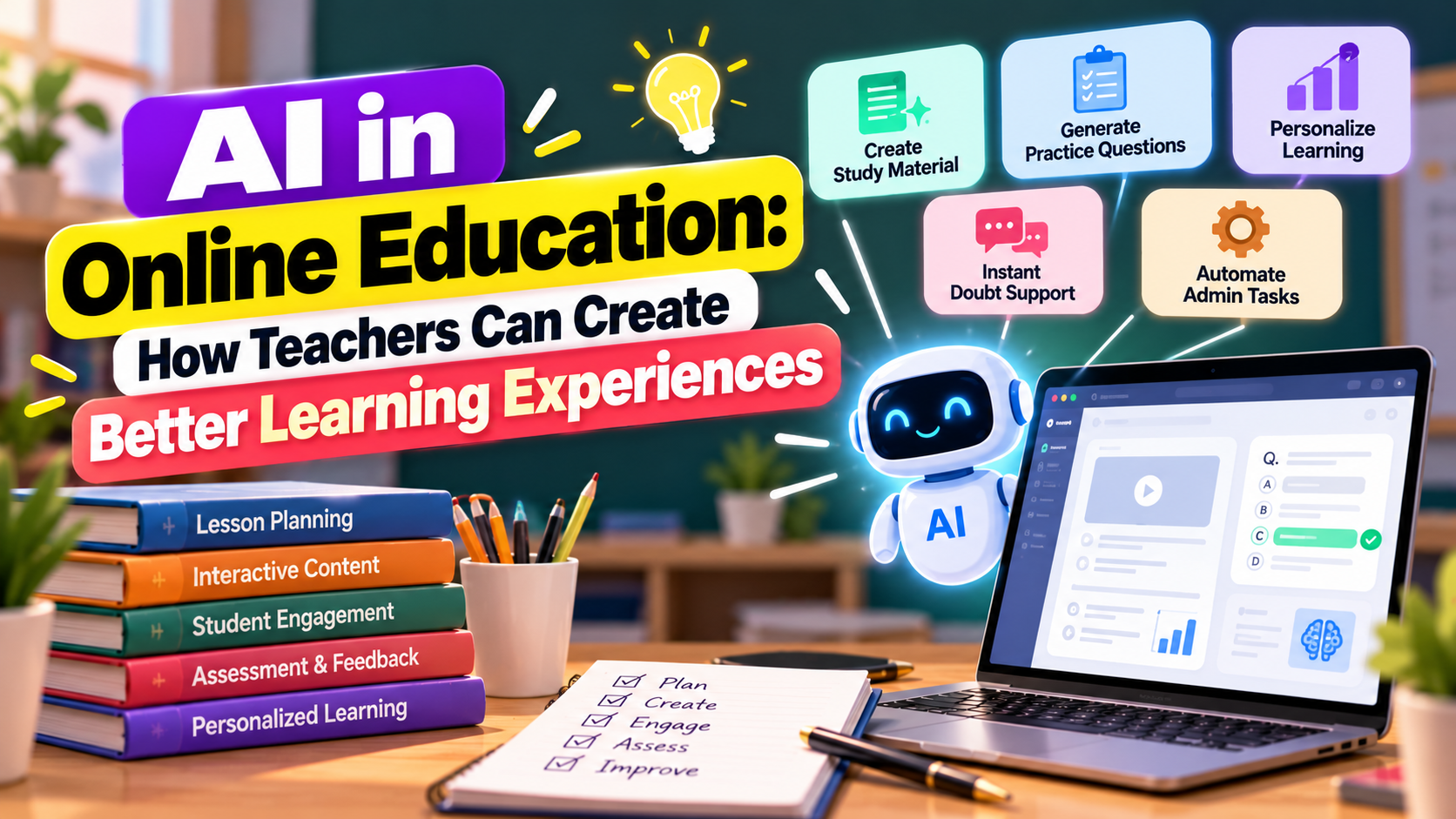
Online education has changed significantly over the past few years. Today, creating an online course is no longer limited to recording video lessons and uploading PDFs. Artificial Intelligence (AI) is helping educators plan courses, create learning materials, develop practice questions, provide additional student support, and manage repetitive tasks more efficiently.
For teachers, tutors, coaching institutes, and course creators, AI can save time and support better learning experiences. However, using AI effectively is not simply about generating content faster. AI-generated information can be inaccurate, biased, or misleading if it is used without proper review.
The real opportunity lies in combining AI-powered efficiency with human expertise.
In this guide, we'll explore how AI is transforming online education, how teachers can use it responsibly, its benefits and challenges, and what the future of AI-powered learning could look like.
What Is AI in Online Education?
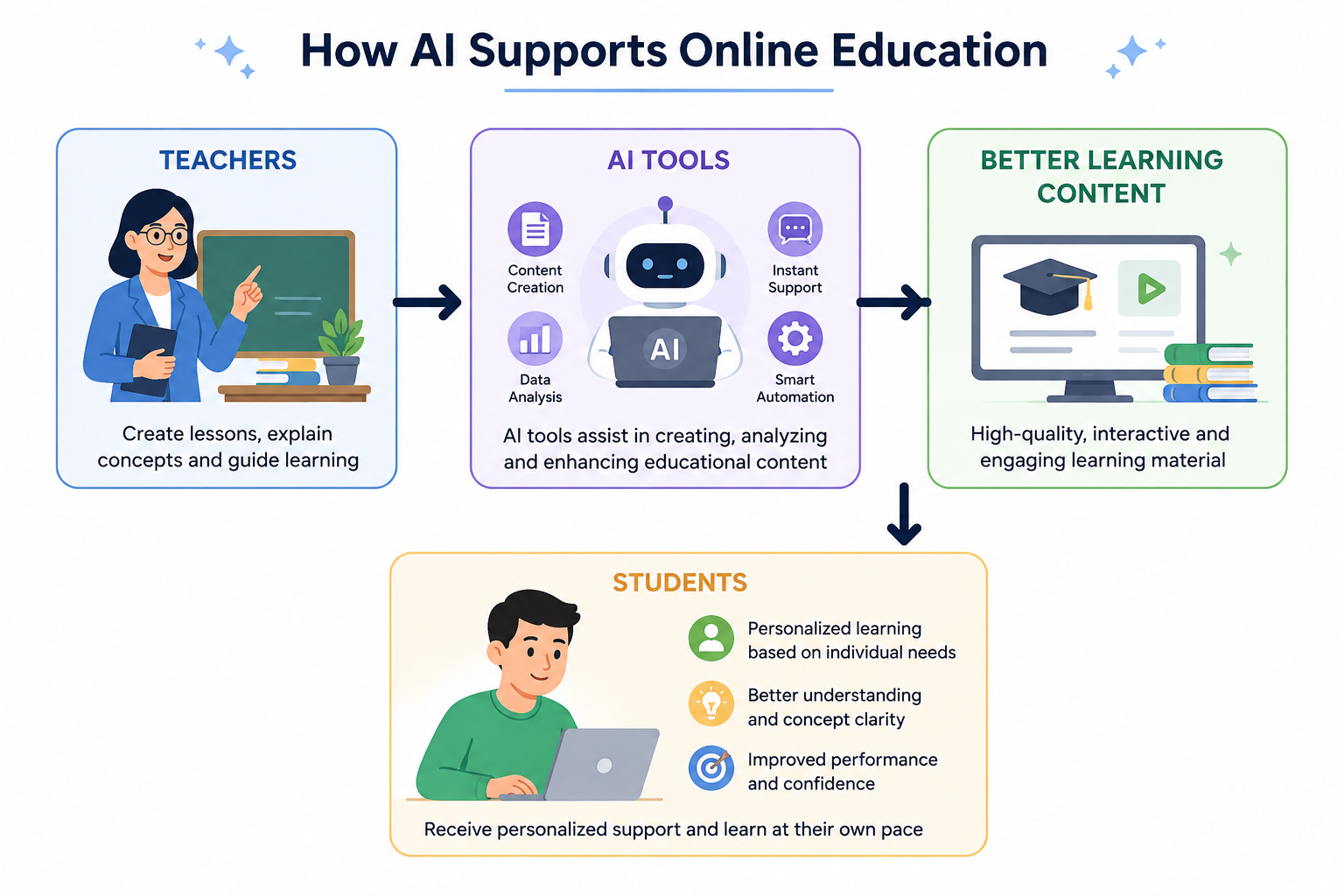
AI in online education refers to the use of artificial intelligence technologies to support teaching, learning, assessment, and educational content creation.
Depending on the tool or platform, AI can help educators:
Create course outlines and lesson plans
Generate initial drafts of practice questions
Organise learning materials
Provide personalised learning support
Analyse learner performance
Offer instant explanations or hints
Reduce repetitive administrative work
For students, AI can make learning more interactive by providing explanations, practice opportunities, and additional support based on their needs.
However, AI should be viewed as a support system for education not a replacement for learning, teaching, or human judgement.
How AI Is Transforming Online Education Today
AI is changing online education in several important ways. Instead of offering the same learning experience to every student, technology can help educators create more flexible and personalised learning environments.
Here are some of the biggest changes.
1. More Personalised Learning Experiences
Every student learns differently. Some students understand a concept quickly, while others may need additional explanations or practice.
AI-powered learning tools can help analyse signals such as:
Quiz performance
Common mistakes
Time spent on learning activities
Topics where students need additional support
Based on this information, an AI-enabled system may recommend additional exercises, explanations, or learning resources.
For example, if a student repeatedly struggles with a particular mathematics topic, an AI-powered learning system may recommend additional practice before the student moves to a more advanced concept.
The goal is not to let AI make every educational decision. Instead, AI can provide useful insights that help teachers better understand student learning needs.
2. Faster Course and Content Creation
Creating educational content requires significant time. Teachers often need to:
Plan lessons
Create course structures
Prepare notes
Develop questions
Create answer explanations
Organise study materials
AI can help speed up the initial stages of these tasks.
For example, a teacher can use AI to brainstorm:
Course modules
Lesson titles
Learning objectives
Practice question ideas
Study material structures
However, AI-generated content should always be reviewed by the educator before it reaches students.
A faster draft does not automatically mean better educational content.
3. Better Support for Practice and Assessment
AI can support educators during the assessment creation process.
Teachers may use AI to help generate:
Initial question ideas
Practice exercises
Quiz formats
Explanations
Different difficulty levels
This can be particularly useful for educators creating mock tests or large question banks.
However, human review remains essential. AI may generate questions with incorrect facts, unclear wording, or inaccurate answers.
For high-stakes exams, every AI-assisted question should be reviewed by a qualified educator before publishing.
4. Instant Learning Support
Students often study outside traditional classroom hours. When they get stuck on a difficult topic, they may not always have immediate access to a teacher.
AI-powered learning assistants can provide:
Additional explanations
Examples
Hints
Step-by-step guidance
Alternative ways of understanding a concept
The most effective AI learning support should not simply provide the final answer.Instead, it should encourage students to think.
For example, instead of immediately solving a mathematics problem, an AI assistant can ask:
What information do you already know?
or
Which formula do you think might be useful here?
This approach can help AI function more like a learning assistant rather than an answer-generating shortcut.
5 Key Benefits of AI for Online Educators
1. Reduced Repetitive Work
AI can help educators spend less time on repetitive tasks such as:
Drafting initial questions
Organising lesson ideas
Summarising content
Structuring course outlines
Creating initial learning resources
This can give educators more time to focus on teaching, mentoring, and improving the student experience.
2. Better Content Planning
AI can help teachers brainstorm and organise educational content.
For example, an educator creating a competitive exam course could use AI to create an initial structure:
Subject
Topic
Sub-topic
Practice activity
Revision material
The educator can then review and improve the structure based on their real teaching experience.
3. More Learning Support for Students
AI can provide additional explanations and practice opportunities for students.
This can be especially helpful when students:
Need another explanation
Want additional examples
Need practice questions
Are studying outside regular teaching hours
However, students should still learn how to solve problems independently rather than depending entirely on AI.
4. Better Use of Learning Data
Digital learning platforms generate valuable information about student activity.
For example:
Which questions students struggle with
Which topics have low accuracy
Where learners spend more time
Which parts of a course students engage with
When used responsibly, these insights can help educators identify areas where students may need additional support.
5. Improved Scalability for Educators
AI can help individual teachers and small coaching institutes manage larger amounts of educational content. Instead of manually starting every task from scratch, educators can use AI to accelerate the initial creation process.
This does not eliminate the teacher's role.
It allows teachers to spend more time where their expertise matters most.
The Challenges and Risks of AI in Education
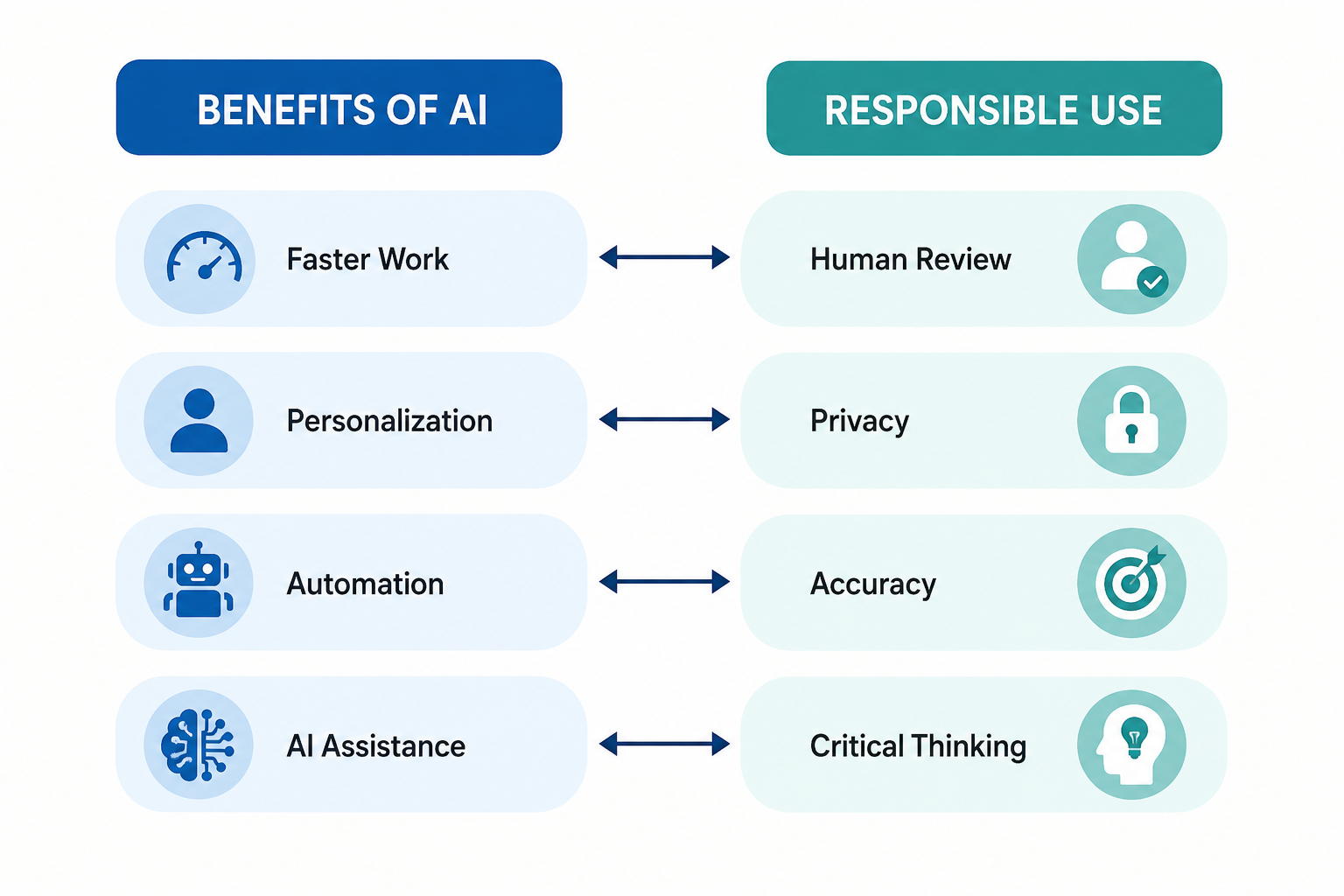
AI offers major opportunities, but it also creates important challenges.
Responsible educators should understand these risks before relying heavily on AI-generated content.
1. AI Can Generate Incorrect Information
Generative AI can sometimes produce information that sounds confident but is factually incorrect.
This is commonly known as an AI hallucination.For educators, this can be particularly risky.
Imagine publishing:
An incorrect exam answer
A wrong formula
An inaccurate historical fact
A misleading explanation
For students preparing for important examinations, incorrect information can have serious consequences.
Best practice:
Always review and verify AI-generated educational content before publishing it.AI should help create the first draft not make the final academic decision.
2. Over-Reliance Can Affect Critical Thinking
One of the biggest concerns about AI in education is over-dependence.
If students use AI to complete every assignment, solve every problem, or write every answer, they may avoid the mental effort required for real learning.Completing a task is not always the same as understanding it.
Students should use AI to:
Ask questions
Explore concepts
Practice
Receive hints
Compare ideas
They should not use it as a replacement for thinking.
3. Data Privacy Concerns
Educators should be careful about what information they share with AI tools.
Avoid uploading sensitive information such as:
Student personal information
Private records
Confidential institutional data
Sensitive assessment information
Before using any AI tool, educators should understand how the platform handles user data and what privacy controls are available.
4. Bias and Unfair Results
AI systems can reflect biases present in their training data or design.
This can potentially affect:
Automated recommendations
Evaluation systems
Generated examples
Language interpretation
Teachers and institutions should not blindly trust AI-generated results.
Human judgement is essential, especially when educational decisions could significantly affect students.
5. Academic Integrity
AI has made it easier for students to generate essays, answers, and assignments.This creates a new challenge for educators:
How do we encourage students to use AI for learning without using it to avoid learning?
The answer is not always to ban AI completely.Instead, educators may need to redesign learning activities around:
Critical thinking
Oral explanations
Practical projects
Problem-solving
Reflection
AI-supported learning with disclosure
Why AI Literacy Matters for Teachers and Students
As AI becomes part of everyday education, knowing how to use it is no longer enough.
People also need to understand:
How AI generates information
Why AI can make mistakes
How to verify AI responses
How to identify potential bias
What information should not be shared with AI
When human judgement is more important than AI output
This is called AI literacy.
For example, a student should not simply copy an AI-generated answer.
They should ask:
Is this information correct?
Can I verify this from a reliable source?
Do I actually understand this explanation?
Similarly, teachers should evaluate AI-generated educational content before sharing it with students.
The future of education will not simply depend on who uses AI.It will increasingly depend on who knows how to use AI responsibly and critically.
Will AI Replace Teachers?
The answer is No, not completely.
AI can automate or assist with certain tasks, including:
Drafting content
Generating practice questions
Organising information
Providing initial explanations
Analysing learning patterns
But teaching involves much more than delivering information.
Teachers provide:
Mentorship
Motivation
Context
Emotional understanding
Professional judgement
Personal feedback
Human connection
AI may change the role of teachers, but it is more likely to become a tool that supports educators rather than completely replacing them.The strongest educational model is likely to be:
Teacher expertise + AI assistance + active student learning
How Teachers Can Use AI Responsibly
Here are some practical guidelines for educators.
Do:
Use AI to brainstorm course structures
Use AI to create initial drafts
Use AI to generate practice ideas
Review every important AI-generated output
Verify facts before publishing
Encourage students to think independently
Protect student privacy
Use AI as a teaching assistant, not an automatic decision-maker
Don't:
Publish AI-generated content without review
Share sensitive student information with public AI tools
Assume AI answers are always correct
Allow AI to replace academic judgement
Encourage students to copy AI-generated work without understanding it
Rely entirely on AI for important educational decisions
How AI Can Support Teachers Creating Online Courses and Test Series
For teachers, tutors, and coaching institutes, AI can be especially useful during the content creation process. AI can help with:
Course Planning
Teachers can brainstorm:
Course structures
Modules
Lesson topics
Learning objectives
Study Material Creation
AI can assist with:
Organising notes
Creating summaries
Simplifying complex concepts
Structuring educational content
Practice Questions
AI can help educators generate initial question ideas and practice exercises.
Mock Test Planning
Teachers can use AI-assisted workflows to organise:
Topics
Difficulty levels
Practice formats
Learning objectives
The important step comes after generation:
Review, edit, verify, and improve.
The teacher remains responsible for the final quality of the learning experience.
How Platforms Like Testkart Can Support Digital Educators
Creating educational content is only one part of running an online teaching business.
Educators also need to manage:
Courses
Mock tests
Study materials
PDFs and notes
Students
Payments
Content delivery
This is where creator-focused education platforms can help.
Testkart provides a platform where educators can create and manage educational products such as courses, tests, and study materials.AI can support the content creation process, while a dedicated education platform can help educators organise and deliver that content to learners.
The most effective approach is not to depend on technology blindly.It is to combine:
Teacher expertise + useful technology + quality content + responsible AI practices
The Future of AI in Online Education
AI will continue to influence how educational content is created and delivered.
We are likely to see more focus on:
Personalised learning
AI-powered learning support
Adaptive practice
AI literacy
Responsible AI use
Human-in-the-loop content creation
Better learning analytics
However, the biggest question is not:
How much AI can we use?
The better question is:
How can we use AI to help people learn better?
Technology should not reduce education to automatically generated answers.
The goal should be to help educators teach more effectively and help students develop deeper understanding.
Final Thoughts
AI is transforming online education, but the most valuable use of AI is not simply creating content faster.
Its real potential lies in helping educators:
Save time on repetitive tasks
Improve learning support
Create better practice opportunities
Understand learner needs
Scale educational content responsibly
At the same time, AI must be used carefully.
Teachers should remain responsible for verifying content, protecting student privacy, encouraging critical thinking, and making important educational decisions.The future of online education is unlikely to be AI versus teachers.
It is more likely to be:
AI supporting teachers to create better learning experiences while human expertise remains at the centre of education.
If you're an educator creating online courses, mock tests, or study materials, platforms like Testkart can help you manage and deliver your educational content.
Comments (0)
Please log in to join the discussion.
Log In to CommentNo comments yet. Be the first to share your thoughts!