
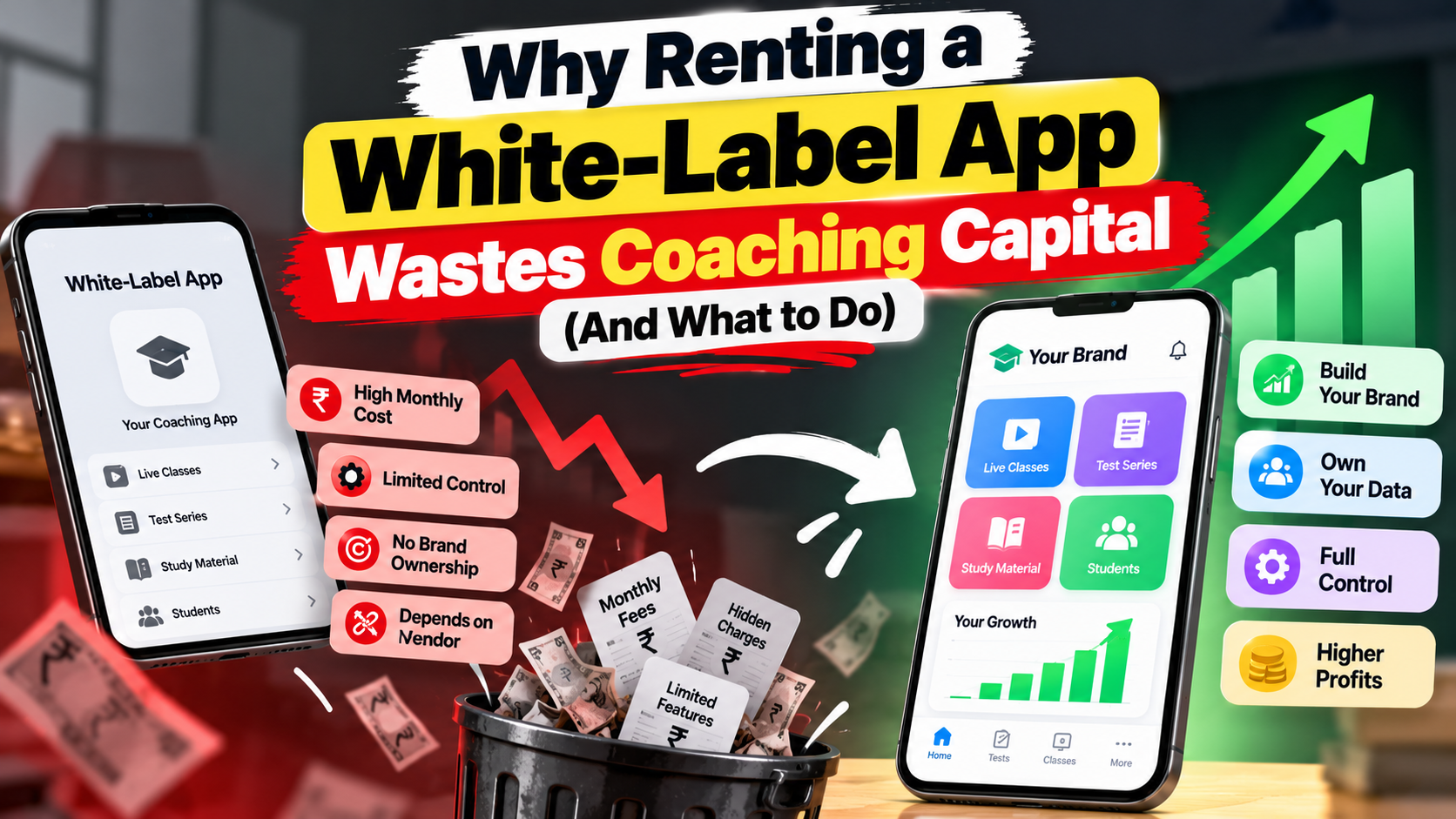
When growing an online coaching practice or scaling an educational institute, every creator hits a critical digital crossroads: How do I deliver my content, communicate with clients, and track student progress on mobile devices?
For years, the software industry pushed a false binary choice:
Option A: Build a Custom Native App. Hire a software development agency, spend ₹1,50,000 to ₹15,00,000 upfront, wait 6 to 12 months for delivery, and absorb monthly developer retainers for iOS/Android bug fixes.
Option B: Rent a White-Label Coaching App. Pay a SaaS platform a recurring subscription fee to put your logo and brand colours onto a pre-built template app.
Faced with massive upfront development costs, most coaches naturally choose Option B.
However, renting a standalone white-label app often turns out to be a financial trap. While it offers rapid speed-to-market, it continuously drains operational capital without delivering true software ownership or meaningful business differentiation.
Here is an analysis of why renting white-label apps wastes your coaching capital, along with a practical, high-ROI alternative to grow your business.
The Hidden Capital Drains of White-Label Coaching Apps
White-label apps are marketed as affordable shortcuts. However, analysing the long-term financial reality reveals three distinct ways they quietly drain your coaching profits:
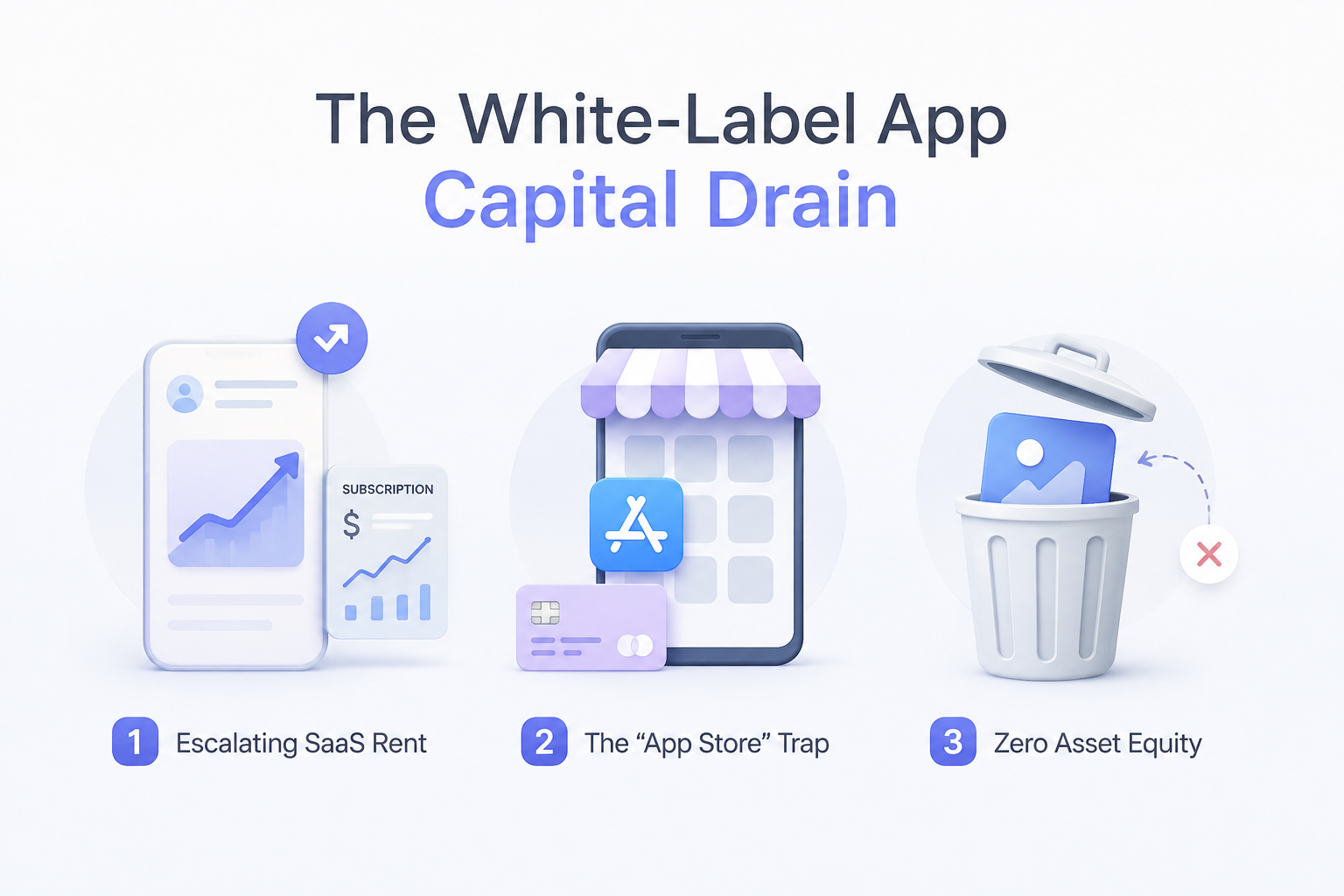
1. Escalating SaaS Rent Eats Your Scalability
White-label providers rarely charge a flat fee forever. Most platforms use tiered pricing based on active client seats or feature access.
As your coaching business grows, the cost of a white-label platform can increase through higher subscription tiers, additional student seats, storage, integrations, and premium features. Depending on the provider, Indian education platforms can range from a few thousand rupees per month to ₹25,000+ per month, with higher-end enterprise plans costing considerably more.
Over 3–5 years, recurring platform fees can accumulate into several lakh rupees without giving you ownership of the underlying software platform.
2. The Illusion of Brand Ownership
Putting a logo on a pre-built layout does not make software "yours".
Your clients download a generic shell app from the App Store or Google Play and enter an access code.
You are constrained by the vendor's database layout, feature choices, and user interface limitations. If you need a custom progress metric or a unique test engine that the vendor doesn't support, you are out of luck.
3. High Vulnerability with Zero Equity
When renting software, you do not own a single line of code. If the white-label vendor changes their pricing, gets acquired, suffers outages, or shuts down, your entire digital delivery stack disappears overnight taking your client's historical data with it.
Custom App vs. White-Label App: The Breakdown
To understand where your capital is best directed, evaluate the core differences across cost, control, and long-term business value:
Comparison Metric | Custom App Development | Renting a White-Label App |
Upfront Cost | ₹4 lakh – ₹12 lakh for a mid-complex education/coaching app | ₹25,000 – ₹1 lakh+ setup is a more realistic range |
Time to Market | Slow (4 to 12 months) | Fast (1 to 2 weeks) |
Recurring Maintenance | ~15–20% of development cost/year + hosting/support | Included in subscription, depending on provider |
Feature Customization | 100% Total Freedom | Restricted to template options |
Data & Code Ownership | Can be owned by you if source code/IP transfer is included in the contract | Underlying platform/code generally remains vendor-owned |
Long-Term Capital ROI | High equity / Heavy liabilities | Negative (Continuous capital drain) |
What to Do Instead: The Creator Marketplace Strategy
Instead of pouring profits into custom code or overpriced white-label app subscriptions, modern educators and coaches use a Creator Marketplace Model (such as Testkart).
Rather than forcing you to act as a software company, a creator platform provides a ready-made, high-converting digital storefront and testing infrastructure.
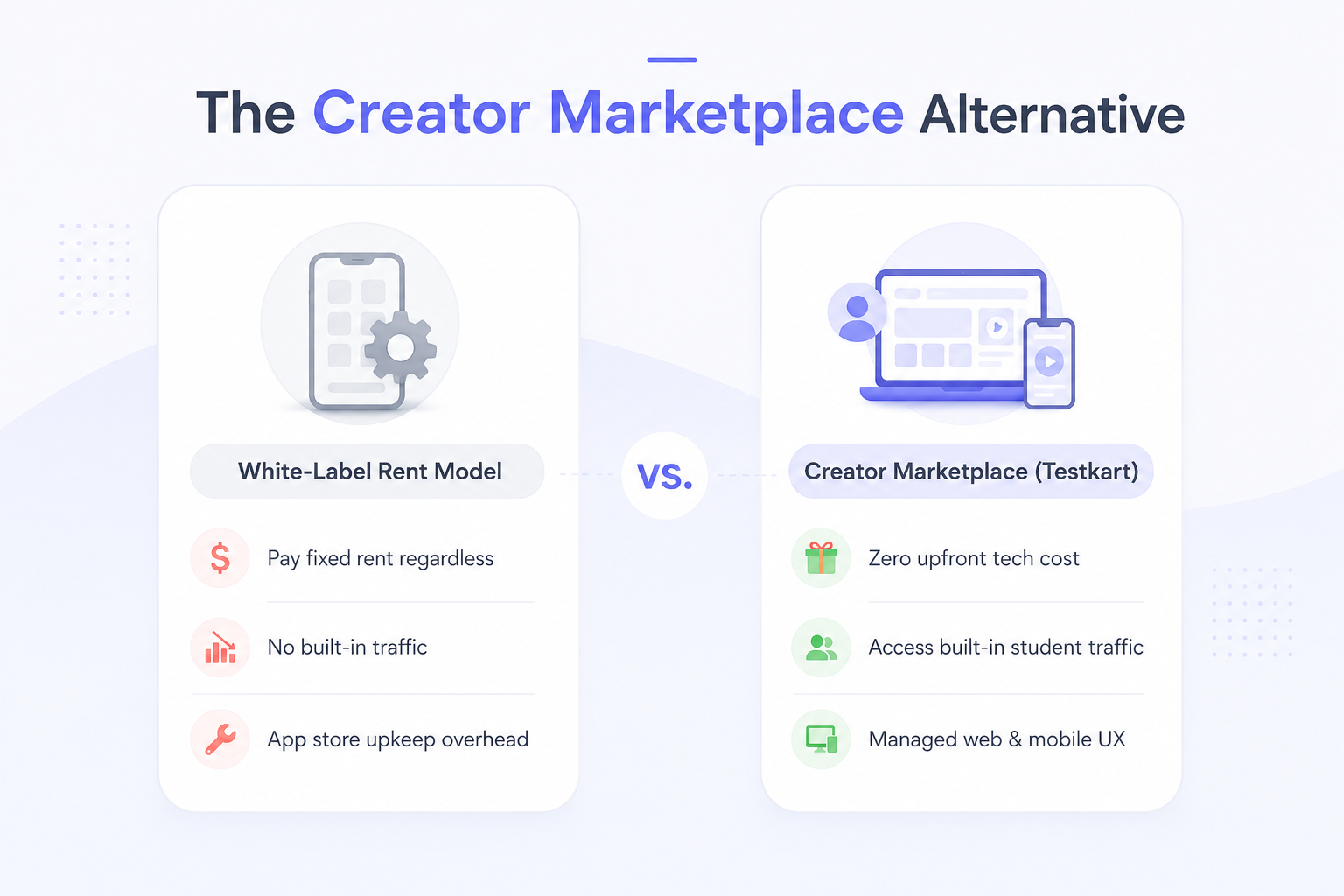
Why the Creator Marketplace Model Delivers Superior ROI
Zero Upfront Tech Risk: Launch your mock tests, courses, or coaching bundles instantly without paying developer retainers or monthly SaaS fees.
Built-In Student Traffic: White-label apps live in isolation; you must bring 100% of your traffic. Creator platforms host marketplace ecosystems where active buyers discover your material organically.
Enterprise-Grade Testing & Delivery: Instead of basic form-fillers inside white-label apps, creator platforms deliver CBT exam interfaces, automated tab-switch security, and rank analytics out of the box.
Reinvest Savings Into Acquisition: Money saved on app fees can be directed into high-converting organic content, video lessons, and student acquisition.
Step-by-Step Action Plan for Coaches
If you want to maximise margins and avoid software traps, execute this simple action framework:
Step 1: Audit Your Tech Stack Capital: Avoid locked-in annual app contracts.
Calculate what you currently pay in monthly app subscriptions, add-ons, and payment processing fees.
Step 2: Package High-Value Core Assets: Focus on content quality over shiny app icons.
Structure your coaching methodology into high-yield mock tests, practice packs, or handwritten study PDFs.
Step 3: Launch on a Creator Platform: Leverage web-optimised creator stores.
List your courses or assessments on a zero-upfront marketplace like Testkart to eliminate fixed tech overhead.
Step 4: Reinvest Margins into Audience Growth: Convert profits into brand growth.
Direct saved capital into YouTube tutorials, community building, and personal student mentorship.
Invest in Your Coaching, Not Software Rent
Software should serve your coaching business, not drain it. Renting white-label apps often creates an illusion of ownership while quietly consuming profit margins. At the same time, custom software development remains out of reach for most independent operators due to high costs.
By shifting to a creator platform model, you protect your capital, eliminate technology headaches, and focus on what truly drives business growth: exceptional coaching and student results.
Comments (0)
Please log in to join the discussion.
Log In to CommentNo comments yet. Be the first to share your thoughts!