
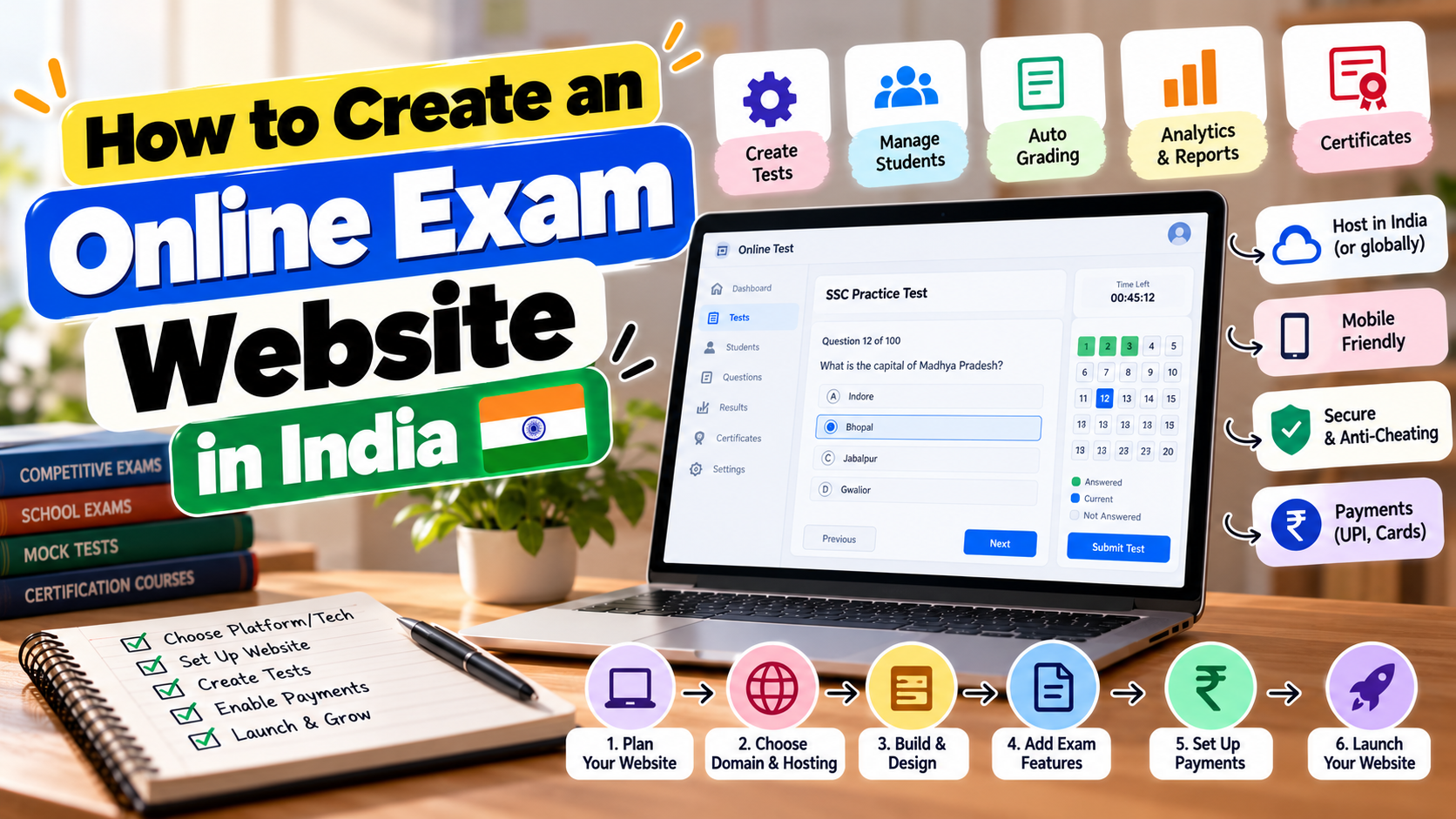
Many teachers and institutes reach the same point: your tests are good, your students want to attempt them on a screen, and handing out papers or sharing PDFs has stopped working. You decide you need an online exam website. The question is how to get one without spending months on it.
This guide explains the three realistic routes, the features worth planning for, a step-by-step launch plan and the point at which using an existing platform is smarter than building your own.
First, decide what the website is for
"Online exam website" can mean several different things, and the right path depends on which one you need.
Goal | What it looks like |
Practice tests | Students attempt mock tests to learn and improve |
Selling tests | Students pay to attempt a test series |
Internal exams | Your own students sit tests set by your faculty |
Formal assessments | Results carry real consequences such as admission or certification |
Practice and selling are the most common needs for coaching teachers. Formal assessments need extra work on security and supervision, which is covered in the guide to a proctored test.
The three routes
Route 1: Build it yourself
You hire a developer or an agency, or you use a website builder with a quiz plugin. You get full control over how the site looks and behaves.
What it takes: a domain name, hosting, a question engine, a timer, answer scoring, user accounts, payments if you sell, and constant maintenance. A site that works for ten students can fail when a thousand log in at once, so load testing matters.
Best for: organisations with a technical team and a long-term plan.
Route 2: Use exam software
You subscribe to software built for exams. Some run on your own domain, others on the vendor's. You get ready-made features, but you pay on a continuing basis and you still bring your own students. The guide to online exam software explains what to compare.
Best for: institutes that want a fixed, branded tool and have their own audience.
Route 3: Publish on a marketplace
You create your tests on a platform that already exists and list them where students can find them. Testkart works this way: teachers and educators create, publish and sell mock tests, courses and study materials, and the platform provides the technology to create and conduct online tests. You do not run a website at all.
Best for: teachers and small institutes who want to start quickly and reach new students.
Comparing the routes
| Build yourself | Exam software | Marketplace |
Time to launch | Months | Weeks | Days |
Technical effort | High | Medium | Low |
Ongoing upkeep | Yours | Shared | Platform |
Finding students | Your job | Your job | Platform helps |
Control over design | Full | Partial | Limited |
Best for | Technical teams | Institutes with an audience | New and small sellers |
Features to plan for
Whichever route you take, students will expect a basic set of features from an online exam.
Feature | Why students expect it |
Clear question screen | Easy reading with options laid out simply |
Visible timer | The exam clock is part of the experience |
Question navigation | A palette showing answered and unanswered questions |
Mark for review | A way to return to hard questions |
Automatic scoring | Results straight after submission |
Review of answers | Seeing what went wrong helps learning |
Works on a phone | Many students will attempt tests on mobile |
Reliable under load | The site must not fail on test day |
If your exam follows a computer-based test format, copy the interface style of the real exam so students feel at home.
Step-by-step plan to launch
1. Define the purpose. Practice, selling or formal exams. It decides everything else.
2. Pick the exam and the format. Number of questions, sections, time limit and marking.
3. Write the questions. Content matters more than technology. Build a small, well-checked set first.
4. Choose your route. Build, subscribe or publish on a marketplace.
5. Set up the test. Enter questions, answers, timing and marking.
6. Run a trial. Ask a few students to attempt it and note every problem.
7. Fix and finalise. Correct unclear questions and slow screens.
8. Launch to a small group. Start with one batch, then grow.
9. Collect feedback. Ask students what confused them.
10. Expand. Add more tests, then a full series.
Things people forget
• Mobile use. Many students do not have a laptop.
• Internet drops. Students may lose connection mid-test. Decide what happens in that case.
• Support. Someone must answer students on exam day.
• Content protection. Plan how you will discourage copying of your questions.
• Legal basics. If you sell, check what taxes and terms apply to your business with a professional.
• Privacy. You will collect student details, so treat them with care and say how you use them.
When building your own is not worth it
Building a website feels powerful, but it often delays the real work, which is writing good tests. A teacher who spends four months on a site and then has twenty questions is worse off than one who published a test in a week and has already learned from student feedback.
If your main goal is to create tests and sell them to students, a marketplace route lets you start with the content. The online test creator page explains how teachers build tests on Testkart, and the online test series platform page shows how tests are packaged into a series.
FAQs
How do I create an online exam website?
Decide the purpose, choose whether to build, use exam software or publish on a marketplace, prepare your questions, set up the test, run a trial and launch to a small group first.
How much does an online exam website cost?
It depends on the route. Building from scratch costs the most in money and time. Exam software involves a continuing fee. A marketplace route is usually the lightest. Compare current plans before you decide.
Do I need coding skills?
Not if you use exam software or a marketplace. Coding is needed mainly when you build from scratch.
Can I sell tests on my own exam website?
Yes, but you will need to add payments, accounts and access control. A marketplace includes selling as part of the offer.
Can an online exam be secure?
Practice exams need little security. Formal exams need supervision and extra controls.
Comments (0)
Please log in to join the discussion.
Log In to CommentNo comments yet. Be the first to share your thoughts!