
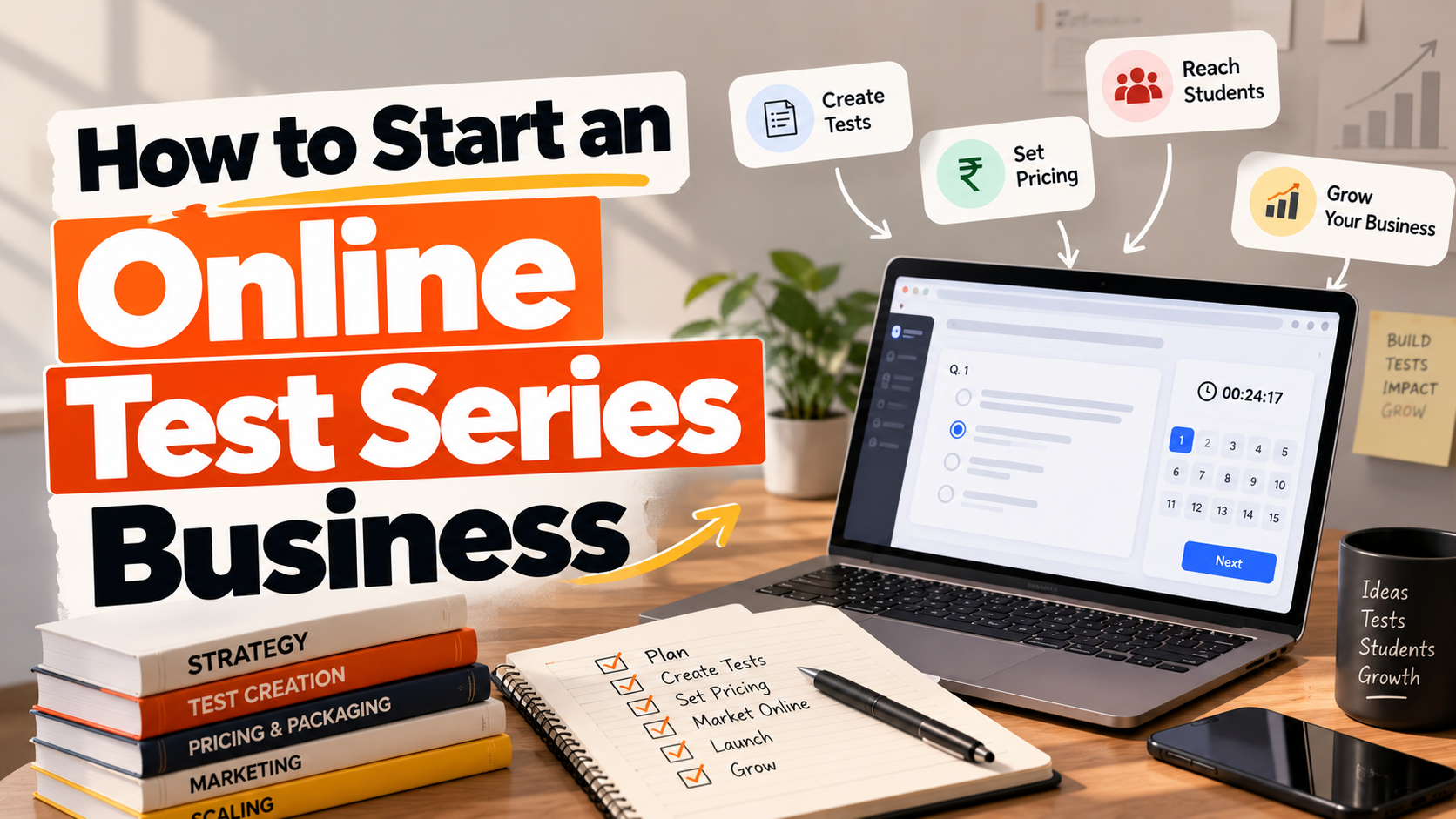
If you know a competitive exam well, you already hold the main ingredient of an online test series business: the ability to write good practice questions. Students preparing for exams are always looking for well-made papers, and many are willing to pay for tests that feel like the real thing. A test series is also one of the lighter ways to start teaching online, because it needs no studio, no video production and no large team.
This guide walks through the steps of starting, from choosing an exam to getting your first students. It is written for teachers, tutors and small institutes in India.
What a test series business is
A test series is a planned set of tests that a student attempts over time, usually in preparation for an exam. Your business creates these tests, packages them into a series, sells access and improves them with each batch of students.
Income comes from students buying access. The tests themselves are created once and can be sold many times, which is what makes the model attractive, provided the questions are good and kept current.
Step 1: Choose one exam
Do not start with "all competitive exams". Pick one exam where you have real knowledge.
Question | Why it matters |
Do I know this exam's pattern well? | Your tests must match it |
Do students for this exam search for practice? | Demand must exist |
Do I know what mistakes students make? | This shapes your questions |
Is the syllabus stable? | Constant changes mean constant rewriting |
Can I add something other series do not? | Differentiation helps you stand out |
Popular choices include SSC and railway exams, but the right one is the exam you know best.
Step 2: Understand what students want
Before writing a single question, spend a week looking at what is already available. Attempt a few existing series as a student would. Note what you like, where the questions feel unrealistic and what students complain about. Read comments on social media groups and ask a few aspirants what they wish they had.
You will usually find three things students want: papers that match the real exam, clear explanations for answers, and a sensible order of difficulty.
Step 3: Plan your series
Write a plan before you write questions.
Decision | Options |
Number of tests | A small first series of five to ten tests is easier to finish than fifty |
Test types | Topic-wise, sectional and full-length mocks |
Release pattern | All at once, or one test every few days |
Difficulty path | Start slightly easier, then match or slightly exceed the real exam |
Language | The language your students prefer |
Explanations | Short written solutions for each question |
A realistic first series is better than an ambitious unfinished one.
Step 4: Write good tests
The quality of your questions is your product. A few principles:
• Match the real exam. Use the same number of questions, sections, timing and marking.
• Write original questions. Do not copy from other series or books.
• Check every answer key twice. One wrong key damages trust quickly.
• Include a spread of difficulty. Easy, medium and hard.
• Add short explanations. Students learn most from understanding their mistakes.
• Attempt your own tests. If you cannot finish a paper in the time limit, students will not either.
The online test creator page explains how teachers build tests on Testkart, and the mock test glossary page explains what a good mock test should contain.
Step 5: Pick a platform
You can sell a test series in several ways.
Option | Good side | Watch out for |
Share PDFs through messaging apps | Quick | Piracy, no scoring, no real exam feel |
Build your own website | Full control | Slow, costly and you must find every student |
Use exam software | Branded tools | You still need to bring students |
Publish on a marketplace | Fast, and students can find you | Your listing sits beside others |
Testkart is a marketplace where teachers and educators create, publish and sell mock tests, courses and study materials for competitive exams, with technology to create and conduct online tests. Many new sellers choose a marketplace so they can spend their time on content. You can read more on the online test series platform page.
Step 6: Price it fairly
Pricing is often the part new sellers fear most. A few guidelines:
• Look at similar series for the same exam.
• Think about the number of tests and the quality of explanations.
• Offer one free sample test so students can judge for themselves.
• Start at a fair price and adjust after your first batch.
• Avoid a price so low that students doubt the quality.
The guide on how to price and sell a test series online covers this in more depth.
Step 7: Launch to a small group first
Do not wait for perfection. Launch to a small group, such as your current students or a social media group you already belong to. Ask for honest feedback after the first two or three tests. Fix confusing questions quickly and thank the students who helped you find them.
Step 8: Get your first students
Channel | How to use it |
Your current students | Offer early access in exchange for feedback |
Social media | Share a free sample test and a clear description |
Telegram and WhatsApp groups for aspirants | Join as a member first, then share useful content |
YouTube | Explain a few solved questions and point to your series |
Marketplace listing | A clear title, honest description and sample test |
Word of mouth | Happy students tell their friends |
Never spam groups. Give something useful first, then mention your series.
Step 9: Improve every batch
After each batch, review what happened.
• Which questions did most students get wrong? Check whether they were unclear.
• Which tests did students skip?
• What did buyers ask before they purchased?
• What did your best-performing students say?
Update tests, fix errors and add new ones. A series that improves every month earns better reviews and more sales.
Step 10: Grow beyond the first series
Once the first series works, you can expand in several directions.
• Add tests for a second exam.
• Offer study notes or a short course alongside the tests. See how to sell courses online.
• Bring in other faculty or partner with other teachers.
• Offer a revision series before each exam.
• Create a free tier to attract students.
Common mistakes
Mistake | Better approach |
Launching with fifty rushed tests | Launch with a few good ones |
Copying questions from other sources | Write original questions |
Ignoring explanations | Explain every answer briefly |
Setting a price without checking the market | Compare and adjust |
Not asking for feedback | Ask the first students directly |
Treating the series as finished | Update it every season |
How long does it take?
A focused teacher can plan and publish a small first series in a few weeks. The slow part is usually writing and checking questions, not the technology. The most useful habit is to publish early, learn from real students and improve steadily.
Where to start today
If you are ready, create a teacher account on the teachers and tutors page, choose one exam and begin with a short free sample test.
FAQs
How do I start an online test series business?
Choose one exam, study what students need, plan a small series, write and check your tests, publish on a platform, set a fair price and launch to a small group first.
Do I need an institute to sell a test series?
No. Individual teachers and tutors can publish and sell test series.
How many tests should my first series have?
A first series of five to ten well-checked tests is a realistic starting point.
Can I sell a test series without a website?
Yes. A marketplace such as Testkart lists your series so you do not need to build a website.
Is a free sample test a good idea?
Yes. It lets students judge your quality before they buy.
Comments (0)
Please log in to join the discussion.
Log In to CommentNo comments yet. Be the first to share your thoughts!