
UPSC NDA & NA Examination (I), 2027: Notification, Exam Date, Eligibility, Physical Standards, Medical Requirements and Preparation Strategy
Are you dreaming of becoming an officer in the Indian Army, Indian Navy or Indian Air Force after Class 12? The UPSC National Defence Academy and Naval Academy Examination is an important opportunity for students who want to build a career in the Indian Armed Forces.
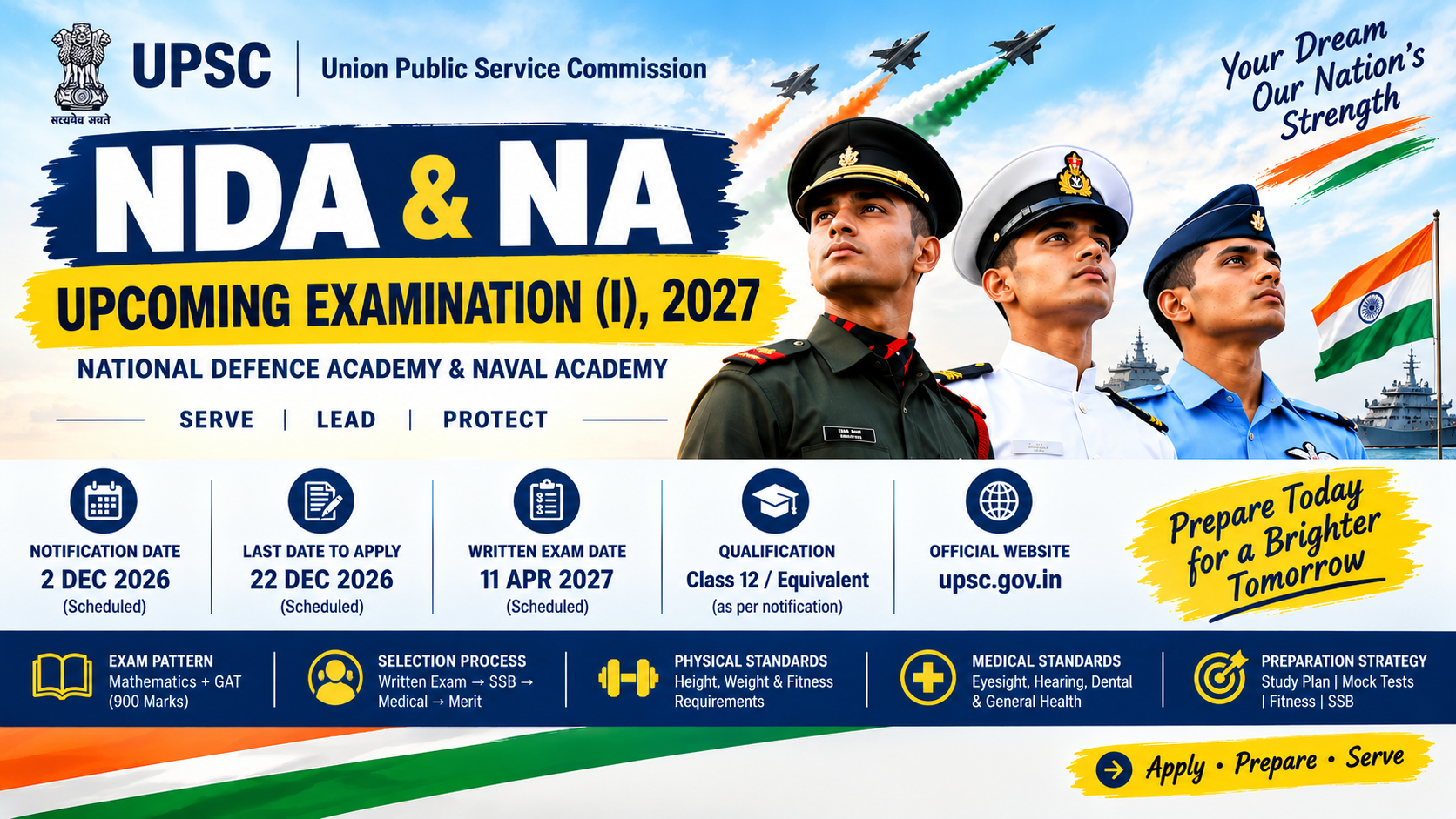
The NDA & NA Examination (I), 2027 is scheduled to be conducted by the Union Public Service Commission (UPSC) on 11 April 2027. According to the UPSC Annual Examination Calendar 2027, the notification is scheduled for 2 December 2026, and the last date to submit the application is 22 December 2026.
For aspirants, preparation should not be limited to Mathematics and General Knowledge. Candidates must also understand the eligibility criteria, physical standards, medical requirements, SSB selection process and the demands of military training.
In this guide, we explain the important details of NDA 2027 and provide a practical preparation strategy that students can begin following now.
NDA & NA Examination (I), 2027: Overview
Particulars | Details |
|---|---|
Examination Name | NDA & NA Examination (I), 2027 |
Conducting Authority | Union Public Service Commission (UPSC) |
Examination Level | National Level |
Notification Date | 2 December 2026 (scheduled) |
Application Deadline | 22 December 2026 (scheduled) |
Written Examination Date | 11 April 2027 (scheduled) |
Application Mode | Online |
Qualification | Class 12 or equivalent, as applicable |
Wings | Army, Navy and Air Force |
Selection Process | Written Examination, SSB, Medical Examination and Merit |
Official Website |
Important update: The dates above are listed in the UPSC Annual Calendar 2027. The detailed NDA & NA (I), 2027 notification will provide the final eligibility conditions, age limits, vacancies, fees, application instructions and applicable medical standards.
NDA 2027 Important Dates
Candidates should keep track of the following dates to avoid missing the application deadline.
Event | Scheduled Date |
|---|---|
Notification Release | 2 December 2026 |
Last Date to Apply | 22 December 2026 |
Written Examination | 11 April 2027 |
Admit Card | To be announced |
Written Examination Result | To be announced |
SSB Interview | To be announced |
The examination calendar is available on the official UPSC website. Candidates should check for any subsequent changes before making plans.
What Is the NDA Examination?
The National Defence Academy is a joint training institution where selected candidates receive training for a future career as officers in the Armed Forces.
The NDA and NA examination provides admission opportunities through the following routes:
Army Wing: For candidates aspiring to become officers in the Indian Army.
Navy Wing: For candidates aspiring to become officers in the Indian Navy.
Air Force Wing: For candidates aspiring to become officers in the Indian Air Force.
Naval Academy: For admission through the prescribed 10+2 Cadet Entry Scheme.
The course and service preferences available to a candidate depend on their eligibility, merit, medical fitness and the applicable selection rules.
NDA 2027 Eligibility Criteria
Before beginning the application process, candidates should check whether they meet the educational, age, nationality and other requirements.
1. Educational Qualification
Army Wing
Candidates must have passed Class 12 or an equivalent examination from a recognised board.
Candidates appearing in Class 12 may also apply, subject to the conditions specified in the official notification.
Air Force Wing, Navy Wing and Naval Academy
Candidates generally need Class 12 with Physics, Chemistry and Mathematics (PCM), or the prescribed equivalent qualification.
Class 12 appearing candidates may be eligible under the applicable rules.
Students should check the detailed notification for the exact subject and qualifying examination requirements.
2. Age Limit
NDA has a strict date-of-birth requirement. Candidates must fall within the birth-date range prescribed in the official notification and satisfy the applicable marital-status conditions.
The exact date-of-birth range for NDA & NA (I), 2027 should be checked when the detailed notification is available. Do not calculate eligibility solely from an age range mentioned for an earlier examination.
3. Gender and Marital Status
Eligible unmarried male and female candidates can apply, subject to the applicable educational, age, nationality and medical requirements.
4. Nationality
Candidates must satisfy the nationality conditions prescribed by UPSC. These may cover Indian citizens and certain other categories specified in the official rules.
5. Application Fee
The fee for NDA 2027 must be confirmed in the detailed notification. In previous examination cycles, the application fee was generally ₹100, with exemptions for eligible categories under the prescribed rules.
Candidates should verify the final fee, exemption conditions and payment instructions before applying.
NDA 2027 Exam Pattern
The traditional NDA written examination consists of two objective-type papers: Mathematics and the General Ability Test (GAT).
Paper | Subject | Maximum Marks | Duration |
|---|---|---|---|
Paper I | Mathematics | 300 | 2.5 hours |
Paper II | General Ability Test | 600 | 2.5 hours |
Total | 900 | 5 hours |
The written examination is followed by the SSB assessment for candidates who qualify under the applicable rules. The traditional SSB assessment carries 900 marks.
Negative marking applies to incorrect answers under the prescribed scheme. Candidates should read the examination instructions carefully before attempting the paper.
Mathematics Syllabus
Important topics include:
Algebra
Matrices and Determinants
Trigonometry
Analytical Geometry
Differential Calculus
Integral Calculus
Differential Equations
Vector Algebra
Statistics
Probability
General Ability Test (GAT) Syllabus
The GAT includes English and General Knowledge.
English
Grammar and usage
Vocabulary
Comprehension
Sentence correction
Basic language skills
General Knowledge
Physics
Chemistry
General Science
History
Geography
Current Affairs
Candidates should use the official syllabus and previous-year question papers to plan their studies.
NDA 2027 Physical Standards: Height, Weight and Fitness Requirements
Physical standards are an important consideration for candidates seeking admission to the NDA or Naval Academy. Students should understand the requirements early instead of waiting until after the written examination.
The standards can differ according to gender, age, service, entry and applicable relaxations. The following information provides general guidance; the final eligibility decision depends on the official standards and authorised medical assessment.
1. Minimum Height Requirements
Height requirements are not identical for every service and entry. Common general reference points for NDA candidates are approximately 157 cm for male candidates and 152 cm for female candidates, subject to the applicable service-specific rules and relaxations.
Category | General Reference |
|---|---|
Male candidates | Approximately 157 cm |
Female candidates | Approximately 152 cm |
Air Force flying-related entry | Specific height and body-proportion requirements apply |
Eligible regional or category-specific cases | Prescribed relaxations may apply |
Certain categories may receive relaxations under the applicable regulations. Air Force candidates may also be assessed for sitting height, leg length and thigh length.
Important: These figures are general references, not a complete eligibility table for NDA 2027. Candidates should verify the applicable standards in the official notification. Meeting the general height requirement does not automatically establish medical eligibility.
2. Weight Requirements
There is no single weight limit suitable for every candidate. The acceptable range depends on height, age, gender and the applicable medical standards.
Candidates should focus on maintaining a healthy body composition and avoiding extreme attempts to change their weight.
For better preparation:
Follow a balanced diet with adequate protein, carbohydrates, healthy fats, vitamins and minerals.
Exercise regularly and increase training gradually.
Avoid crash diets and excessive bulking.
Do not use unverified weight-gain or weight-loss supplements.
Consult a qualified healthcare professional if your weight is significantly outside the prescribed range.
The official height-and-weight tables should be checked when the applicable medical standards are released or referenced by UPSC.
3. General Fitness Preparation
Candidates should gradually develop cardiovascular endurance, strength, flexibility, coordination and recovery habits.
A suitable beginner routine can include:
Brisk walking followed by gradual jogging.
Bodyweight exercises such as squats, modified push-ups and planks.
Mobility exercises and gentle stretching.
Adequate sleep and hydration.
Regular monitoring of fitness progress.
The objective is to build a sustainable fitness routine, not to exhaust yourself through sudden, intensive workouts.
NDA 2027 Medical Standards: Eyesight, Hearing, Dental Health and General Fitness
Clearing the written examination does not guarantee final selection. Candidates must also meet the medical standards applicable to their entry and service.
The medical examination assesses whether a candidate is medically fit for the prescribed training and duties. Some requirements, particularly eyesight standards, differ significantly between service branches.
1. Eyesight Requirements
Eyesight is especially important for candidates seeking entry into the Air Force and certain Navy roles.
The medical assessment may consider:
Uncorrected and corrected visual acuity.
Myopia and hypermetropia.
Astigmatism and refractive error.
Colour perception.
Binocular vision and ocular muscle balance.
Other relevant eye conditions.
There is no single eyesight rule that should be assumed to apply to every NDA candidate. Flying-related entries may have stricter standards than other branches.
What should students do?
If you have blurred vision, difficulty seeing distant objects or a known eye condition, arrange an examination with a qualified ophthalmologist. Keep the reports available and compare the findings with the standards applicable to your preferred service.
Do not assume that spectacles automatically disqualify you or that corrected vision automatically makes you eligible. The final decision depends on the applicable medical rules.
2. Hearing and Ear Health
Candidates must meet the prescribed hearing standards. Persistent hearing difficulties, recurrent ear infections or other relevant conditions should be assessed by a qualified medical professional.
Students should avoid inserting objects into the ears and should not use medication without appropriate medical advice.
3. Dental Health
Good oral health is an important part of general medical fitness.
Candidates should:
Brush their teeth regularly.
Maintain appropriate oral hygiene.
Seek dental advice for untreated cavities or gum problems.
Address persistent dental pain before the medical examination.
A dentist can help assess and treat oral health problems, but only the authorised medical assessment determines eligibility under the prescribed standards.
4. Bones, Joints and Posture
The medical assessment may examine the spine, limbs, joints, gait and other physical characteristics.
Certain conditions, including significant spinal abnormalities, some joint problems, knock knees, flat feet or restricted movement, may require further medical assessment. Their implications depend on the nature and severity of the condition and the applicable service rules.
Candidates should not automatically assume that every minor variation leads to rejection. If you have a known condition, consult a qualified specialist and verify the relevant official requirements.
5. General Health
The medical examination may include assessment of the cardiovascular and respiratory systems, abdomen, neurological function and other areas required by the medical board.
Candidates should maintain healthy daily habits, seek appropriate medical care for persistent symptoms and disclose relevant medical history honestly when required.
Remember: Medical eligibility cannot be guaranteed by a fitness routine or self-assessment. The final decision rests with the authorised medical board.
NDA 2027 Selection Process
The selection process traditionally includes the following stages.
Stage 1: Written Examination
Candidates take the Mathematics and GAT papers. Their performance is assessed under the prescribed examination scheme and qualifying requirements.
Stage 2: SSB Interview
Candidates who qualify proceed to the Services Selection Board assessment. It evaluates officer-like qualities, communication, reasoning, teamwork, leadership and suitability for military service.
The assessment may include psychological tests, group tasks and interviews, as prescribed by the relevant SSB procedure.
Stage 3: Medical Examination
Candidates undergo medical assessment according to the applicable standards for the service or entry for which they are being considered.
Stage 4: Final Merit List
Final selection depends on the applicable merit rules, performance, medical fitness, service preferences and available vacancies.
Qualifying the written examination alone does not guarantee admission.
How to Prepare for NDA 2027 Starting Today
Students who want to improve their selection prospects should prepare for the written examination, SSB assessment and physical fitness together.
There is no guaranteed shortcut to NDA selection. A disciplined routine, regular revision, realistic mock tests and steady personal development can help candidates improve their performance.
1. Make Mathematics Your Daily Priority
Mathematics carries 300 marks in the traditional written examination pattern. Students should focus on understanding concepts and solving questions accurately.
Follow these steps:
Divide the syllabus into manageable topics.
Study the basic concepts before memorising shortcuts.
Practise topic-wise questions every day.
Maintain a notebook of formulas and common mistakes.
Solve previous-year questions regularly.
Attempt timed mock tests and analyse the results.
If a topic is difficult, revisit the concept instead of repeatedly guessing answers.
2. Improve English Through Daily Practice
English preparation should not be left until the final month.
Read English articles, revise grammar rules, learn vocabulary in context and practise comprehension passages. Review incorrect answers to identify recurring weaknesses.
Consistent daily practice is more useful than memorising large vocabulary lists without revision.
3. Prepare General Knowledge Systematically
Divide General Knowledge into Physics, Chemistry, General Science, History and Geography.
Study each subject according to the prescribed syllabus. Make short notes, revise important facts and solve topic-wise questions.
Avoid depending entirely on current affairs or one-liners. A strong foundation in static General Knowledge is also important.
4. Follow Current Affairs Regularly
Read reliable news sources and prepare short notes on:
National and international developments.
Defence exercises and important military developments.
Science and technology.
Major government initiatives.
Important appointments and awards.
Sports and significant international events.
Revise current affairs weekly rather than collecting notes that you never revisit.
5. Solve Previous-Year Papers and Mock Tests
Previous-year papers help students understand question styles, time requirements and the level of difficulty.
After each test, analyse:
Which topics caused the most mistakes.
Which questions consumed too much time.
Whether negative marking reduced your score.
Which concepts need additional revision.
Whether you attempted questions too quickly.
Maintain an error notebook and review it every week. This makes every practice test a learning opportunity.
6. Start SSB Preparation Early
Do not wait for the written result to begin developing the skills needed for SSB.
Students can work on:
Clear and confident communication.
Logical reasoning and decision-making.
Teamwork and cooperation.
General awareness.
Self-awareness and honest reflection.
Leadership through school, college or community activities.
Avoid memorising artificial interview answers. Focus on developing genuine skills and expressing your experiences honestly.
Suggested Daily Study Timetable for NDA Aspirants
Students can adapt this routine according to their school or college schedule.
Subject or Activity | Suggested Daily Time |
|---|---|
Mathematics | 2 hours |
English | 45 minutes |
General Knowledge | 1 hour |
Current Affairs | 30 minutes |
Revision and Question Practice | 45 minutes |
Physical Training | 30 minutes initially, adjusted to fitness level |
The timetable is a suggested starting point, not a compulsory schedule. Students should adjust it according to their current preparation level, school workload and fitness.
A Simple Weekly Progress Checklist
At the end of each week, ask yourself:
Did I complete my planned Mathematics topics?
Did I practise English every day?
Did I revise General Knowledge?
Did I review current affairs?
Did I attempt and analyse a mock test?
Did I maintain a consistent fitness routine?
Did I identify the areas that need more work next week?
A weekly review helps students correct mistakes before they become long-term weaknesses.
Common Mistakes NDA Aspirants Should Avoid
Studying without a realistic timetable.
Ignoring English because Mathematics feels difficult.
Depending entirely on short notes without understanding concepts.
Taking mock tests without analysing mistakes.
Starting intensive exercise without building basic stamina.
Following extreme diets to change body weight quickly.
Ignoring persistent vision, hearing, dental or joint problems.
Assuming that one height or eyesight requirement applies to every service.
Believing that clearing the written examination guarantees final selection.
Relying on unofficial vacancy figures or unverified application links.
Important Links for NDA & NA Examination (I), 2027
Purpose | Official Link |
|---|---|
UPSC Official Website | |
UPSC Examination Calendar | |
NDA & NA (I), 2027 Examination Page | |
UPSC Online Application Portal |
Candidates should use the official application portal only when the application window opens and follow the instructions in the notification.
Frequently Asked Questions (FAQs)
1. When will the NDA & NA (I), 2027 notification be released?
The UPSC Annual Calendar 2027 schedules the notification for 2 December 2026. Candidates should verify the date on the official UPSC website.
2. What is the NDA & NA (I), 2027 examination date?
The written examination is scheduled for 11 April 2027, subject to any subsequent official changes.
3. Can Class 12 students apply for NDA 2027?
Candidates appearing in Class 12 may generally apply if they satisfy the conditions prescribed in the notification. The educational requirements differ between the Army Wing and the wings requiring Physics, Chemistry and Mathematics.
4. Can female candidates apply for NDA 2027?
Yes. Eligible unmarried female candidates can apply, subject to the prescribed age, educational, medical and other requirements.
5. What is the minimum height for NDA candidates?
General reference points are approximately 157 cm for male candidates and 152 cm for female candidates, but applicable requirements and relaxations vary. Candidates must check the official standards for their entry and service.
6. Is wearing spectacles allowed in NDA?
Spectacle use does not lead to the same outcome for every candidate. The applicable visual acuity, refractive error and other eye standards vary by service and role. Candidates should obtain a professional eye examination and check the official medical requirements.
7. What are the total marks in the NDA written examination?
Under the traditional pattern, Mathematics carries 300 marks and GAT carries 600 marks, giving a total of 900 marks.
8. What happens after the NDA written examination?
Candidates who qualify proceed to the SSB assessment under the prescribed rules. Medical examination and final merit determination follow as applicable.
9. How should students start preparing for NDA 2027?
Students should begin with Mathematics fundamentals, daily English practice, systematic General Knowledge preparation, current affairs revision and previous-year questions. They should also develop physical fitness and communication skills gradually.
10. Can a candidate guarantee selection through coaching or mock tests?
No. Coaching and mock tests can support preparation, but selection depends on performance across the prescribed stages, medical fitness, merit and available vacancies.
Conclusion
The UPSC NDA & NA Examination (I), 2027 is an opportunity for eligible students who aspire to serve as officers in the Indian Armed Forces. With the written examination scheduled for April 2027, aspirants should start preparing systematically instead of waiting for the application window.
Build strong fundamentals in Mathematics, English and General Knowledge. Practise previous-year papers, analyse mock tests, follow current affairs and begin SSB preparation early. At the same time, understand the physical and medical standards applicable to your preferred service.
Most importantly, verify age eligibility, educational requirements, height and weight standards, eyesight requirements, application fees and other conditions from the official notification.
For more government examination updates, preparation guidance, practice questions and mock tests, keep visiting Testkart
Official Source: Union Public Service Commission (UPSC)
Comments (0)
Please log in to join the discussion.
Log In to CommentNo comments yet. Be the first to share your thoughts!