
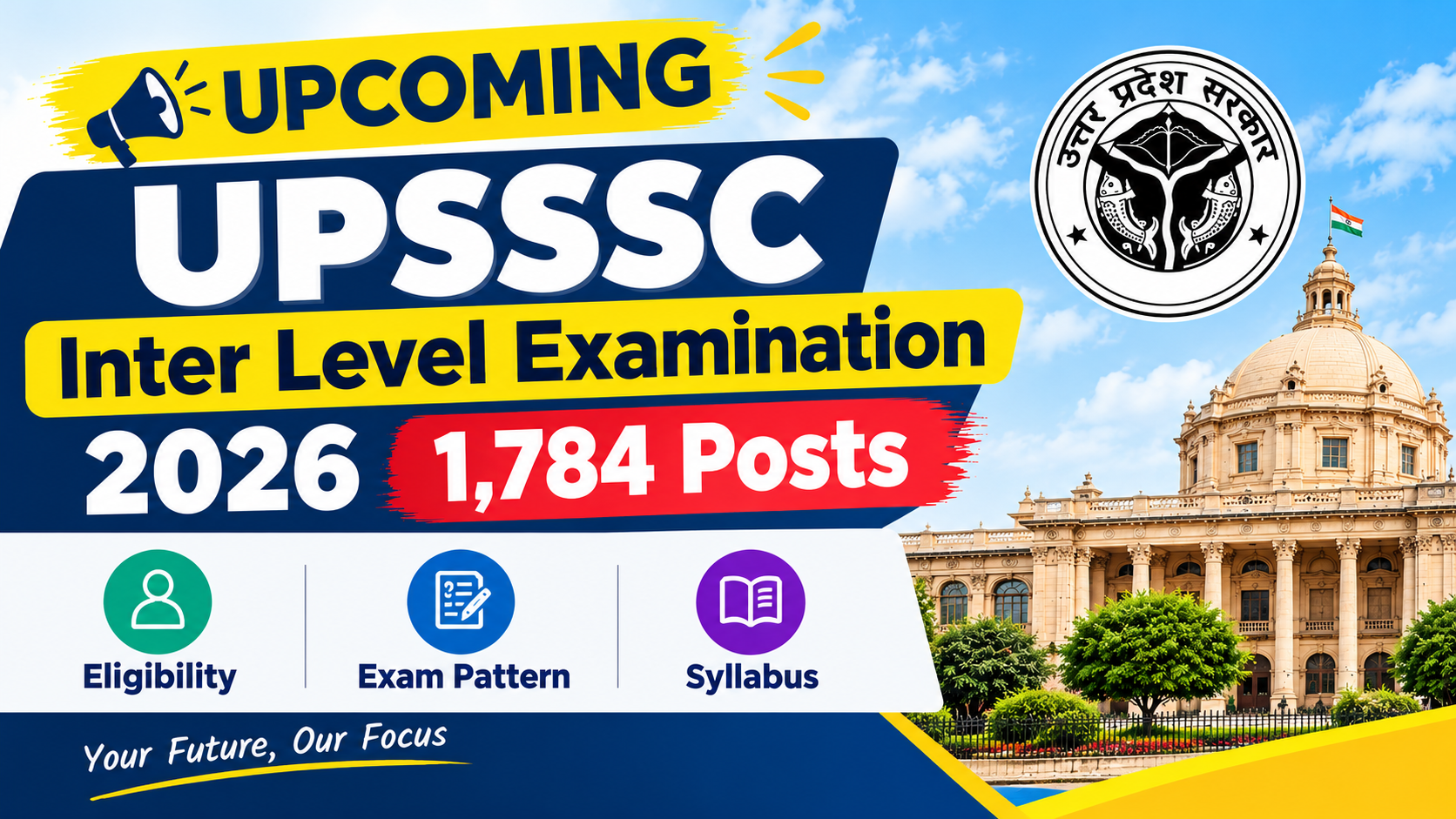
UPSSSC Inter (12th) Level Examination 2026: 1,784 Posts, Eligibility, Exam Pattern & Syllabus
The Uttar Pradesh Subordinate Services Selection Commission (UPSSSC) has released the notification for the UPSSSC Inter (12th) Level Examination 2026 under Advertisement No. 26-Exam/2026. The recruitment drive announces 1,784 vacancies for various Intermediate-level posts in different Uttar Pradesh government departments.
Candidates who have passed Class 12 and meet the post-specific eligibility requirements can check the notification, important dates, age limit, application fee, selection process and detailed syllabus in this article.
The examination is associated with the Combined Lower Subordinate Services (Intermediate Level) Main Examination (PET-2025)/26. Candidates should carefully review the official advertisement before applying.
UPSSSC Inter Level Recruitment 2026: Overview
Particulars | Details |
|---|---|
Recruiting Authority | Uttar Pradesh Subordinate Services Selection Commission |
Examination Name | UPSSSC Inter Level Examination 2026 |
Advertisement Number | 26-Exam/2026 |
Total Vacancies | 1,784 |
Qualification | Intermediate (Class 12), subject to post-specific requirements |
PET Requirement | UPSSSC PET-2025 |
Application Mode | Online |
Application Start Date | 10 November 2026 |
Last Date to Apply | 1 December 2026 |
Selection Process | PET-based shortlisting, Main Examination and document verification |
Official Website |
Important Dates
Candidates should note the following dates for UPSSSC Inter Level Recruitment 2026.
Event | Date |
|---|---|
Notification Release | 16 October 2026 |
Online Application Begins | 10 November 2026 |
Last Date to Apply Online | 1 December 2026 |
Correction Deadline | Check the official notification |
Main Examination Date | To be announced |
Note: The online application process is scheduled to begin on 10 November 2026. Candidates should check the official UPSSSC website for any changes to the schedule.
UPSSSC Inter Level Vacancy 2026
A total of 1,784 vacancies have been announced for different Intermediate-level posts. The recruitment includes posts across multiple government departments, with eligibility requirements varying according to the position.
Some of the reported posts include:
Gram Panchayat Officer
Village Development Officer (Social Welfare)
Commercial Tax Collection Amin
Land Acquisition Amin
Social Welfare Supervisor
Assistant Cooperative and Development Supervisor
Stenographer
Storekeeper and Clerk
House Mother (Grihmata)
Farm Clerk
Sales Clerk
Candidates should refer to the official advertisement for the complete vacancy distribution, reservation details and post-specific eligibility conditions.
Educational Qualification
The basic educational requirement for this recruitment is Intermediate (Class 12) or an equivalent qualification from a recognised board. However, passing Class 12 alone may not be sufficient for every post.
Candidates should keep the following points in mind:
Applicants must possess the prescribed educational qualification for their selected post.
A valid UPSSSC PET-2025 score is required for the applicable Main Examination shortlisting process.
Certain posts may require a computer certificate, typing skills, stenography skills or other additional qualifications.
Qualifications must satisfy the conditions and deadlines specified in the official notification.
Read the detailed advertisement carefully before selecting a post.
Age Limit
The generally reported age range for the recruitment is 18 to 40 years, subject to the individual post's rules and the prescribed age-calculation date.
Age relaxation may be available to eligible reserved-category candidates and other categories under Uttar Pradesh government rules.
Candidates should use the official advertisement to confirm their minimum age, maximum age and applicable relaxation.
Application Fee
The published recruitment information indicates an online processing fee of ₹25 at the initial application stage. Additional fees may apply at later stages, depending on the examination and official instructions.
Candidates should verify the final amount, payment procedure and category-specific requirements on the official UPSSSC portal.
UPSSSC Inter Level Selection Process 2026
The selection process generally consists of the following stages:
1. PET-2025 Score-Based Shortlisting
Candidates who meet the prescribed eligibility requirements are shortlisted for the Main Examination based on their UPSSSC PET-2025 scores and the commission's applicable rules.
2. Main Written Examination
Shortlisted candidates must appear for the relevant Main Examination. The examination assesses general knowledge, Hindi, computer and information technology, data interpretation and other subjects included in the prescribed syllabus.
3. Document Verification
Candidates who qualify at the relevant stages must provide their original educational certificates, identity documents, category certificates and other required records.
4. Skill Test, Where Applicable
Certain posts may require a typing test, stenography test or another prescribed skill assessment. Such requirements depend on the selected post.
UPSSSC Inter Level Exam Pattern 2026
The published examination plan reports an objective-type Main Examination consisting of 100 questions for 100 marks, with a duration of two hours.
Subject | Questions | Marks |
|---|---|---|
History of India and Indian National Movement | 5 | 5 |
Indian Polity and Indian Constitution | 5 | 5 |
Geography of India and the World | 5 | 5 |
Indian Economy and Social Development | 5 | 5 |
Rural Society and Development | 5 | 5 |
Current Events of National and International Importance | 5 | 5 |
Science and Technology | 5 | 5 |
Environmental Ecology and Disaster Management | 10 | 10 |
Data Interpretation | 10 | 10 |
General Hindi | 10 | 10 |
Computer and Information Technology | 15 | 15 |
General Information Related to Uttar Pradesh | 20 | 20 |
Total | 100 | 100 |
Examination duration: 2 hours (120 minutes)
Question type: Objective multiple-choice questions (MCQs)
Negative marking: The published syllabus coverage reports a deduction of 25% of the marks assigned to a question for each incorrect answer. Verify this rule in the official examination scheme before the exam.
UPSSSC Inter Level Syllabus 2026: Subject-Wise Details
The syllabus is divided into three broad parts. Candidates should prepare each subject according to the official examination plan.
Part 1: Subject-Related Knowledge
1. History of India and Indian National Movement
Important topics include:
Ancient, medieval and modern Indian history
Major historical events and developments
Social, cultural, economic and political aspects of Indian history
British rule and colonial administration
The Revolt of 1857
The rise of Indian nationalism
Important leaders of the freedom movement
Major movements and campaigns for independence
Important events leading to India's independence
Preparation tip: Focus on important dates, personalities, historical movements and the causes and consequences of major events.
2. Indian Polity and Indian Constitution
Topics include:
Constitutional development in India
Making and key features of the Indian Constitution
Fundamental Rights and Fundamental Duties
Directive Principles of State Policy
President, Prime Minister and Council of Ministers
Parliament and state legislatures
Supreme Court and High Courts
Centre-state relations
Panchayati Raj institutions
Local self-government
Public policy and governance
Community development
Constitutional and statutory bodies
Preparation tip: Revise constitutional provisions, government institutions, important amendments and the functions of constitutional authorities.
3. Geography of India and the World
Important topics include:
Physical geography of India
Mountains, plateaus, plains and rivers
Climate, rainfall and monsoon
Soil types and natural vegetation
Agriculture and irrigation
Population and urbanisation
Minerals and natural resources
Industries and economic geography
Forests and wildlife
World geography and major geographical features
Environmental and geographical issues
4. Indian Economy and Social Development
Candidates should prepare:
Basic concepts of the Indian economy
National income and economic growth
Poverty and unemployment
Inflation and price changes
Agriculture and rural economy
Industrial and service sectors
Banking and financial institutions
Government welfare programmes
Economic planning and development
Social development indicators
Education, health and human development
Sustainable and inclusive development
5. Rural Society and Development
Important areas include:
Rural social structure
Rural communities and institutions
Rural development programmes
Panchayati Raj and local administration
Rural employment schemes
Poverty alleviation
Agricultural development
Self-help groups
Rural infrastructure
Community development
Government welfare schemes for rural areas
6. Current Events of National and International Importance
Candidates should regularly follow:
Major national and international events
Government policies and programmes
Important appointments
Awards and honours
Sports tournaments
Summits and international organisations
Important reports and indices
Science and technology developments
Books and authors
Important days and themes
Major economic and environmental developments
Preparation tip: Revise current affairs regularly and maintain short notes on important events.
7. Science and Technology
Topics include:
Basic physics, chemistry and biology
Scientific discoveries and inventions
Human body and health
Nutrition and common diseases
Everyday scientific applications
Space research
Biotechnology
Information technology developments
Energy sources
Environmental science
Recent scientific achievements in India
8. Environmental Ecology and Disaster Management
Important topics include:
Ecosystems and ecological balance
Biodiversity and conservation
Pollution and its control
Climate change and global warming
Natural resources
Forest conservation
Environmental protection
Sustainable development
Natural disasters and their management
Floods, droughts, earthquakes and cyclones
Disaster preparedness and response
Disaster risk reduction
9. Data Interpretation
Candidates should practise numerical and graphical problems, including:
Tables and tabular data
Bar graphs
Line graphs
Pie charts
Data comparison
Percentages
Ratios and proportions
Averages
Basic arithmetic calculations
Trends and numerical analysis
Preparation tip: Practise timed questions and focus on calculation accuracy.
10. General Hindi
Important topics include:
वर्णमाला और वर्तनी
संधि और समास
उपसर्ग और प्रत्यय
पर्यायवाची शब्द
विलोम शब्द
अनेकार्थी शब्द
तत्सम और तद्भव शब्द
मुहावरे और लोकोक्तियाँ
वाक्य शुद्धि
शब्द शुद्धि
संज्ञा, सर्वनाम, विशेषण और क्रिया
लिंग और वचन
कारक और काल
रस, छंद और अलंकार की मूल जानकारी
अपठित गद्यांश
Candidates should practise grammar, vocabulary and comprehension questions regularly.
Part 2: Computer and Information Technology
This section covers basic computer knowledge and developments in information technology.
Important topics include:
Introduction, history and applications of computers
Computer hardware and software
Input and output devices
Operating systems
Internet and World Wide Web
IP addresses and internet protocols
Email creation and operation
Printers, tablets and mobile devices
Word processing, including MS Word
Spreadsheet processing, including MS Excel
Social networking
E-governance
Digital financial tools and applications
Cybersecurity and online safety
Future skills and emerging technologies
Artificial Intelligence (AI)
Machine Learning
Deep Learning
Big Data Processing
Internet of Things (IoT)
Technological development and innovation in India
Preparation tip: Understand basic computer concepts, practise common software functions and learn the applications of emerging technologies.
Part 3: General Information Related to Uttar Pradesh
This section is particularly important because the reported examination plan allocates 20 marks to Uttar Pradesh-related general information.
Prepare the following topics:
History and Culture
History of Uttar Pradesh
Important historical places and personalities
Art, architecture and cultural heritage
Festivals and folk dances
Literature and regional languages
Social customs and traditions
Important tourist destinations
Geography and Environment
Geographical regions of Uttar Pradesh
Major rivers and tributaries
Climate and soil
Forests and wildlife
National parks and wildlife sanctuaries
Natural resources
Minerals and environmental issues
Economy and Agriculture
Major crops and agricultural regions
Irrigation projects
Industries and industrial development
Trade and employment
Major economic sectors
Rural and urban development
Polity and Administration
State government structure
Governor and Chief Minister
State legislature
District administration
Local self-government
Panchayati Raj institutions
Administrative divisions and districts
Uttar Pradesh Current Affairs
Recent state government schemes
Important appointments and awards
Infrastructure projects
Economic and industrial developments
State-level sports achievements
Important events and initiatives
How to Prepare for UPSSSC Inter Level Examination 2026
Candidates should follow a structured preparation plan instead of studying subjects randomly.
Step 1: Understand the Exam Pattern
Begin by reviewing the official syllabus, subject-wise marks and negative marking rules. Give sufficient time to high-weightage areas such as Uttar Pradesh General Knowledge, Computer and Information Technology, General Hindi, Environmental Ecology and Data Interpretation.
Step 2: Prepare a Daily Study Schedule
A sample daily schedule is given below.
Subject | Suggested Daily Time |
|---|---|
Uttar Pradesh General Knowledge | 45 minutes |
Computer and Information Technology | 30 minutes |
General Hindi | 30 minutes |
History, Polity, Geography and Economy | 60 minutes |
Current Affairs and Science | 30 minutes |
Data Interpretation and Practice Questions | 45 minutes |
Candidates can adjust this schedule according to their preparation level and available time.
Step 3: Practise Previous-Year Questions
Solve previous-year papers and relevant UPSSSC practice questions to understand question formats, recurring topics and difficulty levels.
Step 4: Take Mock Tests
Attempt full-length mock tests under a two-hour time limit. Analyse mistakes after each test and revise weak topics.
Step 5: Revise Regularly
Keep short notes for Hindi grammar, Uttar Pradesh facts, computer terminology, important historical events and current affairs. Regular revision helps improve retention.
Important Documents
Candidates should keep the following documents ready, wherever applicable:
Class 10 certificate and marksheet
Class 12 certificate and marksheet
UPSSSC PET-2025 scorecard
Photograph and signature
Valid identity proof
Caste or category certificate, if applicable
Disability certificate, if applicable
Computer or typing qualification certificate, where required
Other post-specific documents
The exact list depends on the selected post and official application instructions.
How to Apply for UPSSSC Inter Level Recruitment 2026
The application process is scheduled to begin on 10 November 2026.
Visit the official UPSSSC website at https://upsssc.gov.in/.
Open the recruitment section.
Locate Advertisement No. 26-Exam/2026.
Read the official notification and eligibility requirements.
Complete the prescribed login or registration process.
Fill in the required information.
Select the applicable post and enter the required details.
Complete the fee or processing-fee procedure as instructed.
Review the form and submit it.
Save a copy of the application confirmation for future reference.
Candidates should use only the official website for the application process.
Important Links
Resource | Link |
|---|---|
Official UPSSSC Website | |
Recruitment Notification | Check Advertisement No. 26-Exam/2026 on the official website |
Apply Online | Available when the application window opens |
Exam Syllabus | Refer to the official advertisement and examination scheme |
Admit Card and Exam Updates | Check the official website regularly |
Frequently Asked Questions (FAQs)
1. What is UPSSSC Inter Level Examination 2026?
It is a recruitment examination for various Intermediate-level posts in Uttar Pradesh government departments under Advertisement No. 26-Exam/2026.
2. How many vacancies are available?
A total of 1,784 vacancies have been reported.
3. What is the educational qualification?
Candidates generally need to have passed Class 12 or an equivalent examination. Additional qualifications may apply to particular posts.
4. Is UPSSSC PET-2025 required?
Yes, PET-2025 score-based shortlisting is part of the reported selection process for the Main Examination.
5. When will the application process begin?
The scheduled application start date is 10 November 2026.
6. What is the last date to apply?
The reported last date is 1 December 2026.
7. What is the age limit?
The generally reported age range is 18–40 years, subject to the post-specific rules, age-calculation date and applicable relaxations.
8. What is the examination pattern?
The published examination plan reports 100 objective questions carrying 100 marks, with a duration of two hours.
9. Is there negative marking?
Published syllabus coverage reports a deduction of 25% of the marks assigned to a question for each incorrect answer. Candidates should confirm this in the official examination scheme.
10. Which subjects are included in the syllabus?
The syllabus includes Indian History, Polity, Geography, Economy, Rural Development, Current Affairs, Science and Technology, Environmental Ecology and Disaster Management, Data Interpretation, General Hindi, Computer and Information Technology, and Uttar Pradesh General Knowledge.
11. How many marks are allotted to Uttar Pradesh General Knowledge?
The published examination plan allocates 20 questions and 20 marks to Uttar Pradesh-related general information.
12. Where can I check the official notification?
Visit the official UPSSSC website at https://upsssc.gov.in/ and look for Advertisement No. 26-Exam/2026.
Conclusion
The UPSSSC Inter (12th) Level Examination 2026 offers an opportunity for eligible candidates seeking government jobs in Uttar Pradesh. With 1,784 reported vacancies, candidates should prepare carefully by understanding the eligibility requirements, selection process and examination syllabus.
Focus on Uttar Pradesh General Knowledge, Computer and Information Technology, General Hindi, Data Interpretation and the remaining general studies subjects. Review the official advertisement before applying and check the UPSSSC website for updates on application dates, examination schedules and admit cards.
Comments (0)
Please log in to join the discussion.
Log In to CommentNo comments yet. Be the first to share your thoughts!