
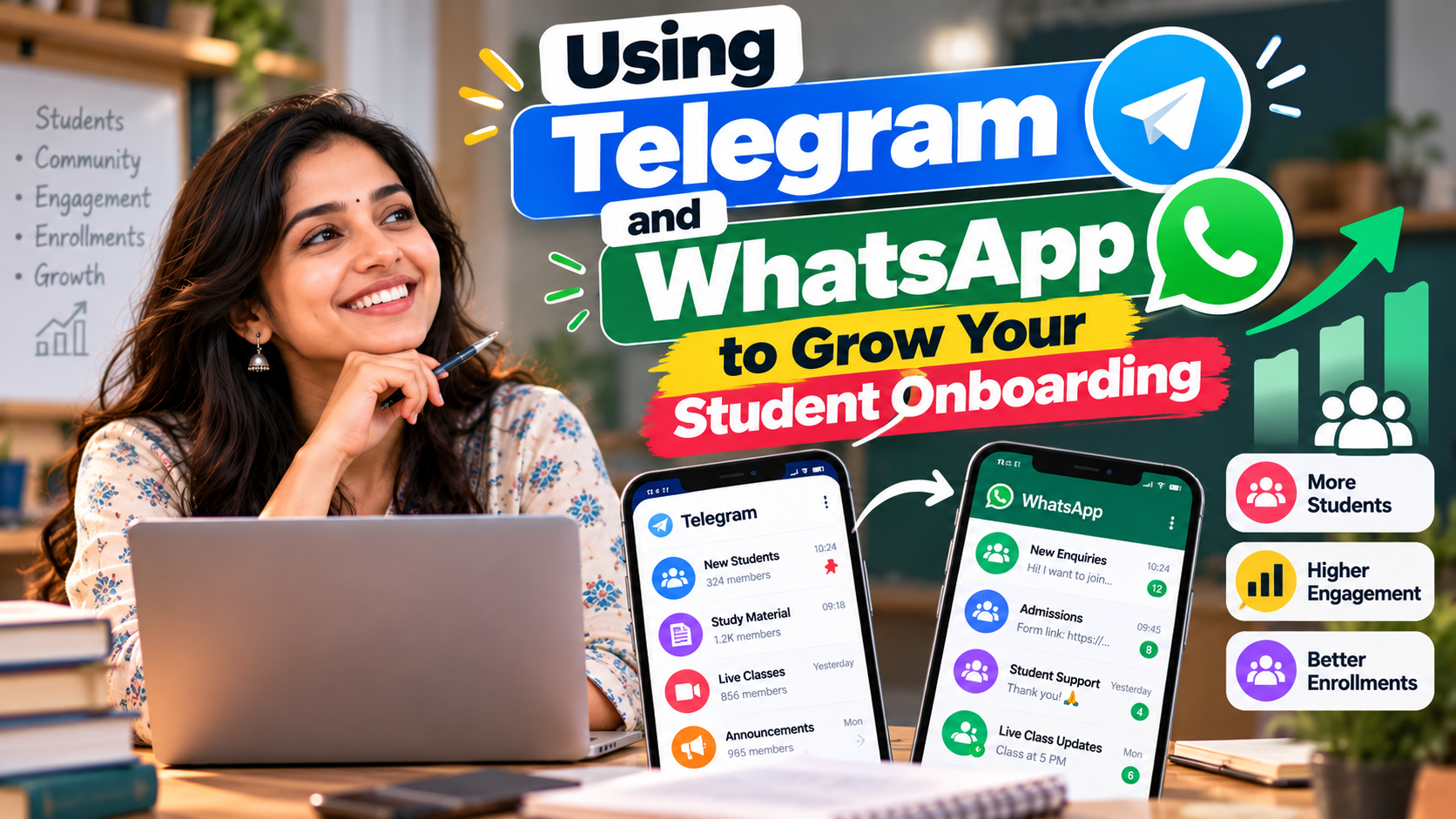
If you run a coaching institute or teach online, you probably already have a WhatsApp group or Telegram channel with a few hundred members. And chances are, most of them haven't bought anything yet.
That's not because WhatsApp and Telegram don't work for selling courses; they work extremely well. It's because most institutes either go silent for weeks and then send one "Enrol Now" message nobody responds to, or post so many promotions that people quietly leave the group. There's a proven middle path, and this guide breaks it down step by step.
Why These Groups Work Better Than Ads
They start with trust. A student who joined your group after seeing a free PDF already trusts you a little; an Instagram ad doesn't have that head start.
Follow-ups cost nothing. Once someone's in your group, reminders and offers reach them for free, unlike running fresh ad campaigns every time.
Students already live there. Most exam-prep students NEET, JEE, SSC, banking aspirants already use WhatsApp and Telegram daily. You're meeting them where they already are.
No algorithm in the way. Unlike Instagram or Facebook, your message reaches the group directly, not based on how the platform feels that day.
What to Actually Post (Not Just "Engage Students")
Free value drops — real, complete resources like "20 Most Repeated Organic Chemistry Questions," not teasers.
Free mini mock tests — a 10-15 question test shows your quality directly, better than a sales pitch.
Doubt-clearing in public — when a teacher solves one student's doubt clearly, everyone watching sees the teaching quality.
Real student wins — "I finally understood limits" from an ordinary student beats a polished testimonial graphic.
Behind-the-scenes previews — a short clip from an actual paid class or a sample notes page.
Honest urgency — "Only 3 seats left" only works if it's true; students talk to each other and spot fake scarcity fast.
Interactive polls — "Which topic should tomorrow's free class cover?" keeps the group active and tells you what to sell next.
Launch-week pricing — a time-bound discount works best after a period of consistent value, not as the first message someone sees.
The Group-to-Sale Funnel
Attract — a reel, YouTube video, or referral brings someone to join the group for free notes.
Bring them in — one-click join, no long forms.
Deliver free value — 3-4 useful posts a week, no selling, for the first 1-2 weeks.
Build credibility — mix in results and doubt-clearing so trust is proof-based, not just claimed.
Spot interested students — polls and "reply if interested" prompts surface your warmest leads.
Introduce the course — as a natural next step: "A lot of you asked for a structured plan instead of scattered notes — here's what's inside."
Handle objections openly — address price and doubts directly instead of ignoring them.
Send a clear CTA — one link, one price, one deadline.
Onboard properly — a welcome checklist within minutes of payment prevents early drop-offs and refund requests.
Keep engaging after purchase — this is what drives renewals and referrals.
Common Mistakes That Kill Conversions
Selling to someone who joined two days ago
Going silent for weeks, then over-posting
Sending the same broadcast to every class/exam level
Ignoring objections instead of answering them
No proper onboarding after payment
Generic, copy-pasted motivational content
Best Practices Checklist
✅ Post free value at least 3x a week before mentioning a paid course
✅ Keep promotional messages under 20% of total posts
✅ Use polls to find your warmest leads
✅ Segment groups by class/exam where possible
✅ Always give a clear deadline in offer messages
✅ Respond to objections publicly when you can
✅ Send a welcome message within minutes of purchase
WhatsApp vs Telegram
Feature | Telegram | |
Best for | Personal follow-ups, offers | Large-scale broadcasting |
File size limit | ~100MB | Up to 2GB |
Two-way chat | Yes | Limited in channels |
Bots/automation | Minimal | Strong |
Ideal use | Onboarding, conversion talk | Free resource libraries |
Many institutes use both Telegram to store and broadcast free resources at scale, and WhatsApp for the personal, conversion-focused conversations.
Where Testkart Fits In
WhatsApp and Telegram are great for building trust and interest, but not built for actually delivering a course, test series, or handling payments cleanly. That's usually where institutes get stuck: interested students, no organised way to convert that interest. Testkart closes that gap: once a student clicks your enrollment link from the group, Testkart handles course delivery, test series, PDFs, and notes access in one place, so you're not manually managing Drive links and payment screenshots.
Conclusion
WhatsApp and Telegram groups don't sell courses by themselves; the sequence you follow inside them does. Free value first, trust built through consistency, then a clear, well-timed offer with proper onboarding after. Start small: pick one type of free content, post it three times a week, track who engages, and offer your next course to exactly that group.
FAQs
How can I sell my online course through WhatsApp?
Share genuinely useful free content for a couple of weeks first, then introduce your course with a clear price and deadline instead of a cold pitch.
Can Telegram help increase course sales?
Yes, its larger file limits and channel format make it ideal for building an audience through free resources, who can then be moved toward a paid course.
How do I convert group members into students?
Find engaged members through polls, address their specific doubts, and send a clear, time-bound offer rather than a generic broadcast.
How often should I send promotional messages?
Roughly 1 promotional post for every 4-5 value posts keeps it from feeling spammy.
What should I post in the group?
Free notes, mock tests, doubt-clearing highlights, student results, quick polls, and occasional previews of your paid course.
Comments (0)
Please log in to join the discussion.
Log In to CommentNo comments yet. Be the first to share your thoughts!