
Currency in Circulation and India's Growing Digital Payments Economy
Key points
Why in the News?
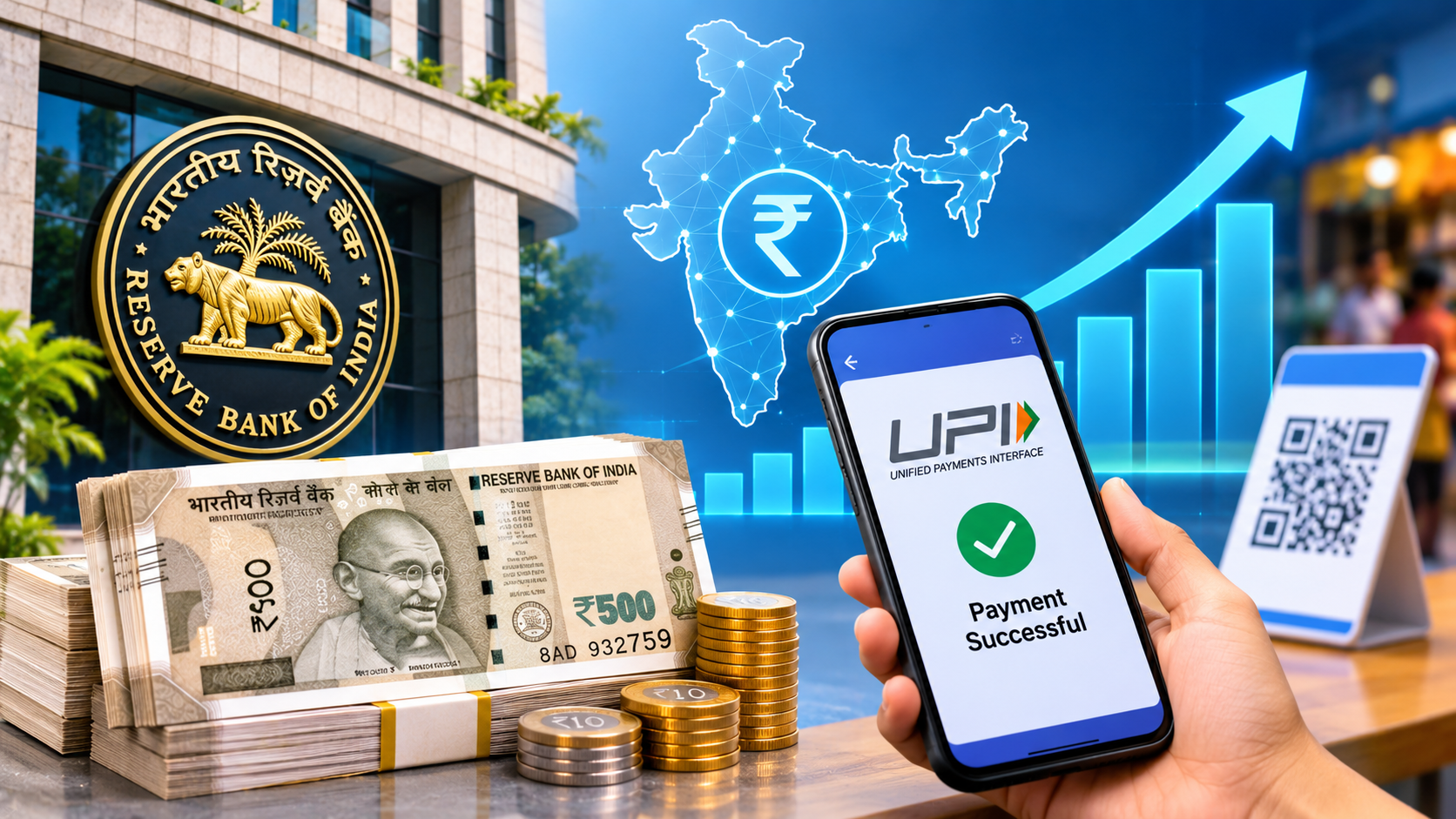
India's currency in circulation has continued to rise despite the rapid growth of digital payments, highlighting the coexistence of cash and electronic transactions in the economy.
According to Reserve Bank of India (RBI) data, the value of banknotes in circulation reached approximately ₹43.15 lakh crore as of 23 October 2026.
Meanwhile, the National Payments Corporation of India (NPCI) reported that UPI processed approximately 2,547 crore transactions worth ₹31.53 lakh crore in October 2026.
These developments indicate that India is moving towards a digitally enabled payment economy without completely replacing physical cash.
Currency in Circulation in India
Currency in circulation refers to the total value of currency notes and coins circulating in the economy.
According to RBI data:
November 2016: Currency in circulation was approximately ₹17.7 lakh crore before demonetisation.
January 2026: Currency in circulation crossed approximately ₹40 lakh crore.
October 2026: Banknotes in circulation reached approximately ₹43.15 lakh crore.
Major Trend: Cash holdings continue to increase in nominal terms despite the growing popularity of digital transactions.
The increase reflects economic expansion, inflation, precautionary cash holdings and continued cash usage in informal economic activities.
Growth of UPI and Digital Payments
The Unified Payments Interface (UPI), developed by NPCI, has transformed India's payment infrastructure since its introduction in 2016.
UPI allows users to transfer money instantly between bank accounts using smartphones and QR codes.
Key UPI Statistics:
Indicator | Details |
|---|---|
UPI Launch | 2016 |
Developer | NPCI |
October 2026 Transactions | 2,546.67 crore |
October 2026 Transaction Value | ₹31.53 lakh crore |
Banks Live on UPI (October 2026) | 758 |
FY 2025–26 Transaction Volume | 24,162 crore |
FY 2025–26 Transaction Value | Approximately ₹314 lakh crore |
Digital payments have expanded across urban, rural and semi-urban areas, improving access to financial services and reducing dependence on cash for everyday transactions.
Why Is Cash Circulation Still Increasing?
Despite the widespread adoption of UPI, India's demand for physical currency remains strong.
1. Economic Growth: Expansion in economic activity increases the demand for money, including physical currency.
2. Inflation: Rising prices can increase the nominal amount of cash required for transactions.
3. Informal Economy: Small businesses, agricultural markets and informal workers continue to use cash.
4. Precautionary Savings: Households often hold cash for emergencies and unexpected expenses.
5. Rural Cash Demand: Limited digital connectivity and differences in financial access sustain cash usage in some areas.
Cash-to-GDP Ratio and Digital Transformation
The cash-to-GDP ratio measures the value of currency in circulation relative to the country's Gross Domestic Product.
Although currency circulation has increased in absolute terms, the cash-to-GDP ratio has declined from approximately 14.4% in FY 2020–21 to 11.1% in FY 2024–25.
This suggests that the Indian economy is becoming relatively less dependent on cash, even as the total value of physical currency increases.
Digital payments and cash can therefore grow simultaneously because they serve different transaction and savings needs.
Significance for India's Economy
The growth of digital payments has strengthened India's financial infrastructure and supported greater financial inclusion.
Major benefits include:
Faster and more convenient financial transactions.
Increased adoption of QR-code payments by small merchants.
Greater access to banking services.
Improved transparency and transaction records.
Expansion of digital public infrastructure.
Stronger participation in the formal financial system.
However, cybersecurity risks, digital fraud, internet connectivity and financial literacy remain important challenges.
Important Facts for Exams
Currency Issuing Authority: Reserve Bank of India (RBI) for banknotes, except the ₹1 note.
RBI Established: 1 April 1935.
RBI Headquarters: Mumbai.
UPI Full Form: Unified Payments Interface.
UPI Developer: National Payments Corporation of India (NPCI).
NPCI Established: 2008.
UPI Introduced: 2016.
Currency in Circulation: Currency held by the public and banks.
Cash-to-GDP Ratio: Currency in circulation divided by nominal GDP, multiplied by 100.
Digital Payment Systems: UPI, IMPS, NEFT, RTGS and RuPay.
JAM Trinity: Jan Dhan, Aadhaar and Mobile.
Digital Rupee (e₹): India's Central Bank Digital Currency issued by RBI.
Legal Framework: Reserve Bank of India Act, 1934, and Payment and Settlement Systems Act, 2007.
Major Objective: Promote secure, accessible and efficient payment systems.