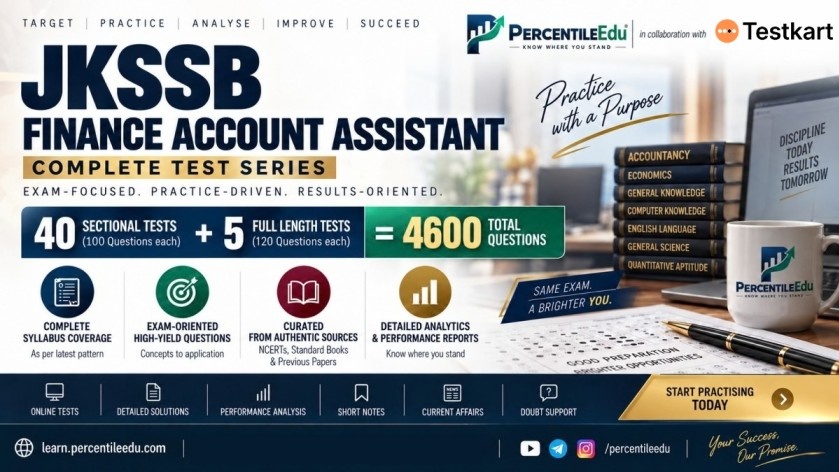
JKSSB FAA | COMPLETE TEST SERIES MASTER PLAN
TEST SERIES SUMMARY Subject-Wise Tests: 43 Tests across 8 Sections |4,250 Questions/4,250 Marks | Test-wise question distribution varies by subject. Full-Length Tests (FLTs): 6 Tests | 120 Questions.
Test series content
General Knowledge With Special Reference to J&K UT
SECTION II- ACCOUNTANCY & BOOK KEEPING
SECTION – III GENERAL ENGLISH
SECTION IV- STATISTICS
SECTION V - MATHEMATICS
SECTION VI- GENERAL ECONOMICS
SECTION VII- GENERAL SCIENCE
SECTION VIII- KNOWLEDGE OF COMPUTERS
SECTION IX - Full-Length Tests
Top performers
What you'll master
Requirements
- Finish JKSSB Accountancy topics like journal and BRS before attempting ACC tests
- Keep NCERT Math and Statistics basics ready before numerical test sections
- Attempt FLTs only after covering all 8 subjects and basic MS Office topics
- Use a laptop or tablet with stable internet for timed online mock tests
Description
PERCENTILEEDU
JKSSB ACCOUNTS ASSISTANT (FINANCE) 2026
COMPLETE TEST SERIES | STUDENT PREPARATION PLANNER
KNOW WHERE YOU STAND.
Prepare with purpose. Practise with precision. Measure your progress.
WELCOME TO PERCENTILEEDU
Dear Aspirant,
Welcome to the PercentileEdu JKSSB Accounts Assistant (Finance) 2026 Complete Test Series.
A competitive examination demands more than completing the syllabus. It requires conceptual understanding, regular practice, accuracy under pressure, and the ability to distinguish between closely competing answer choices.
With this objective, the PercentileEdu Academic Team has structured a comprehensive practice programme covering all eight subjects prescribed by the Jammu & Kashmir Services Selection Board (JKSSB).
Our approach is straightforward: help you understand what you have studied, identify what you have missed, and recognise the areas where your preparation needs further attention.
The series combines subject-wise practice, numerical and application-based questions, conceptual MCQs, examination-style objective questions and full-length simulations. The emphasis is on meaningful practice rather than attempting large numbers of questions without reviewing mistakes.
Our guiding principle is simple: A test should not merely tell you how many questions you answered correctly. It should help you understand why you answered the others incorrectly.
We welcome you to a more disciplined and measurable approach to preparation.
Team PercentileEdu
1. TEST SERIES AT A GLANCE
Particulars | Programme Details |
|---|---|
Examination | JKSSB Accounts Assistant (Finance) 2026 |
Recruitment Reference | Advertisement No. 10 of 2025 |
Syllabus Reference | JKSSB Notification dated 23 December 2025 |
Subject Coverage | All 8 prescribed subjects |
Subject-Wise Tests | 43 |
Full-Length Mock Tests | 6 |
Total Tests | 49 |
Subject-Wise Questions | 4,250 |
Full-Length Questions | 720 |
Total Question Bank | 4,970 MCQs (planned total) |
Full-Length Test Duration | 120 minutes each |
Full-Length Test Marks | 120 marks each |
Examination Pattern | Objective-type MCQs with negative marking |
The programme follows a progressive structure: individual subject preparation, topic-wise evaluation, revision and full-syllabus examination practice.
2. OFFICIAL EXAMINATION PATTERN
All six full-length tests are designed around the subject-wise marks prescribed in the JKSSB syllabus.
Subject | Questions | Marks |
|---|---|---|
General Knowledge with Special Reference to J&K UT | 30 | 30 |
Accountancy & Book Keeping | 30 | 30 |
General English | 10 | 10 |
Statistics | 10 | 10 |
Mathematics | 10 | 10 |
General Economics | 10 | 10 |
General Science | 10 | 10 |
Knowledge of Computers | 10 | 10 |
TOTAL | 120 | 120 |
Time Allowed: 120 minutes
Correct Answer: +1 mark
Incorrect Answer: −0.25 mark
Unattempted Question: 0 marks
The subject distribution reflects the notified syllabus. Particular emphasis is placed on General Knowledge and Accountancy, which together constitute 50% of the examination.
3. SUBJECT-WISE TEST SERIES BREAKUP
Section | Subject | Tests | Questions | Time (Min) |
|---|---|---|---|---|
I | General Knowledge with J&K UT | 5 | 770 | 770 |
II | Accountancy & Book Keeping | 5 | 500 | 500 |
III | General English | 5 | 300 | 300 |
IV | Statistics | 5 | 500 | 500 |
V | Mathematics | 5 | 500 | 500 |
VI | General Economics | 6 | 560 | 560 |
VII | General Science | 6 | 560 | 560 |
VIII | Knowledge of Computers | 6 | 560 | 560 |
IX | Full-Length Mock Tests | 6 | 720 | 720 |
TOTAL | 49 | 4,970 |
4. DETAILED SUBJECT-WISE TEST PLANNER
SECTION I — GENERAL KNOWLEDGE WITH SPECIAL REFERENCE TO J&K UT
5 Tests | 770 Questions | 30 Marks in the Main Examination
Test Code | Test Title | Principal Coverage |
|---|---|---|
GK 01 | Physical & Political Geography | World and Indian geography, physical divisions, rivers, lakes, weather, climate, crops and transport |
GK 02 | Indian Culture, Heritage & Freedom Movement | Indian art, architecture, cultural traditions, British expansion, freedom struggle, national movement and independence |
GK 03 | Demography, Communication & Environment | Census, population, communication, ecology, biodiversity, pollution and environmental conservation |
GK 04 | Jammu & Kashmir UT | History, geography, economy, heritage, culture, flora, fauna, rivers, lakes and tourist destinations |
GK 05 | J&K Reorganisation & Current Affairs | J&K Reorganisation Act, 2019, constitutional and administrative developments, national, international and J&K current affairs |
Reference Base: NCERT Geography and History, JKBOSE publications, Lucent General Knowledge, Indian Census publications, J&K Economic Survey and Statistical Digest, relevant government reports, India Year Book, official legislation and government information portals.
Preparation Focus: Factual accuracy, chronology, geography-based comparisons, statement-based questions, matching, administrative developments and important current events.
SECTION II — ACCOUNTANCY & BOOK KEEPING
5 Tests | 500 Questions | 30 Marks in the Main Examination
Test Code | Test Title | Principal Coverage |
|---|---|---|
ACC 01 | Accounting Fundamentals & Journal | Accounting principles, terminology, accounting equation, double-entry system, rules of debit and credit, journal entries |
ACC 02 | Ledger, Cash Book, Trial Balance & BRS | Ledger posting, cash book, vouchers, trial balance, bank reconciliation, errors and rectification |
ACC 03 | Final Accounts & Financial Statements | Trading Account, Profit & Loss Account, Balance Sheet, adjustments, depreciation and financial statement analysis |
ACC 04 | Partnership, Audit & Social Accounting | Partnership accounts, financial audit, social accounting, social audit, cash-based and single-entry accounting |
ACC 05 | Government Finance, Taxation & Cost Accounting | PFMS, Indian financial management system, direct and indirect taxation, GST fundamentals, cost accounting, budgetary control and accounting developments |
Reference Base: NCERT Accountancy XI–XII, T.S. Grewal, D.K. Goel, ICAI Foundation material, CGA/CAG publications, PFMS resources, Ministry of Finance and official taxation resources.
Preparation Focus: Numerical accuracy, practical journal and ledger entries, debit-credit identification, accounting tables, BRS adjustments, statement preparation and conceptual understanding.
SECTION III — GENERAL ENGLISH
5 Tests | 300 Questions | 10 Marks in the Main Examination
Test Code | Test Title | Principal Coverage |
|---|---|---|
ENG 01 | Tenses, Articles & Modals | Rules, contextual application, exceptions, error identification and sentence completion |
ENG 02 | Clauses, Voice & Narration | Clause structures, active/passive transformation, direct/indirect speech |
ENG 03 | Pronouns, Prepositions & Confusing Words | Pronoun usage, preposition rules, homophones, homonyms and commonly confused expressions |
ENG 04 | Vocabulary, Idioms & Phrases | Synonyms, antonyms, idioms, phrasal expressions and correct contextual usage |
ENG 05 | Sentence Arrangement, Cloze & Integrated Practice | Jumbled sentences, fill-in-the-blanks, grammar integration and mixed examination practice |
Reference Base: Wren & Martin, S.P. Bakshi's Objective General English, standard school-level grammar texts and examination-oriented English practice resources.
Preparation Focus: Grammar application rather than memorising isolated rules, vocabulary in context and avoiding common grammatical traps.
SECTION IV — STATISTICS
5 Tests | 500 Questions | 10 Marks in the Main Examination
Test Code | Test Title | Principal Coverage |
|---|---|---|
STAT 01 | Data Collection & Questionnaires | Primary and secondary data, collection methods, sources, questionnaires, census and sampling fundamentals |
STAT 02 | Tabulation & Central Tendency | Data classification, compilation, tables, mean, median, mode and applications |
STAT 03 | Theory of Probability | Probability principles, events, conditional probability, elementary applications and expectation |
STAT 04 | Attributes & Index Numbers | Theory of attributes, classification, association, index-number construction, tests, CPI and WPI |
STAT 05 | Demography & Vital Statistics | Census, population measures, fertility rates, mortality rates and reproduction measures |
Reference Base: S.P. Gupta's Statistical Methods, standard Business Statistics texts, NCERT Statistics, MOSPI, Census publications and official statistical resources.
Preparation Focus: Formula application, tabular data interpretation, correct method selection, numerical problems and statistical terminology.
SECTION V — MATHEMATICS
5 Tests | 500 Questions | 10 Marks in the Main Examination
Test Code | Test Title | Principal Coverage |
|---|---|---|
MATH 01 | Interest & Linear Equations | Simple and compound interest, linear equations in two variables and practical applications |
MATH 02 | Permutations, Combinations & Binomial Theorem | Counting principles, arrangements, selections, binomial expansion and general terms |
MATH 03 | Limits & Derivatives | Fundamental limits, continuity basics, differentiation rules and elementary applications |
MATH 04 | Sets, Relations, Functions, Matrices & Determinants | Set operations, relations, functions, matrix operations and determinants |
MATH 05 | Probability, Geometry & Vectors | Probability, coordinate geometry, three-dimensional geometry and vector fundamentals |
Reference Base: NCERT Mathematics IX–XII, R.S. Aggarwal, R.D. Sharma and standard objective mathematics exercises.
Preparation Focus: Understanding formulas, selecting appropriate methods, calculation efficiency and solving objective numerical problems within the allotted time.
SECTION VI — GENERAL ECONOMICS
6 Tests | 560 Questions | 10 Marks in the Main Examination
Test Code | Test Title | Principal Coverage |
|---|---|---|
ECO 01 | Basic Concepts, Consumer Behaviour & Demand | Economic principles, utility, demand analysis, indifference curves and consumer equilibrium |
ECO 02 | Production, Factor Pricing & Market Structures | Production laws, marginal productivity, Ricardian rent theory, perfect and imperfect competition |
ECO 03 | National Income, Growth & Development | National income concepts, measurement, economic growth, development and developing economies |
ECO 04 | Fiscal Policy, Monetary Policy & RBI | Government fiscal instruments, monetary policy, banking and RBI functions |
ECO 05 | Planning, Economic Reforms & External Sector | Planning versus market economy, Indian economic reforms, development problems and related concepts |
ECO 06 | Supplementary Economics & Mixed Practice | Economists, important books, key terminology, relevant economic developments and integrated revision |
Reference Base: NCERT Introductory Microeconomics, Macroeconomics and Indian Economic Development, H.L. Ahuja, RBI publications, Economic Survey and official economic reports.
Preparation Focus: Basic conceptual clarity, applied economic reasoning, diagrams where relevant, policy distinctions and commonly confused terminology.
SECTION VII — GENERAL SCIENCE
6 Tests | 560 Questions | 10 Marks in the Main Examination
Test Code | Test Title | Principal Coverage |
|---|---|---|
SCI 01 | Motion, Force & Electricity | Newton's laws, speed, velocity, acceleration, mass, weight, electric current, voltage, power and energy |
SCI 02 | Sources of Energy | Conventional and non-conventional sources, biomass, wind, solar, tidal energy and related applications |
SCI 03 | Chemical Reactions, Metals & Non-Metals | Chemical equations, types of reactions, physical and chemical properties |
SCI 04 | Biology, Nutrition & Human Health | Nutrition, respiration, plant transport, communicable and non-communicable diseases, vitamins |
SCI 05 | Ecosystems, Environment & Ecology | Ecosystem components, food chains, food webs, pollution, ozone layer and greenhouse effect |
SCI 06 | Supplementary Science & Mixed Practice | Everyday science, additional syllabus-linked concepts, selected scientific developments and revision |
Reference Base: NCERT Science VI–X, relevant higher-secondary fundamentals, standard General Science resources and authoritative scientific/government publications.
Preparation Focus: Everyday applications, units and measurements, scientific principles, biological functions, factual-conceptual comparisons and closely related answer choices.
SECTION VIII — KNOWLEDGE OF COMPUTERS
6 Tests | 560 Questions | 10 Marks in the Main Examination
Test Code | Test Title | Principal Coverage |
|---|---|---|
COMP 01 | Computer Fundamentals & Hardware | Computer components, CPU, memory, storage devices, peripherals and input-output devices |
COMP 02 | Software & Operating Systems | System and application software, operating systems, firmware, human-ware and open-source technology |
COMP 03 | MS Office & PDF | MS Word, Excel, Access, PowerPoint, PDF, common functions, file formats and productivity applications |
COMP 04 | Networking, Internet & Cybersecurity | Networks, internet, email, computer viruses, antivirus software and basic information security |
COMP 05 | IT in Governance & Digital Services | Information technology in governance, government digital platforms and public service delivery |
COMP 06 | Supplementary Computer Knowledge & Mixed Practice | Additional relevant applications, contemporary computing concepts, technology terminology and revision |
Reference Base: NCERT IT/Computer Science resources, standard computer-awareness texts, official Microsoft documentation, Digital India, MeitY and government IT resources.
Preparation Focus: Practical computer awareness, MS Office operations, shortcut/function recognition, closely related technical terms and government technology applications.
5. FULL-LENGTH MOCK TEST PROGRAMME
SIX COMPLETE EXAMINATION SIMULATIONS
6 Tests | 720 MCQs | 720 Marks Across All Tests
The full-length programme is intended to move candidates from separate subject preparation to integrated examination performance.
Each paper will contain 120 objective questions carrying 120 marks, with 120 minutes allowed and the exact official subject-wise weightage.
Test Code | Mock Test | Intended Evaluation Focus |
|---|---|---|
FLT 01 | Full Syllabus Mock — I | Initial full-syllabus assessment, concept retention and baseline performance |
FLT 02 | Full Syllabus Mock — II | Conceptual application, practical problem-solving and accuracy |
FLT 03 | Full Syllabus Mock — III | Integrated factual, numerical, statement and table-based questions |
FLT 04 | Full Syllabus Mock — IV | Wider syllabus coverage, close answer choices and time management |
FLT 05 | Full Syllabus Mock — V | Advanced mixed practice, decision-making and common examination traps |
FLT 06 | Final Examination Simulator | Comprehensive final assessment of preparation, speed and accuracy |
All six mock papers are planned to collectively cover important areas across the prescribed syllabus, including less frequently practised topics.
Questions will be distributed to reflect the examination's requirements, with a balance of direct factual recall, conceptual understanding, practical calculations and application-based reasoning.
6. OUR ACADEMIC APPROACH
Prepared with the examination in mind
PercentileEdu follows a subject-focused preparation approach built around three objectives:
1. Syllabus Relevance
The test programme is mapped to the JKSSB-prescribed syllabus, keeping priority on examination-relevant concepts and applications.
2. Meaningful Question Practice
The question sets are designed to include factual, conceptual, numerical, statement-based, matching, and table-oriented MCQs where appropriate. Answer choices are intended to test knowledge and understanding, rather than make the correct option obvious.
3. Learning Through Evaluation
Students are encouraged to review explanations, revisit incorrect attempts, maintain an error record and return to weak topics before proceeding to the next test.
Our aim is to make every test an opportunity for measurable academic improvement.
7. HOW TO USE THIS TEST SERIES EFFECTIVELY
Stage I — Build Your Foundation
Complete the relevant topic from your study notes or standard textbook before attempting the corresponding test. Focus on understanding definitions, rules, formulas, procedures and practical examples.
Stage II — Attempt Subject-Wise Tests
Attempt each test within its prescribed time limit, without consulting notes or answer keys. Treat every attempt as a genuine assessment.
Stage III — Analyse Your Mistakes
After completing a test, distinguish between questions answered incorrectly due to lack of knowledge, confusion between alternatives, calculation mistakes and time pressure.
Stage IV — Revise and Reattempt Weak Areas
Return to the relevant topic, revise the concept and practise additional questions. Avoid memorising answer letters without understanding the reason.
Stage V — Move to Full-Length Simulations
Once all subjects have received sufficient attention, attempt the full-length tests under examination conditions. Monitor accuracy, attempts, time management and performance across individual sections.
Remember: Your preparation is not measured only by the number of tests you attempt, but by the improvement you achieve from one test to the next.
8. STUDY MATERIAL — NOTES & PDFs
Prefer to study before attempting the tests?
Candidates who wish to supplement their practice with structured study material can explore the Notes & PDFs section available in the left-side panel of the platform.
The study material is intended to support concept building, syllabus coverage, important facts, formulas, worked examples and revision.
How to access study material:
Open the left-side navigation panel.
Select Notes & PDFs.
Browse the available subject-wise study resources.
Select the required material and purchase it separately.
Important: Notes and PDF study resources are available through separate purchases, where applicable, and are not automatically included with this test-series enrolment.
9. THE PERCENTILEEDU LEARNING ECOSYSTEM
A wider vision for competitive examination preparation
PercentileEdu is being developed as more than a collection of mock tests.
We are working towards an independent digital learning platform that brings together examination practice, structured reading resources, learning assistance and performance-focused preparation.
Our planned learning ecosystem includes:
PercentileEdu Test Series: Subject-wise assessments and full-length examination simulations.
e-Lyceum: A dedicated space for organised digital study resources and reading material.
Ask e-Vidwan: A proposed learning-assistance feature to help students clarify concepts and academic doubts.
These are part of our evolving educational platform, with new services to be introduced as they become available.
One vision. Better preparation. Measurable progress.
A FINAL WORD TO ASPIRANTS
Competitive examinations reward clarity, consistency and sound judgement.
There will be tests where you perform below your expectations. There will be questions you cannot answer, concepts you need to relearn and mistakes you may repeat before you overcome them.
What matters is how you respond to those shortcomings.
A meaningful test series helps you discover those gaps while there is still time to address them.
Study carefully. Attempt sincerely. Review your mistakes. Improve consistently.
Do not wait until the examination to discover where you stand.
PERCENTILEEDU
KNOW WHERE YOU STAND.
Your preparation. Your progress. Your percentile.
With best wishes,
TEAM PERCENTILEEDU
An Independent Competitive Examination Preparation Initiative
Disclaimer: PercentileEdu is an independent educational initiative and is not affiliated with, endorsed by or associated with the Jammu & Kashmir Services Selection Board. The official JKSSB notifications and instructions shall prevail in all examination-related matters.