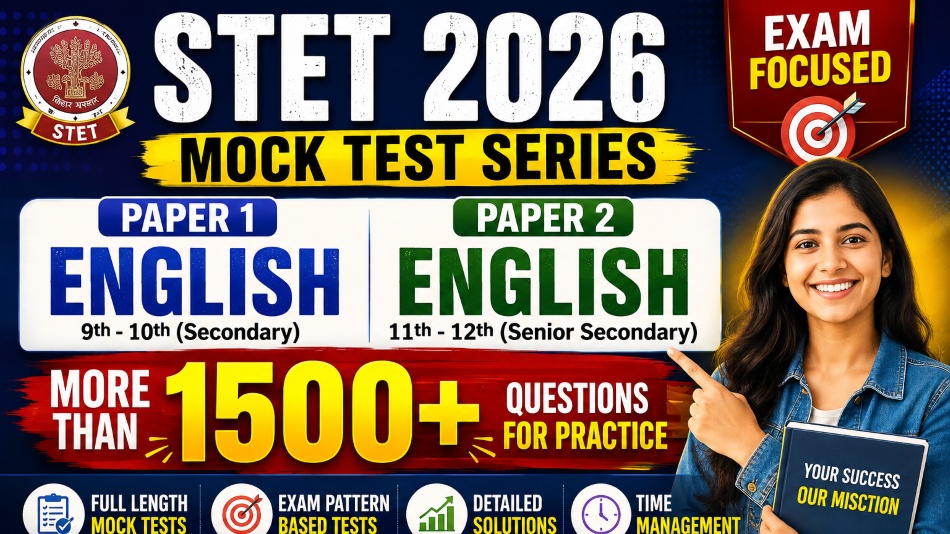
STET Paper 2 English Mock Test Series 2026
Full-length STET Paper 2 English mock tests with 150 questions, 150 marks, and 150 minutes. Practice, analyze, and improve to succeed in the exam.
Test series content
STET Paper 2 English (Test 1)
STET Paper 2 English (Test 2)
STET Paper 2 English (Test 3)
STET Paper 2 English (Full Mock Test 1)
STET Paper 2 English (Full Mock Test 2)
STET 2026 British Literature
STET 2026 Indian Writing in English
STET General
STET Paper 1 English (Test 1)
STET Paper 1 English (Test 2)
STET Paper 1 English (Test 3)
STET Paper 1 English (Test 4)
Top performers
Description
Bihar STET Paper 2 and Paper 1 English Test Series 2026
Complete Syllabus-Based Mock Tests | Full Preparation for English Subject
📚 English Description
Bihar STET Paper 2 and Paper 1 English Test Series is a comprehensive, syllabus-oriented test series designed especially for candidates preparing for the Bihar Secondary Teacher Eligibility Test (STET) Paper 2 and Paper 1 – English.
This test series has been carefully prepared according to the prescribed STET English syllabus and covers the major areas of English Literature, Language, Linguistics, Grammar, Literary Criticism, Literary Theory, English Language Teaching, and Teaching Aptitude.
The objective of this test series is not only to help you practice questions but also to develop your conceptual understanding, literary knowledge, accuracy, speed, and exam-oriented problem-solving ability.
🎯 Major Areas Covered
The test series covers the following important sections:
1. British Poetry
History of British Poetry
Spenser
William Shakespeare
John Donne
Alexander Pope
William Blake
William Wordsworth
P. B. Shelley
John Keats
Alfred Lord Tennyson
Matthew Arnold
W. B. Yeats
T. S. Eliot
Philip Larkin
Seamus Heaney
Prescribed poems and their important themes, literary features and concepts.
2. British Drama
History of British Drama
Christopher Marlowe – Doctor Faustus
William Shakespeare – Macbeth
Aphra Behn – The Rover
William Congreve – Love for Love
Oscar Wilde – The Importance of Being Earnest
G. B. Shaw – Candida
John Galsworthy – Justice
T. S. Eliot – Murder in the Cathedral
John Osborne – Look Back in Anger
Samuel Beckett – Waiting for Godot
3. British Prose & Fiction
History of Prose and Fiction
Daniel Defoe – Robinson Crusoe
Jane Austen – Pride and Prejudice
Charles Dickens – A Tale of Two Cities
Emily Brontë – Wuthering Heights
George Eliot – Silas Marner
Thomas Hardy – The Mayor of Casterbridge
D. H. Lawrence – The Fox and The White Stocking
Francis Bacon – Of Studies
E. M. Forster – What I Believe
A. G. Gardiner – On Saying Please
4. British Literary Criticism
History of Literary Criticism
Philip Sidney – An Apology for Poetry
Alexander Pope – An Essay on Criticism
Samuel Johnson – Preface to Shakespeare
William Wordsworth – Preface to Lyrical Ballads
Matthew Arnold – The Study of Poetry
T. S. Eliot – The Function of Criticism
5. Indian English Poetry
Derozio
Toru Dutt
Rabindranath Tagore
Sarojini Naidu
Kamala Das
Nissim Ezekiel
A. K. Ramanujan
Arun Kolatkar
Vikram Seth
Sujata Bhatt
Eunice de Souza
Gurudas Mukherjee
Agha Shahid Ali
Tabish Khair
6. Indian Drama
History of Indian Drama
Kalidasa – Abhijanashakuntalam
Shudraka – Mrichhakatikam
Vijay Tendulkar – Silence! The Court is in Session
Girish Karnad – Hayavadana
Mahesh Dattani – Final Solutions
7. Indian Prose & Fiction
Prescribed essays and stories by important writers including:
R. N. Tagore
Pandita Ramabai
Swami Vivekanand
M. K. Gandhi
J. L. Nehru
S. C. Bose
Rajendra Prasad
Salim Ali
Jai Prakash Narayan
A. P. J. Abdul Kalam
M. R. Anand
R. K. Narayan
Ruskin Bond
Jhumpa Lahiri
Shashi Deshpande
Khushwant Singh
Bhabani Bhattacharya
8. American Literature
Tennessee Williams – The Glass Menagerie
Toni Morrison – Beloved
Edgar Allan Poe – The Purloined Letter
O. Henry – The Last Leaf
F. Scott Fitzgerald – The Crack-up
William Faulkner – Dry September
Anne Bradstreet – The Prologue
Walt Whitman – selected poems
Sherman Alexie – Crow Testament, Evolution
Robert Frost – The Road Not Taken and Stopping by Woods on a Snowy Evening
9. Post-Colonial Literature
Introduction to Postcolonial Literature
Colonial and Postcolonial concepts
Postcolonial Theory and salient features
Pablo Neruda
Derek Walcott
A. K. Ramanujan
Gabriel Okara
David Malouf
Badal Sircar
Chinua Achebe – Things Fall Apart
Raja Rao – Kanthapura
10. Language & Linguistics
Definition and features of language
Language varieties
Dialect, Register and Standard Language
Language Change
Old, Middle and Modern English
Phonetics and Phonology
Organs of Speech
Vowels and Consonants
Phonemes
Syllables
Stress and Intonation
Morphology
Morphemes and Allomorphs
Word Formation
Oral Practice and Language Laboratory techniques
11. Grammar & Vocabulary
Parts of Speech
Subject-Verb Agreement
Time and Tense
Modal Auxiliaries
Voice
Narration
Degree of Adjective
Question Tags
Common Errors
Synonyms & Antonyms
Idioms & Phrases
Proverbs
12. Literary Terms
Important literary and critical terms including:
Alliteration, Allegory, Anaphora, Allusion, Antithesis, Chiasmus, Hyperbole, Metaphor, Onomatopoeia, Malapropism, Euphemism, Affective Fallacy, Intentional Fallacy, Irony, Litotes, Pathetic Fallacy, Oxymoron, Personification, Synecdoche, Simile, Satire, Soliloquy and Zeugma.
13. English Language Teaching (ELT)
Knowing the Learner
Bloom’s Taxonomy
Multiple Intelligences
Learning Disabilities
Socio-economic and cultural contexts
Learning and participation styles
Cooperative Learning
IT/Device-Based Teaching
LSRW Skills
Teaching Vocabulary
Teaching Grammar
Teaching Poetry and Prose
Lesson Planning
Error Identification and Correction
Language Proficiency
Formative, Summative and Project-Based Assessment
ICT in Language Teaching
14. Contemporary Criticism & Literary Theory
Questions based on:
New Criticism
Psychoanalytical Criticism
Colonialism
Postcolonialism
Marxism
Feminism
Structuralism
Post-Structuralism
New Historicism
Ecocriticism
Ecofeminism
Postmodernism
15. Literature of the Marginalised
Dalit Literature
Bama – Karukku
Omprakash Valmiki – Joothan
Tribal Literature
Mamang Dai – The Black Hill
Temsula Ao – Laburnum for My Head
African-American Literature
Alice Walker – The Color Purple
Ralph Ellison – Invisible Man
👨🏫 Art of Teaching & Other Skills
The test series also takes into account Unit II – Art of Teaching and Other Skills, including:
Teaching & Learning
Teaching Objectives
Instructional Objectives
Bloom’s Taxonomy
Teaching Methods
Lesson Planning
Microteaching
Instructional Analysis
Effective Classroom Ecosystem
Textbook & Library
Qualities of a Teacher
Evaluation & Assessment
Curriculum
Factors Affecting Teaching & Learning
Teaching Aids
Hands-on Learning
General Knowledge
Environmental Science
Mathematical Aptitude
Logical Reasoning
⭐ Why You Should Attempt This Test Series?
✔ Completely syllabus-oriented preparation
✔ Covers Literature + Language + Linguistics + ELT + Teaching
✔ Practice questions from important authors, poets, texts and concepts
✔ Helps identify your strong and weak areas
✔ Improves speed and accuracy
✔ Builds confidence for the actual examination
✔ Useful for revision and repeated practice
✔ Designed for serious Bihar STET Paper 2 English aspirants
🎯 Who Should Join?
This test series is ideal for:
Bihar STET Paper 2 and Paper 1 English aspirants
Candidates preparing for the English subject paper
Students revising English Literature
Candidates who want systematic syllabus-wise practice
Aspirants looking to improve their accuracy and exam performance
📌 Preparation Strategy
Study → Practice → Analyse → Revise → Repeat
Attempt every test seriously, analyse your mistakes, revise the concepts behind incorrect answers and regularly retake important topics. Consistent practice will help you convert your literary knowledge into exam-ready performance.
Prepare Smart. Practice Regularly. Improve Your Score.