

Pricing an online course or mock test series is one of the most stressful decisions an educator faces. Price too high, and students click away to a cheaper competitor. Price too low, and you risk looking low-quality while stuck chasing volume just to cover your time.
In India's competitive EdTech space, where platforms like Testkart let you sell courses, live mock tests, and handwritten notes directly to students, your pricing isn't just a revenue decision. It's part of how students judge your credibility before they've even opened your test.
Here are five pricing models that help you earn fairly, attract serious students, and stop competing purely on "who's cheapest."
The Hidden Psychology of EdTech Pricing
Before picking a model, it helps to understand one thing: students aren't buying a PDF or a set of questions. They're buying a better shot at selection.
A student preparing for UPSC, SSC CGL, Banking, or a State PSC exam isn't counting how many mock tests are in your bundle they're judging whether your test series will actually move their score. That changes how they read your price.
When you price something too low say, a 50-test bundle for ₹49 it can unintentionally signal that the content isn't serious. A fair, clearly justified price, on the other hand, builds trust before the student even starts the first test, which tends to show up later as better completion rates and fewer refund requests..
1. The Good-Better-Best Tiered Bundling Strategy
Instead of one flat-priced package, give students three options. This is sometimes called the "good-better-best" model, and it works because it changes the question in a student's head from "should I buy this?" to "which of these fits my budget?"
How to structure your tiers
Example structure — adjust the content and prices to match your own test series:
Tier Level | Package Name | Includes | Recommended Price Point |
Tier 1 (Base) | Essential Test Pack | 10 Mock Tests + Auto Analysis | ₹299 |
Tier 2 (Target) | Complete Exam Pass | 25 Mock Tests + Sectional Tests + PDF Notes | ₹699 (Best Value) |
Tier 3 (Premium) | Mastery Bundle | Everything in Tier 2 + 5 Live Video Doubt Sessions | ₹1,499 |
Why This Prevents Student Drop-Off
With a single price point, a hesitant student's only choice is yes or no and "no" is easy. With three tiers, you keep cost-sensitive students at the base level instead of losing them entirely, while still giving serious aspirants a premium option to opt int
2. Use Anchor Pricing to Show Students What They're Really Getting
Price perception is relative. A ₹499 test series might feel expensive on its own, but it feels like an absolute bargain when placed next to a ₹2,000 anchor price.
How to Implement Price Anchoring
Calculate the True Value: Sum up the individual values of every component in your package.
15 Full-Length Mock Tests = ₹1,500
Chapter-wise Handwritten Notes = ₹500
Previous Year Solved Papers = ₹300
Total Value = ₹2,300
Set the Retail Anchor: List the regular price as ₹2,299.
Offer the Bundle Price: Sell the entire package on Testkart for ₹699.
Pro Tip: Always explain why the discount exists (e.g., "Early Bird Exam Special," "Batch Launch Offer," or "Festival Offer"). Unexplained massive discounts raise suspicion regarding quality.
3. The Freemium Hook Strategy (Free Mock to Paid Upsell)
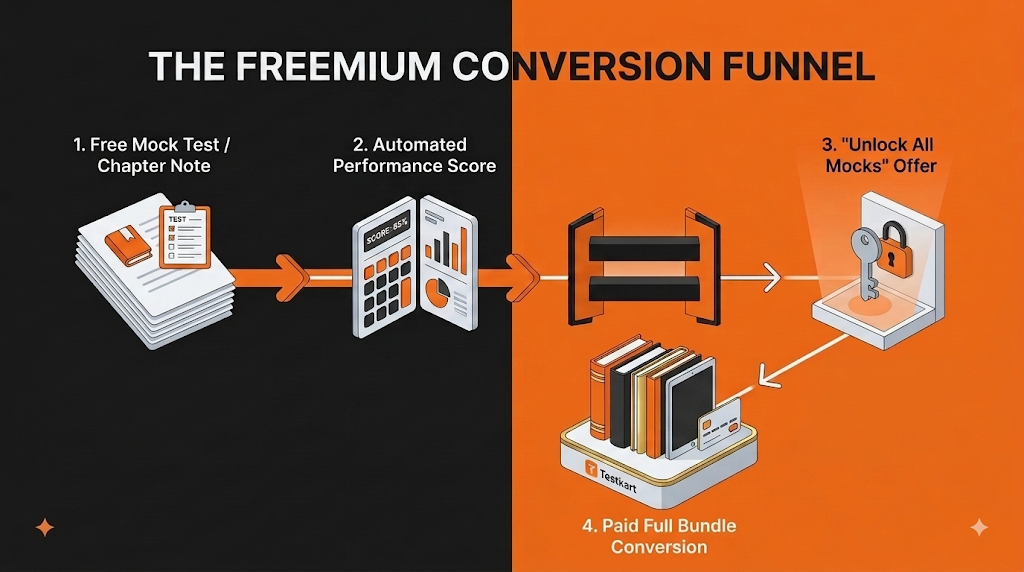
The hardest part of selling online education is getting a student to enter their payment details for the first time. The Freemium Strategy eliminates initial friction completely.
Step-by-Step Execution
Publish one genuinely strong mock test or one summary note completely free on Testkart make it your best work, not a watered-down teaser.
Let the student complete it and see their performance report.
At the end of that report, offer a clear next step: "Scored well? Unlock the remaining 20 full-length mocks and performance analytics for ₹499."
Because the student has already experienced your test environment and question quality firsthand, this converts far better than asking someone to pay before they've seen anything.
4. Reward Early Buyers With Time-Limited Pricing
Students tend to procrastinate many wait until two weeks before an exam to buy a test series, which makes revenue unpredictable for tutors. Early-bird pricing adds gentle urgency and spreads out your sales.
Dynamic Pricing introduces Urgency (FOMO) to accelerate purchase decisions.
How to Run an Early-Bird Campaign
Phase 1 (First 50 Students): ₹399 (Launch Special)
Phase 2 (Next 100 Students): ₹599 (Standard Price)
Phase 3 (Final 2 Weeks Before Exam): ₹899 (Last-Minute Prep Pass)
By clearly stating "Price increases to ₹599 after the first 50 seats are filled," you trigger immediate action from serious aspirants who want the best deal possible.
5. Subject-Wise Micro-Pricing (Catching Niche Buyers)
Not every student needs a full, 100-test mega bundle. Many students are strong in quantitative aptitude but struggle with Reasoning, General Awareness, or Specific State GK.If you only sell a massive ₹1,500 all-in-one bundle, you lose students who only want help in one weak area to competitors who offer smaller packs.
Breaking your content into smaller, affordable packs
All-in-One Full Exam Series: ₹999
Quantitative Aptitude Only Pack: ₹199
State Specific GK Notes & Tests: ₹149
Micro-pricing acts as an entry point. Once a student buys your ₹149 State GK pack and loves it, up-selling them to your full ₹999 master bundle becomes significantly easier.
A Quick Checklist Before You Publish Your Next Price
Before publishing your next course or test series on Testkart, run through this quick checklist:
Have you added a free sample test or chapter note to build initial trust?
Are you offering at least two pricing tiers?
Is your anchor (strike-through) price honestly calculated and clearly shown?
Does your offer include a deadline or seat limit to create healthy urgency?
Do you have a low-cost, subject-specific pack for students with one weak area?
By structuring your pricing strategically instead of competing in a race to the bottom, you preserve your brand value, outsmart cheap competitors, and build a sustainable online teaching income.
Ready to put these pricing strategies to work? Create your free Teacher Account on Testkart today, upload your first test series, and start earning what your content is really worth.
Frequently Asked Questions
How much should I charge for an online test series?
It depends on the exam and what's included, but most creators start a base pack around ₹199–₹399 and a full bundle around ₹699–₹999.
Is it better to price low or price high?
Neither extreme works well. Very low pricing can signal poor quality; price fairly and back it with a visible anchor price instead.
Should I offer a free trial or free test?
Yes. One strong free test lets students try your quality before paying, which makes the first purchase much easier.
4.How do I price a bundle with notes, tests, and video sessions?
Price each item separately, add them up as your anchor price, then offer the full bundle at a lower combined rate.
What's a good starting price for a new teacher on Testkart?
Start slightly lower to build reviews, then raise prices once you have steady demand.
Comments (0)
Please log in to join the discussion.
Log In to CommentNo comments yet. Be the first to share your thoughts!