
SSC CGL 2026: Overview, Syallabus, Latest Updates, Mock Tests & Other Resources
The SSC CGL (Staff Selection Commission – Combined Graduate Level) Examination is a national-level competitive exam conducted annually in India to recruit staff for Group "B" and Group "C" non-technical posts across various central government ministries, departments, and organizations.
SSC CGL Study Material
Mock Tests
View allSSC CGL Tier 1 Full-Length Mock Test Series (English & Hindi)

Free
SSC General Intelligence & Reasoning Mock Test 20 Questions
Free
English Language Full Mock Test for Competitive Exams
Free
SSC CGL CURRENT AFFAIRS AND POLITICS MOST IMPORTANT QUESTION
Free
Ancient History Mock Test [250 MCQ (Hindi Medium)] for SSC GD, SSC CGL, SSC MTS, SSC GD, RRB, Police, UPPSC, Banking, CTET/TETNDA/CDS and other competitive exam
₹9
SSC Reasoning: 1000 अति महत्वपूर्ण प्रश्न | SSC GD, CHSL
₹50₹20
Study Notes
View allM. Laxmikanth Indian Polity Handwritten Notes Hindi PDF
380 pages · 8 files₹59
Numbers Chapter Maths Notes for Competitive Exams
17 pagesFree
CBSE Class 10 Science Practice Paper 2026-27
13 pages₹10
Complete Ratio & Proportion Handwritten Notes (SSC CGL/CHSL)
15 pages₹19
SSC CGL Mathematics Concept Notes | Complete Maths Study Material
350 pages₹99
General Awareness Previous Year Questions for All SSC Exams (till 2024) – Subject-wise & Topic-wise with Answer Key & Detailed Solutions
523 pages₹9
Bundles
View allIndian History GK Presentation PDF Bundle | Ancient, Medieval and Modern

3 itemsSave 14%₹63₹54
All Competitive Exams VVI MCQ Question Bank in hindi medium
56 itemsSave 84%₹32,045₹4,999
UPSC All Exams Complete Test Series Bundle PDF
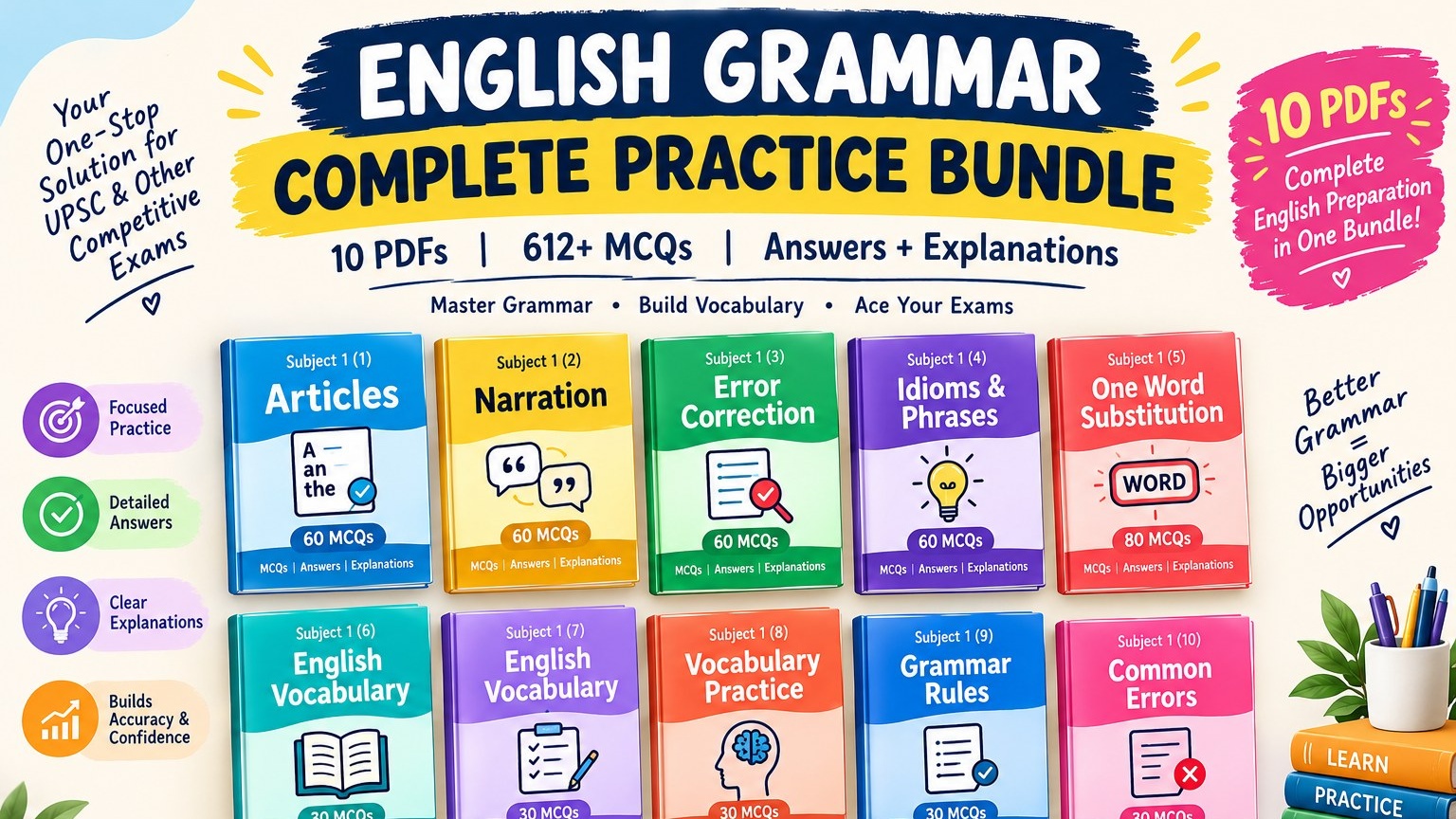
12 itemsSave 53%₹631₹299
All-in-One Exam Preparation Bundle with Notes, Tests & Courses
10 itemsSave 29%₹1,400₹999
Reasoning & Quantitative Aptitude Test Series Bundle

3 itemsSave 25%₹40₹30
COMPLETE Ancient Indian History Master Notes Bundle | UPSC & UGC NET

12 itemsSave 45%₹183₹100
The Staff Selection Commission’s Combined Graduate Level Examination (SSC CGL) recruits graduates for Group B and Group C jobs across central government ministries, departments and organisations. One examination can lead to several kinds of work, from administration and tax to audit, accounts and statistics. Your options depend on the qualifications you hold, the posts you choose and how you perform in the relevant papers.
For the 2026 cycle, start with two facts that change how you prepare: Tier I gives each subject its own 15-minute timer, and Tier II includes a separate Finance and Economics paper for candidates shortlisted for Assistant Audit Officer or Assistant Accounts Officer. If you have already taken Tier I, use the waiting period to start Paper I practice and check whether you also need a specialist paper.
2026 application and exam status
The application and correction windows for 2026 have closed. SSC reopened applications until 25 June 2026, with payment due by 26 June and the correction window running from 1 to 3 July. Where the main notice tied an eligibility condition to the application closing date, the reopening notice moved that reference to 25 June. The separately stated 1 August 2026 date for age and educational qualifications still applies.
SSC’s later Tier I notice gave a schedule of 30 September to 30 October 2026. The main notice listed December 2026 as the tentative period for Tier II. Use the SSC notice board and your candidate login for confirmed dates, shortlist details and admission certificates. The main notice advertised about 12,256 tentative vacancies; check SSC’s latest post and category breakdown before relying on that number or ranking jobs.
Which jobs can you get through SSC CGL?
Assistant Section Officer posts can involve drafting, examining files and coordinating work across offices. Tax inspector posts can combine casework and office duties with field assignments, depending on the department and posting. Sub-Inspector posts may involve investigative work and have physical or medical requirements. Auditor, Accountant and Divisional Accountant posts suit candidates interested in records, expenditure or financial checks. Junior Statistical Officer and Statistical Investigator Grade II posts are options for candidates who meet the specialist degree requirements.
The 2026 notice also lists Assistant Audit Officer and Assistant Accounts Officer posts. Read the exact cadre entry: state cadre posts can require proof of proficiency in the state’s regional or official language at matriculation level. The notice distinguishes essential qualifications from desirable professional or postgraduate credentials and describes a departmental examination during probation for these officer roles.
When comparing posts, consider the work, likely locations, pay level and any physical, medical, language or computer standards. Two posts at the same pay level can have very different duties and posting patterns. Keep a shortlist of posts you would accept and make a note of the evidence you would need for each.
Eligibility: check the post before you apply
Most posts require a recognised bachelor’s degree or equivalent. Final-year candidates could apply if they obtained the essential qualification by 1 August 2026. Check that you can prove when you qualified, especially if your final marksheet or degree certificate was issued later. Candidates with a distance or online qualification should check recognition for the relevant programme and period and keep any supporting evidence required by the notice.
- Junior Statistical Officer: A recognised bachelor’s degree with at least 60% in Mathematics at Class 12 level, or a recognised bachelor’s degree with Statistics as a degree subject.
- Statistical Investigator Grade II: A recognised bachelor’s degree in one of the subjects specified in paragraph 8.3. The list includes Statistics, Mathematics, Economics, Demography, Population Studies, Operations Research, and specified computing and data disciplines. Check your degree title against the actual list.
- Assistant Audit Officer and Assistant Accounts Officer: Check the relevant cadre entry for the degree requirement, language evidence where applicable, and other conditions.
Post age bands include 18–27, 20–30, 18–30 and 18–32, measured on 1 August 2026. Use the birth-date range for your post and the date on your matriculation certificate. Upper age relaxations include five years for SC/ST and three years for OBC; the notice gives separate provisions for persons with benchmark disabilities, eligible ex-servicemen and other specified groups. Also check the nationality rules and any certificate of eligibility they require. If claiming reservation, verify the certificate format, applicable dates and category rules early.
Tier I: four subjects, four timers
Tier I is an objective computer-based screening examination. Reasoning, General Awareness, Quantitative Aptitude and English Comprehension each have 25 questions worth 50 marks. That makes 100 questions and 200 marks in total. A correct answer earns two marks and a wrong answer costs 0.50 marks. The standard duration is 60 minutes, split into 15 minutes per subject. Candidates eligible for the compensatory timing specified in the notice have 20 minutes per subject.
Practise as if each section were a separate test. Finishing English early gives you time to review English within its timer; it does not give you more time for mathematics. An older paper can still provide useful questions if you set four separate clocks. Tier I marks determine shortlisting for Tier II, with separate cutoffs for the specialist post streams and for other posts. Tier I marks do not enter final merit.
Tier II: common paper and specialist papers
Paper I is compulsory for all posts. Its first session lasts 2 hours and 15 minutes under standard timings. Mathematical Abilities and Reasoning each have 30 questions and 30 minutes. English has 45 questions and 40 minutes; General Awareness has 25 questions and 20 minutes. The Computer Knowledge Test has 20 questions and 15 minutes. Each correct objective response earns three marks and each wrong one costs one mark.
After a break for re-registration, Session II consists of the Data Entry Speed Test (DEST). The standard test allows 15 minutes for a passage of about 2,000 keystrokes. The computer test and DEST are qualifying components, and SSC can set higher standards for posts that prescribe them. You must qualify the sections of Paper I separately. If eligible for compensatory time, follow the timings for each subject and session in paragraph 13.9 rather than extending a practice test by a single block of time.
Paper II is Statistics. It is for candidates who applied for and are shortlisted for Junior Statistical Officer or Statistical Investigator Grade II. Paper III is General Studies (Finance and Economics). It is for candidates shortlisted for Assistant Audit Officer or Assistant Accounts Officer. Each specialist paper has 100 objective questions, 200 marks and a standard duration of two hours. A wrong answer costs 0.50 marks. SSC may hold these papers in separate shifts or on separate days. Check the shortlist and your admission certificate for the papers you need to sit.
What to study
Maths: Start with percentages, ratios, averages, profit and loss, interest, time and work, and speed and distance. Move on to algebra, geometry, mensuration and trigonometry. For Tier II, also practise interpreting charts and working with elementary statistics and probability. Keep a short formula sheet and write down when a formula applies, so you can recognise a problem even when its wording changes.
Reasoning: Work through analogies, classification, series, coding, spatial problems, and verbal and non-verbal patterns. When you review an error, identify the clue you missed and explain why the alternative pattern fails. English: Cover grammar, vocabulary, sentence correction, cloze passages and reading comprehension. Review a passage by locating the words that support each answer, particularly when two options sound plausible.
General Awareness: Build a base in history, geography, polity, economics and science, and add current events in short, regular sessions. Test recall with questions before rereading notes. Computer knowledge: Review basic hardware and software, operating systems, office applications, internet and email, networking and cyber security. Practise using a keyboard regularly so the data entry test feels familiar under a clock.
For Statistics, cover data presentation, averages and dispersion, probability and distributions, sampling, inference, correlation and regression, time series and index numbers. For Finance and Economics, cover accounting concepts, journals and ledgers, and financial statements. Then study demand and supply, markets, the Indian economy, money and banking, and the governance and public finance topics listed in the notice. Use paragraph 13.11 of the main notice as your topic checklist.
How the online application works
For any future application window, use the official SSC portal. Complete One-Time Registration, then open the separate CGL application. Check your name, date of birth and other details against your certificates. Fill in your qualifications, category, centre choices and any applicable accommodation details. Follow the live photograph and signature instructions in the notice and inspect the preview before submitting. The 2026 fee was ₹100, with exemptions for women, SC/ST candidates, persons with benchmark disabilities and ex-servicemen eligible for reservation.
Save your submitted form, application number and payment confirmation where applicable. Registration alone does not submit an exam application. If you applied in 2026, keep access to your login and monitor it for your next stage. When an admission certificate is issued, check the exact venue, shift, reporting time and identification requirements; a city intimation serves a different purpose.
How SSC makes the final selection
After Tier I shortlisting, final merit comes from Tier II. For most posts, the marks from Sections I and II of Paper I form the merit score, subject to passing the required sections and qualifying tests. The relevant specialist paper is added for the statistics or audit and accounts streams. A minimum qualifying mark is a floor; the competitive cutoff for a post or category can be higher.
Watch for the separate online option form. SSC uses the submitted preferences, merit and vacancies for allocation; omitting a post means you cannot be considered for it, and missing the form can exclude you from final consideration. Rank posts in the order you would actually accept them. Read the physical, medical and other eligibility conditions before choosing, since failing a post’s standard after allocation can cost you the appointment. Keep originals and required certificates ready for verification by the allotted department, and follow its instructions on any further checks.
A practical preparation plan
Begin with a timed diagnostic and record correct, wrong and unattempted answers by subject. Mark whether each error came from a knowledge gap, a misread question, a calculation slip or time pressure. Choose a short list of recurring errors to fix each week. If you lose marks on ratios, for example, review the underlying method, solve a small mixed set the next day and try a timed set later in the week. Check that the mistake stays fixed when the topic is mixed with others.
Use previous papers to learn question styles and current-pattern mocks to practise the 2026 timers. During a section, answer questions you can solve confidently first, then return to the slower ones within that subject’s time. Review net marks alongside attempts: in Tier II Paper I, three wrong answers cancel one correct answer. If you are waiting for Tier I results, train with the full Paper I session, practise a short typing passage several times a week and schedule dedicated study blocks for your specialist paper if applicable.
In the last stretch, simulate your exam sessions, including the break before DEST. Track your typing errors as carefully as your speed, and repeat passages with numbers and punctuation. Revisit frequently missed questions and rehearse what to do when a subject timer is about to expire. A good final practice week should leave you with a repeatable routine for each section and a clear list of the documents and instructions to check before exam day.