NEET UG 2027 Mock Tests, Courses & Study Notes
All India medical entrance exam for MBBS and BDS admission
NEET UG Study Material
Courses
View allComplete Vectors for Physics: JEE Main & NEET
Free
Mole Concept and Foundations of Chemistry(Animated) for NEET/JEE Main
₹149
NEET/JEE Chemistry Foundation

₹499
Bohr's Model Formulae Derivation for NEET & JEE
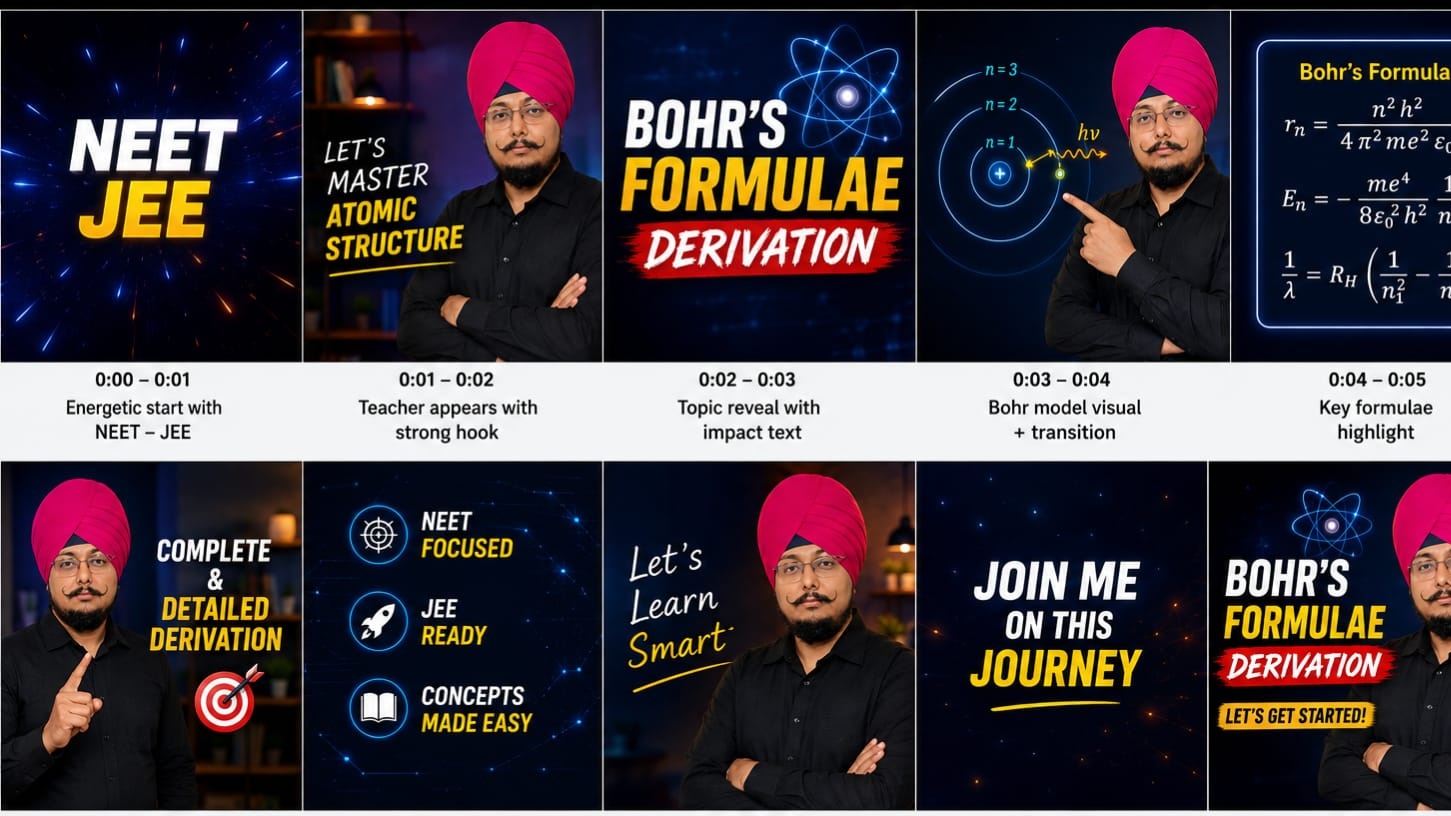
₹25
Thermodynamics Practice Questions for Chemistry
₹25
One Shot Revision: Some Basic Concepts of Chemistry (Class 11) – 6 Lessons
₹55
Mock Tests
View allNEET level mock test Series 2027

Free
NEET Unit-Wise Test Series 2026

Free
Mole Concept Modified PYQs
₹10₹5
NEET 2026 Physics Grand Test | 20 Most Expected PYQs | Re-NEET 2026 Practice Paper
₹16₹15
Chemistry Solutions Chapter Test (Handpicked Questions)
₹99₹39
NEET QP Mock test (60 Qns)
₹100₹40
Study Notes
View allNEET UG Physics Current Electricity Handwritten Short Notes
7 pages₹29
D&F BLOCK ELEMENTS AND CHEMICAL EQUILIBRIUM ALLEN KOTA Achiever Batch Notes for NEET & JEE Mains
45 pages · 2 filesFree
NEET 2027 Biology Concept Drill Lab
5 pagesFree
NEET Mole Concept Practice Questions
7 pagesFree
NEET Body Fluids and Circulation Revision Notes
9 pages₹15
Free NEET 2027 Blueprint: Physics & Chemistry
8 pagesFree
Bundles
View allUltimate NEET 2026: Physics Grand Test & Topper Revision Notes
3 itemsSave 47%₹36₹19
Ultimate Class 12 Organic Chemistry Complete Notes | NEET & Boards
6 itemsSave 90%₹1,354₹129
NEET Physical Chemistry Complete Notes Bundle

8 itemsSave 50%₹802₹399
Complete NEET Organic Chemistry Notes Bundle

7 itemsSave 50%₹703₹351
NEET Inorganic Chemistry Complete Notes Bundle

6 itemsSave 50%₹694₹349
Complete Exam Preparation Bundle: Notes, Mock Tests & Practice Papers

6 itemsSave 26%₹134₹99
NEET UG (National Eligibility cum Entrance Test, Undergraduate) is the single national entrance examination for admission to MBBS, BDS, BAMS, BUMS, BSMS and BHMS courses in India. It is conducted by the National Testing Agency (NTA) and is also used for admission to B.Sc (Hons) Nursing and to the 15% All India Quota seats in BVSc & AH programmes recognised by the Veterinary Council of India. If you want to become a doctor, dentist or AYUSH practitioner through a government or recognised private college, this is the exam that decides your seat. This page gives you the complete overview, and links to detailed guides on NEET UG eligibility, the NEET UG exam pattern and the NEET UG syllabus.
The 2026 cycle was an eventful one. The exam was held on 3 May 2026 and was re-conducted on 21 June 2026. The result and final answer key were released on 16 July 2026. Dates for NEET UG 2027 have not been announced yet, so anything you read about 2027 dates on unofficial sites should be treated as a guess until NTA publishes the notice on neet.nta.nic.in.
What is on this page
What is NEET UG?
Before NEET, medical aspirants had to appear in separate entrance exams for different states and institutes. NEET UG replaced most of these with one national test, so that a single score can be used for seats across the country. The exam tests your understanding of Physics, Chemistry and Biology (Botany and Zoology) at the Class 11 and Class 12 level.
Your NEET UG score is used in three ways. It decides whether you are qualified, it fixes your All India Rank, and it is the basis for counselling, where seats are actually allotted. A qualifying result alone does not guarantee admission, because seats are limited and depend on rank, category, choices filled and the round of counselling.
Courses that use NEET UG
Course | Full form | Field |
|---|---|---|
MBBS | Bachelor of Medicine and Bachelor of Surgery | Modern medicine |
BDS | Bachelor of Dental Surgery | Dentistry |
BAMS | Bachelor of Ayurvedic Medicine and Surgery | Ayurveda |
BUMS | Bachelor of Unani Medicine and Surgery | Unani |
BSMS | Bachelor of Siddha Medicine and Surgery | Siddha |
BHMS | Bachelor of Homoeopathic Medicine and Surgery | Homoeopathy |
B.Sc (Hons) Nursing | Bachelor of Science (Honours) in Nursing | Nursing |
BVSc & AH | Bachelor of Veterinary Science and Animal Husbandry | Veterinary (15% All India Quota) |
NEET UG
Particular | Details |
|---|---|
Exam name | NEET (UG) |
Conducting body | National Testing Agency (NTA) |
Official website | neet.nta.nic.in |
Level | National |
Mode | Pen and paper (OMR based) |
Subjects | Physics, Chemistry, Biology (Botany and Zoology) |
Questions | 180 compulsory multiple-choice questions |
Total marks | 720 |
Duration | 3 hours (2 PM to 5 PM) |
Minimum age | 17 years by 31 December of the admission year |
Frequency | Once a year |
Latest updates: NEET UG 2026 cycle
The main points from the 2026 cycle, as per the NTA press release dated 16 July 2026 and the Information Bulletin, are these:
Exam dates: The exam was conducted on 3 May 2026 and re-conducted on 21 June 2026. A fee refund provision was announced for candidates linked to the 3 May exam.
Answer key: The provisional answer key was released on 25 June 2026, and the final key came out along with the result.
Result: The result was declared on 16 July 2026. Around 20 lakh candidates appeared and about 11.21 lakh qualified.
Counselling: The Medical Counselling Committee (MCC) handles All India Quota seats for MBBS and BDS, and state authorities handle state quota seats. Counselling registration has started on mcc.nic.in.
NEET UG 2027: No official dates yet. Keep watching the NTA website.
Important dates
Event | Date |
|---|---|
Exam (first date) | 3 May 2026 |
Exam (re-conducted) | 21 June 2026 |
Provisional answer key | 25 June 2026 |
Result and final answer key | 16 July 2026 |
NEET UG 2027 notification and exam date | Not announced yet |
NTA also issued a notice extending the last date of application during the 2026 cycle. The exact extended date is not repeated here, so please confirm it in the notice archive if you need it for reference. For 2027, do not rely on any date until it appears in an official NTA notice.
Application fee
The fee is paid online while filling the application form. The fee below is as per the 2026 Information Bulletin and can change each year, so always check the current bulletin.
Category | Fee |
|---|---|
General | Rs. 1,700 |
General-EWS / OBC-NCL | Rs. 1,600 |
SC / ST / PwBD / Third gender | Rs. 1,000 |
Candidates applying from outside India | Rs. 9,500 |
Bank or gateway service charges and GST may be extra. Never pay fees through any link other than the official NTA application portal.
Eligibility, exam pattern and syllabus in brief
Eligibility
A candidate must be at least 17 years old by 31 December of the year of admission. There is no upper age limit. You must have passed or be appearing in Class 12 with Physics, Chemistry, Biology or Biotechnology, and English. Details for NRI, OCI and foreign candidates, and for BUMS and BSMS language conditions, are on the eligibility page.
Exam pattern
The paper has 180 compulsory questions: 45 each in Physics and Chemistry, and 90 in Biology (45 Botany and 45 Zoology). Each correct answer gives 4 marks, each wrong answer costs 1 mark, and unattempted questions carry no mark. The maximum score is 720. See the full exam pattern page for medium of paper, marking rules and centre details.
Syllabus
NEET UG follows the syllabus prescribed by the National Medical Commission (NMC). An updated syllabus was issued through a public notice dated 22 December 2025, with 20 units each in Physics and Chemistry and 10 units in Biology. Unit-wise coverage is on the syllabus page.
Selection process and qualifying criteria
Admission through NEET UG has three broad stages:
Application and exam: Register on the NTA portal, pay the fee, download the admit card and appear in the exam.
Result and rank: NTA declares the score, percentile and All India Rank.
Counselling: MCC and state authorities allot seats based on rank, category, domicile and choices.
To be declared qualified, you must score at or above the cut-off percentile for your category.
Category | Qualifying percentile |
|---|---|
General / General-EWS | 50th percentile |
SC / ST / OBC-NCL (including their PwBD candidates) | 40th percentile |
General PwBD | 45th percentile |
Percentile is not the same as percentage. A percentile shows the share of candidates who scored equal to or less than you. Please confirm the percentiles against the current bulletin before quoting them elsewhere.
Tie-break: If two candidates get the same total marks, NTA uses the tie-breaking rules given in the bulletin. These generally compare performance subject by subject, so it is useful to read that section once.
Result highlights
In 2026, roughly 20 lakh candidates appeared and about 11.21 lakh qualified. This shows how large the pool is. Qualifying is achievable for a majority of appearing candidates, but a good rank is what gets you a seat in a government college, and that is far more competitive. Set your target by the rank you need, not by the qualifying percentile.
Counselling and admission
NTA does not allot seats. After the result, counselling takes place in separate streams:
MCC (mcc.nic.in): All India Quota seats for MBBS and BDS, and seats in central institutes such as AIIMS, JIPMER, BHU, AMU and Delhi University institutions, ESIC and central B.Sc Nursing seats. Registration for AFMC is done through MCC, and the college holds its own further process.
State authorities: State quota seats in government and private colleges, with domicile and state-specific rules.
AACCC: Counselling for AYUSH courses (BAMS, BUMS, BSMS, BHMS) at the All India Quota level.
Keep your documents ready: Class 10 and 12 marksheets, NEET admit card and scorecard, category or PwBD certificate if applicable, photo ID and passport-size photographs. Each counselling authority publishes its own document list, so follow the one for the round you register in.
Reservation
Reservation applies as per central and state rules. For All India Quota seats under the central government, the general pattern is given below. State quota seats follow the reservation policy of the respective state.
Category | Reservation in central quota |
|---|---|
Scheduled Caste (SC) | 15% |
Scheduled Tribe (ST) | 7.5% |
OBC-NCL | 27% |
General-EWS | 10% |
Persons with benchmark disabilities (PwBD) | 5% horizontal |
The counselling brochure for each round is the final word on the exact seat matrix.
How to prepare for NEET UG
Preparation is a two-year job for most students, but a focused plan can work even in a shorter time. These are the points that matter most.
Give Biology the most time: Biology carries 360 of the 720 marks, so Botany and Zoology together are half the paper. Read NCERT line by line, including diagrams, tables and examples.
Build Physics through problems: Learn a concept, then solve numericals until the method is automatic. Keep a formula sheet and revise it every week.
Treat Chemistry in three parts: Physical chemistry needs practice, inorganic needs repeated reading and organic needs reaction mapping.
Practise previous-year questions: They show how NCERT lines and concepts are turned into questions.
Take timed full-length tests: You get about one minute per question, so speed and accuracy have to be trained together.
Analyse every test: Note which mistakes came from concept gaps, silly errors or time pressure, and fix them in that order.
Manage negative marking: A wrong answer costs 1 mark, so guess only when you can eliminate at least one option.
Once you know the syllabus, the best way to improve is regular timed practice. You can explore NEET UG mock tests on Testkart, attempt them in exam-like conditions and review your weak topics after each attempt. Use them alongside NCERT revision and previous-year questions, not instead of them.
NTA does not authorise any agent or website to guarantee admission or to change marks or ranks. If someone promises this, it is fraud. Rely only on neet.nta.nic.in and mcc.nic.in for notices, and report suspicious offers.