
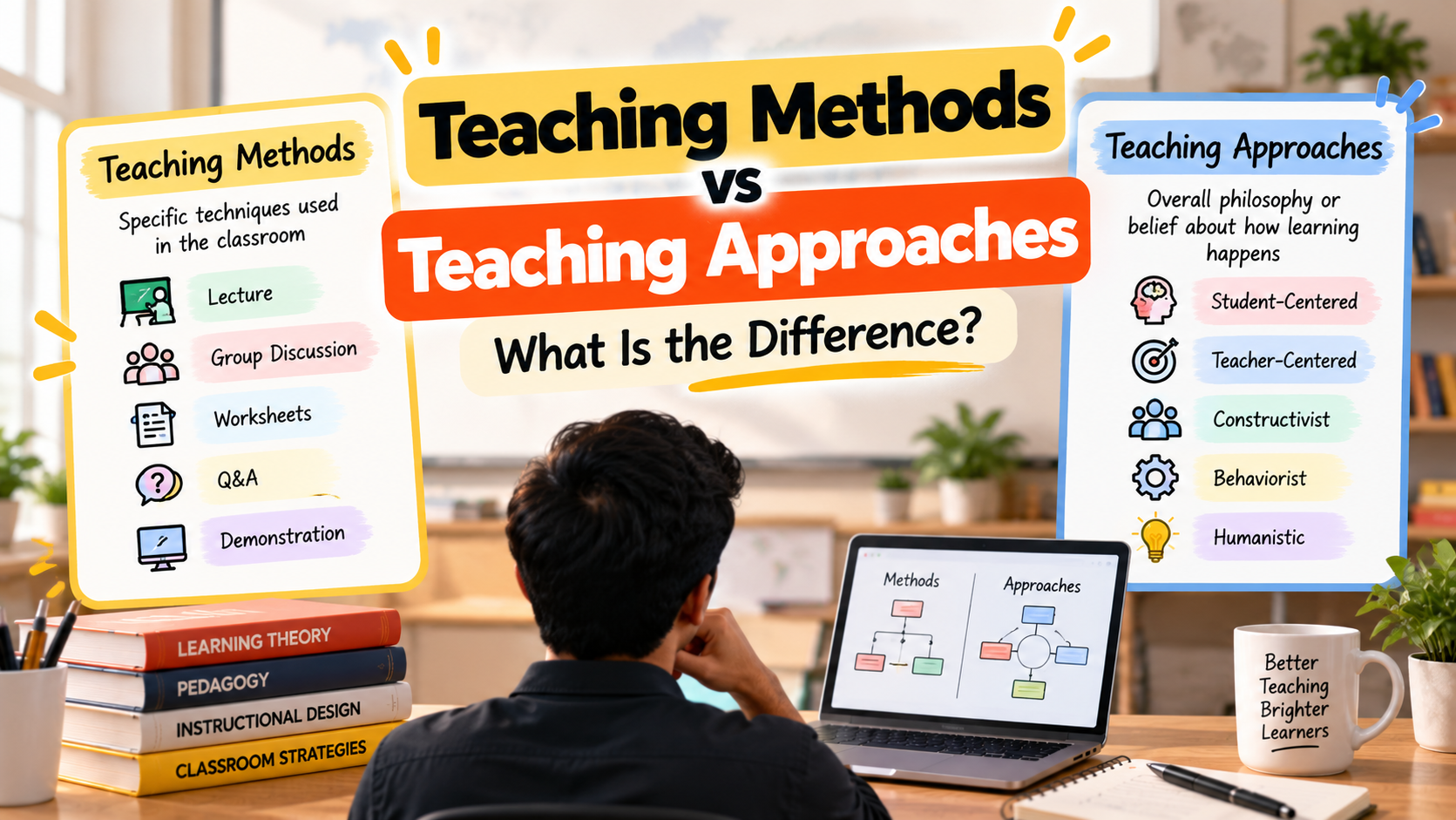
Teachers hear both words all the time, often in the same sentence, and many use them as if they meant the same thing. They do not. A teaching approach is the thinking behind how you teach. A teaching method is what you actually do in the classroom. Knowing the difference helps you plan lessons more clearly, explain your choices and fix problems when something is not working.
This article defines both terms, gives common examples, compares them side by side and shows how to choose for your own class.
What is a teaching approach?
A teaching approach is a set of beliefs and principles about how people learn and how teaching should work. It is the philosophy behind your lessons. It answers the question: what do I believe about learning?
Two teachers with different approaches can teach the same chapter in very different ways. One believes that students learn best by being told clearly and practising. Another believes students learn best by discovering ideas themselves.
What is a teaching method?
A teaching method is a systematic way of delivering a lesson. It is a plan for what the teacher and the students do during the class. It answers the question: how will I teach this topic today?
Methods are concrete. Lecturing, demonstration, group discussion and problem solving are all methods. A single approach can use several methods, and one method can serve different approaches.
Where technique fits
Many textbooks add a third word, technique. A technique is a small classroom action that carries out a method, such as asking a question, giving an example or using a diagram. So the order from broad to narrow is: approach, then method, then technique.
Approach vs method at a glance
| Teaching approach | Teaching method |
Nature | Philosophy and principles | Practical plan |
Question it answers | What do I believe about learning? | How will I teach this lesson? |
Level | Broad | More specific |
Changes | Slowly, with experience and study | Often, lesson by lesson |
Example | Student-centred approach | Group discussion |
Result | A direction | A procedure |
Common teaching approaches
Approach | Core idea | What it looks like in class |
Teacher-centred | The teacher is the main source of knowledge | Lectures, explanation, structured practice |
Student-centred | Students take an active role in learning | Projects, discussions, student choice |
Inductive | Start with examples, then reach the rule | Students observe several cases and find the pattern |
Deductive | Start with the rule, then apply it | The teacher states the rule, students practise |
Multidisciplinary | Look at a topic from several subjects separately | A theme such as water studied in science and geography |
Interdisciplinary | Combine subjects around a shared problem | A project that blends maths, science and writing |
Communicative | Learn a language by using it | Conversation, role play, real tasks |
Inquiry-based | Learning through questions and investigation | Students pose questions and look for answers |
The inductive approach in teaching
In the inductive approach, learners meet examples first and work out the rule themselves. A teacher of grammar might show ten sentences using a particular structure and ask the class what they notice. The idea is that a rule discovered by the learner is better remembered than one simply stated.
The deductive approach
Here the teacher states the rule first and students apply it to examples. It is efficient and suits topics where students need a clear procedure, such as a maths formula.
Multidisciplinary and interdisciplinary approaches
A multidisciplinary approach studies a theme through several subjects, each keeping its own methods. An interdisciplinary approach blends methods from different subjects to address a shared question. Both aim to show students how knowledge connects.
Common teaching methods
Method | What happens | Works well for |
Lecture | Teacher explains, students listen and take notes | Introducing new ideas to large groups |
Demonstration | Teacher shows a process step by step | Science experiments, practical skills |
Discussion | Students talk through a topic | Developing reasoning and communication |
Question and answer | Teacher asks, students respond | Checking understanding |
Problem solving | Students work on a task | Maths, science, reasoning |
Group work | Students collaborate on a task | Projects and peer learning |
Practice and drill | Repeated exercises | Skills that need fluency |
Role play | Students act out situations | Languages, social studies |
Self-study | Students learn from material alone | Revision and exam preparation |
How approach and method work together
Think of an approach as the destination you want to reach and a method as the route you take on a particular day. A teacher with a student-centred approach might use group discussion on Monday, a project on Wednesday and a short demonstration on Friday. A teacher with a teacher-centred approach might use lecture and drill. The methods differ, but each flows from the belief behind it.
A mismatch causes trouble. If you believe students should discover ideas but you only lecture, you are not teaching in line with your own approach, and students may feel confused.
How to choose for your class
1. Know your learners. Age, level and motivation change what works.
2. Look at the goal. Do you want recall, understanding or application?
3. Consider the topic. Some topics suit demonstration, others discussion.
4. Think about time. Discovery takes longer than direct explanation.
5. Mix methods. Variety keeps attention and supports different learners.
6. Check understanding. Short tests show whether the method is working. A short achievement test at the end of a unit tells you how much was learned.
7. Adjust. If results are weak, change the method before changing the approach.
Approach and method in exam preparation
Teachers who prepare students for competitive exams often rely on lecture and practice. That is a sound method for syllabus coverage, but pure lecturing can leave students passive. Adding regular short tests turns learning into something active, and the results show which topics need re-teaching. See formative vs summative assessment for how to use tests during learning, and the online test creator for building them.
Common mistakes
• Treating the words as identical in a lesson plan or an interview answer.
• Naming an approach but never changing the methods to match.
• Sticking to one method for every topic.
• Following a trend without checking whether it suits the class.
• Skipping feedback from students.
Where to go next
If you teach on your own and want to add online practice to your classes, the teachers and tutors page explains how Testkart works for individual teachers, and the guide to free tools and apps for teachers lists useful extras.
FAQs
What is the difference between a teaching approach and a teaching method?
An approach is the philosophy and principles behind teaching. A method is the practical way a lesson is delivered.
Can one approach use several methods?
Yes. A student-centred approach can use discussion, projects and group work.
What is a student-centred approach?
It is an approach in which students take an active role in their own learning, through discussion, projects and choice.
What is the inductive approach in teaching?
It starts with examples and guides learners to discover the rule themselves.
What is the difference between multidisciplinary and interdisciplinary?
Multidisciplinary studies a theme through several separate subjects. Interdisciplinary blends the subjects around a shared problem.
Is lecture a method or an approach?
Lecture is a method. It is often used within a teacher-centred approach.
Comments (0)
Please log in to join the discussion.
Log In to CommentNo comments yet. Be the first to share your thoughts!