Aditya-L1 Discovers Uneven Solar Eruptions: ISRO's New Space Discovery 2026
Key points
Why in the News?
The Indian Space Research Organisation (ISRO) and the Department of Science and Technology highlighted a new scientific discovery made using India's Aditya-L1 solar observatory.
Scientists from the Indian Institute of Astrophysics (IIA), Bengaluru, discovered that a solar eruption observed on 5 August 2024 expanded unevenly rather than uniformly.
The researchers combined observations from Aditya-L1's Visible Emission Line Coronagraph (VELC), NASA's Solar Dynamics Observatory (SDO), and three-dimensional modelling.
Key Highlights
Mission: Aditya-L1
Space Agency: ISRO
Research Institution: Indian Institute of Astrophysics (IIA), Bengaluru
Main Instrument: Visible Emission Line Coronagraph (VELC)
NASA Mission Involved: Solar Dynamics Observatory (SDO)
Solar Eruption Observed: 5 August 2024
Major Discovery: Asymmetric expansion of a Coronal Mass Ejection (CME)
Research Journal: The Astrophysical Journal Letters
What Is Aditya-L1?
Aditya-L1 is India's first dedicated space-based solar observatory, developed by the Indian Space Research Organisation (ISRO).
It was launched on 2 September 2023 aboard the PSLV-C57 rocket from the Satish Dhawan Space Centre, Sriharikota.
The spacecraft operates in a halo orbit around the Sun–Earth Lagrange Point 1 (L1), approximately 1.5 million kilometres from Earth in the direction of the Sun.
Its instruments observe the Sun, solar atmosphere, solar wind and related space-weather phenomena.
What Did Scientists Discover?
Scientists found that the observed Coronal Mass Ejection (CME) did not expand uniformly like a spherical bubble.
Instead, the eruption developed an asymmetric shape with uneven sideways expansion and a tilted axis.
The VELC instrument detected different Doppler shifts, showing that some solar plasma was moving towards the observer while other plasma was moving away.
This information helped researchers reconstruct the three-dimensional movement of the eruption.
What Is a Coronal Mass Ejection (CME)?
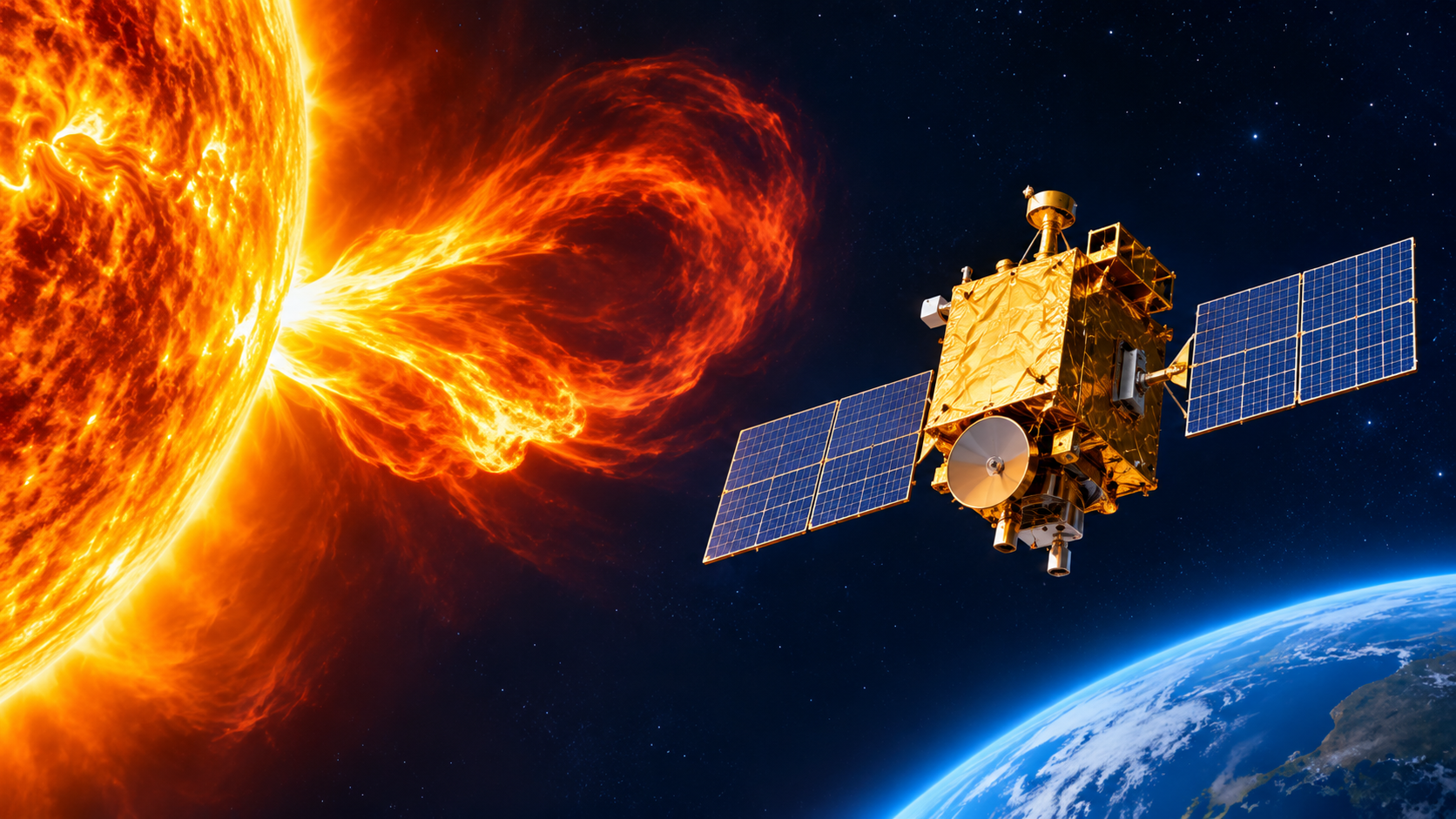
A Coronal Mass Ejection is a massive release of magnetised plasma from the Sun's outer atmosphere, called the corona.
CMEs can travel through interplanetary space and sometimes reach Earth.
When directed towards Earth, they can cause geomagnetic disturbances.
Possible Effects of CMEs
Disruption of satellite operations.
Interference with GPS navigation.
Disturbances in radio communication.
Increased risks to electrical power grids.
Changes in space-weather conditions.
What Is the VELC Instrument?
The Visible Emission Line Coronagraph (VELC) is the primary scientific payload aboard Aditya-L1.
It observes the Sun's corona and uses spectroscopy to study the movement of hot solar plasma.
Unlike ordinary images, spectroscopic observations can provide information about plasma moving towards or away from the observer.
Why Is This Discovery Important?
1. Better Understanding of Solar Eruptions
The research shows that CMEs can expand unevenly during their early development.
2. Improved Space-Weather Research
Understanding the three-dimensional shape of CMEs may help scientists improve models of their movement through space.
3. Protection of Satellites
Better solar-eruption modelling could eventually help assess risks to satellites and communication systems.
4. Advances in Solar Physics
The findings demonstrate the importance of combining Indian and international space observations.
Aditya-L1 Mission: Important Facts
Particulars | Details |
|---|---|
Mission | Aditya-L1 |
Space Agency | ISRO |
Launch Date | 2 September 2023 |
Launch Vehicle | PSLV-C57 |
Launch Site | Satish Dhawan Space Centre, Sriharikota |
Destination | Sun–Earth Lagrange Point 1 |
Distance from Earth | Approximately 1.5 Million km |
Number of Payloads | 7 |
Main Objective | Study the Sun and solar phenomena |
Instrument Used in Recent Discovery | VELC |
What Is Lagrange Point 1 (L1)?
L1 is a location in the Sun–Earth system where the gravitational effects of the two bodies and the orbital motion of a spacecraft allow it to maintain a relatively stable position with limited station-keeping.
Aditya-L1 operates in a halo orbit around this point.
Its position provides a nearly continuous view of the Sun, making it suitable for solar observations.
Conclusion
The Aditya-L1 mission has provided important evidence that some solar eruptions expand asymmetrically rather than uniformly.
The discovery highlights India's growing capabilities in solar physics and could contribute to better understanding and future forecasting of space-weather events.