
Census 2027: Digital Self-Enumeration Begins in Four States
Key points
In the News
The Ministry of Home Affairs (MHA) announced the commencement of Phase II self-enumeration under Census 2027 on 16 November 2026 in Goa, Punjab, Uttar Pradesh and the non-snow-bound areas of Uttarakhand.
Residents can submit their details online until 30 November 2026, followed by door-to-door population enumeration from 1 December 2026 to 4 January 2027.
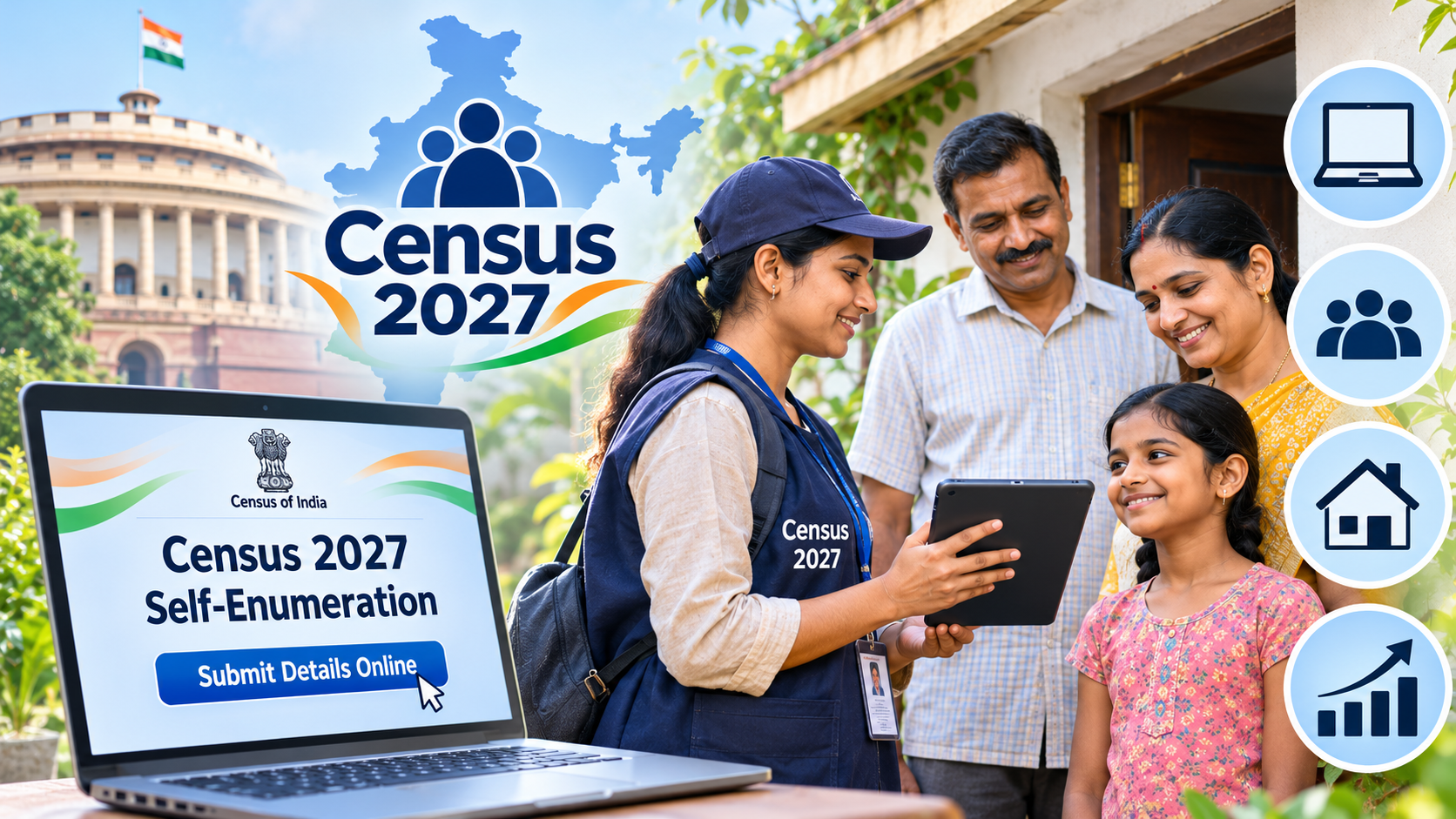
Census 2027 is India's first digital census, introducing online self-enumeration and mobile-based data collection to improve efficiency, accuracy and accessibility.
Background
The Census of India is a nationwide exercise conducted to collect demographic, social and economic information about the population.
It is administered by the Office of the Registrar General and Census Commissioner of India (ORGI) under the Ministry of Home Affairs.
The Census is conducted under the Census Act, 1948, and the Census Rules, 1990, as amended.
The previous Census was conducted in 2011. Census 2027 will be India's 16th Census overall and 8th since Independence.
The Union Cabinet approved an expenditure of ₹11,718.24 crore for conducting Census 2027.
Key Highlights
1. India's First Digital Census
Census 2027 introduces digital data collection using mobile applications and a secure online self-enumeration portal.
Enumerators will use smartphones to collect household information, reducing dependence on traditional paper-based surveys.
2. Self-Enumeration Facility
Residents can voluntarily submit their information through the official portal:
The facility is available in 16 Indian languages.
After submitting the required details, households receive a unique Self-Enumeration ID (SE ID), which must be shared with the enumerator during the subsequent field visit.
3. Two Phases of Census 2027
Phase I – Houselisting and Housing Census: Collects information about buildings, housing conditions, household amenities and assets.
Phase II – Population Enumeration: Collects demographic and other individual-level information about household members.
The second phase includes 40 notified questions covering household and individual particulars.
4. State-Wise Population Enumeration Schedule
For Goa, Punjab, Uttar Pradesh and non-snow-bound areas of Uttarakhand:
Self-enumeration: 16–30 November 2026
Door-to-door enumeration: 1 December 2026 – 4 January 2027
Revisional round: 5–9 January 2027
Reference date: 5 January 2027
For the remaining states and Union Territories, excluding areas covered by special schedules:
Self-enumeration: 10–24 January 2027
Population enumeration: 25 January – 28 February 2027
Revisional round: 1–5 March 2027
Reference date: 1 March 2027
Separate arrangements apply to certain snow-bound areas.
5. Census Administration and Monitoring
The Office of the Registrar General and Census Commissioner coordinates the exercise nationally.
State and district administrations appoint enumerators, supervisors and other field officials.
The Census Management and Monitoring System (CMMS) supports digital administration and monitoring of census operations.
Approximately 30 lakh field functionaries are involved in the nationwide exercise.
6. Data Security and Confidentiality
Information collected under the Census Act, 1948, is confidential and used for statistical purposes and development planning.
Digital security measures are incorporated into data collection, transmission and storage.
Self-enumeration is an additional facility, not a replacement for door-to-door verification.
7. Importance for Government Planning
Census data supports decisions relating to public infrastructure, education, healthcare, housing, welfare programmes and resource allocation.
Accurate demographic information helps governments identify population needs and prepare development policies.
Important Facts for Competitive Exams
Registrar General and Census Commissioner of India: The authority responsible for coordinating and conducting the Census under the Ministry of Home Affairs.
Census Act, 1948: The principal legislation governing census operations and confidentiality of collected information in India.
Self-Enumeration: A digital facility allowing residents to enter their household information online before an enumerator's field visit.
Population Enumeration: The census stage that collects information about individuals, including demographic and other notified particulars.
Reference Date: The specific date and time to which census population information relates.
Digital Census: The use of mobile applications, electronic data collection and digital monitoring systems for conducting census operations.
Census 2027: The 16th Census in India's census series and the eighth conducted after Independence.
Quick Revision
Latest Development: Phase II self-enumeration began on 16 November 2026 in Goa, Punjab, Uttar Pradesh and non-snow-bound areas of Uttarakhand.
Digital Innovation: Census 2027 is India's first digital census, introducing online self-enumeration, mobile applications and electronic monitoring.
Administrative Authority: The exercise is conducted by the Office of the Registrar General and Census Commissioner of India, under the Ministry of Home Affairs.
Legal Framework: Census operations are governed by the Census Act, 1948, and Census Rules, 1990, as amended.
Important Dates: Self-enumeration in the four specified states and areas continues until 30 November 2026, followed by door-to-door enumeration beginning on 1 December.
Budget and Workforce: The government approved ₹11,718.24 crore, with approximately 30 lakh field functionaries involved nationwide.
Conclusion
Census 2027 represents a major step towards digital governance and modern statistical administration in India.
The introduction of self-enumeration, mobile-based surveys and digital monitoring is expected to improve data collection and support more effective public policy planning.
For competitive examinations, the most important areas are Census 2027, the Census Act, 1948, self-enumeration, the Registrar General of India and digital governance.