Price Regulation of Anti-Cancer Medicines in India 2026: NPPA Caps Trade Margins at 30%
Key points
Why in the News?
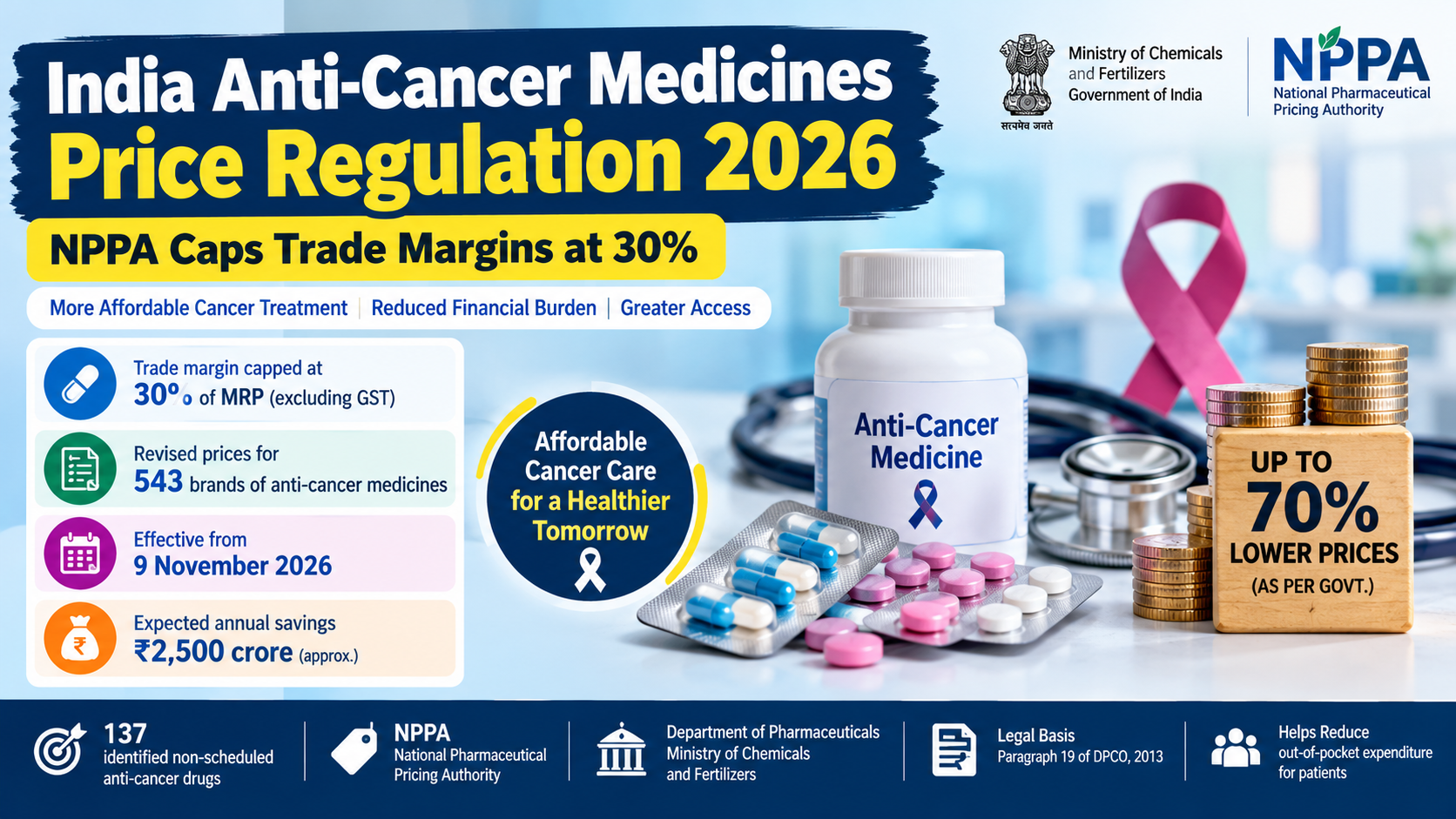
On 28 October 2026, the Department of Pharmaceuticals announced that the National Pharmaceutical Pricing Authority (NPPA) had released revised maximum retail prices (MRPs) for 543 brands of anti-cancer medicines. The revised prices will come into effect on 9 November 2026.
The measure follows the government's decision to regulate trade margins on 137 identified non-scheduled anti-cancer drugs to make cancer treatment more affordable and reduce the financial burden on patients. <Link url="https://www.pib.gov.in/PressReleasePage.aspx?PRID=2329698&lang=1®=48" title="Official PIB announcement"/>
Key Highlights
Regulatory authority: National Pharmaceutical Pricing Authority (NPPA)
Nodal department: Department of Pharmaceuticals
Ministry: Ministry of Chemicals and Fertilizers
Medicines covered: 137 identified non-scheduled anti-cancer drugs
Revised price list: 543 brands
Trade margin cap: 30% of the maximum retail price (MRP), excluding GST
Effective date: 9 November 2026
Expected annual savings: Approximately ₹2,500 crore, according to the government
Legal provision: Paragraph 19 of the Drugs (Prices Control) Order, 2013
What Is the Government's Decision?
The government has introduced Trade Margin Rationalisation (TMR) for 137 identified non-scheduled anti-cancer drugs. Under this measure, the trade margin is capped at 30% of the MRP, excluding applicable GST.
Trade margins are the amounts added through the distribution and sale chain between the manufacturer and the final consumer. Excessive margins can significantly increase the price paid by patients, especially for expensive cancer medicines.
The intervention aims to reduce these excessive margins while maintaining the availability of essential cancer treatments. The government expects the measure to reduce the MRPs of the identified medicines by up to 70%, depending on their existing price structures.
What Is the National Pharmaceutical Pricing Authority (NPPA)?
The National Pharmaceutical Pricing Authority is a government regulatory body under the Department of Pharmaceuticals, Ministry of Chemicals and Fertilizers.
Its main responsibilities include:
Fixing and revising prices of medicines under applicable drug-pricing rules.
Monitoring the prices of scheduled formulations.
Ensuring compliance with government price-control orders.
Taking action against manufacturers or sellers who charge prices beyond permitted limits.
Promoting the availability of medicines at affordable prices.
The NPPA plays an important role in balancing access to affordable medicines with the need to maintain their supply.
Scheduled and Non-Scheduled Medicines: What Is the Difference?
Scheduled medicines: These are formulations included in the National List of Essential Medicines (NLEM) and covered by the applicable price-control provisions. Their ceiling prices are fixed by the government under the Drugs (Prices Control) Order.
Non-scheduled medicines: These are formulations not included in the scheduled list. They are not generally subject to the same scheduled-medicine ceiling-price mechanism, although they remain subject to applicable regulatory provisions.
The new trade-margin rationalisation measure extends additional price protection to selected non-scheduled anti-cancer drugs.
Which Anti-Cancer Medicines Are Covered?
The identified medicines include several types of cancer treatments, including:
Immunotherapy medicines: Used to help the immune system recognise and fight cancer.
Denosumab: Used in certain conditions involving bone complications, including in some patients with breast or prostate cancer.
Pegfilgrastim: Used to reduce the risk of neutropenia, a condition involving low levels of neutrophils, in appropriate cancer-treatment settings.
Bevacizumab: A targeted therapy used for certain cancers, including colorectal, ovarian and cervical cancers.
The measure also covers widely used medicines such as pembrolizumab, durvalumab and osimertinib. The exact medicines and brand-level revised prices should be checked against the official NPPA list.
Revised Prices of Cancer Medicines
On 28 October 2026, the government announced revised MRPs for 543 brands. The list includes medicines manufactured by multiple pharmaceutical companies.
Examples published by the Press Information Bureau include:
Medicine and brand | Pack or strength | Old MRP | Revised MRP |
|---|---|---|---|
Anastrozole — Anarzole | 1 mg, 10 tablets | ₹695.76 | ₹73.00 |
Azacitidine — Azacytin | 100 mg injection | ₹6,337.00 | ₹1,495.04 |
Bevacizumab — Bevacizab | 100 mg/4 ml injection | ₹21,767.70 | ₹5,930.13 |
Dasatinib — Dasanat 20 | 20 mg, 60 tablets | ₹2,812.50 | ₹1,085.93 |
Important: These are examples from the official revised-price announcement. The revised prices are scheduled to take effect on 9 November 2026. Check the latest NPPA list for the exact brand, pack size and price before purchasing.
Why Has the Government Introduced This Measure?
Cancer treatment can involve substantial expenditure on medicines, hospitalisation, diagnostic tests and other medical services. High medicine prices can force patients and families to spend a significant part of their income on treatment.
The government cited NPPA market analysis indicating that non-scheduled anti-cancer medicines had an average trade mark-up of around 170%, with some cases reaching 700% or more.
By limiting trade margins on selected medicines, the government aims to:
Reduce the cost of cancer medicines.
Improve access to essential cancer treatments.
Reduce patients' out-of-pocket expenditure.
Address excessive margins across the medicine supply chain.
Encourage fairer pricing while maintaining medicine availability.
The estimated annual savings of approximately ₹2,500 crore are a government projection, not a guarantee of identical savings for every patient.
Legal Basis: Drugs (Prices Control) Order, 2013
The NPPA has used Paragraph 19 of the Drugs (Prices Control) Order, 2013 (DPCO) for the trade-margin rationalisation measure.
This provision allows the government to intervene in drug pricing in the public interest under the applicable framework. The decision builds on an earlier initiative from 2019, when trade margins were capped on 42 selected non-scheduled anti-cancer drugs. That exercise reportedly reduced MRPs by up to 91% across 526 brands and generated estimated annual savings of ₹984 crore.