India Highlights Biodiversity Conservation at CBD COP-17 in Armenia
Key points
Why in the News?
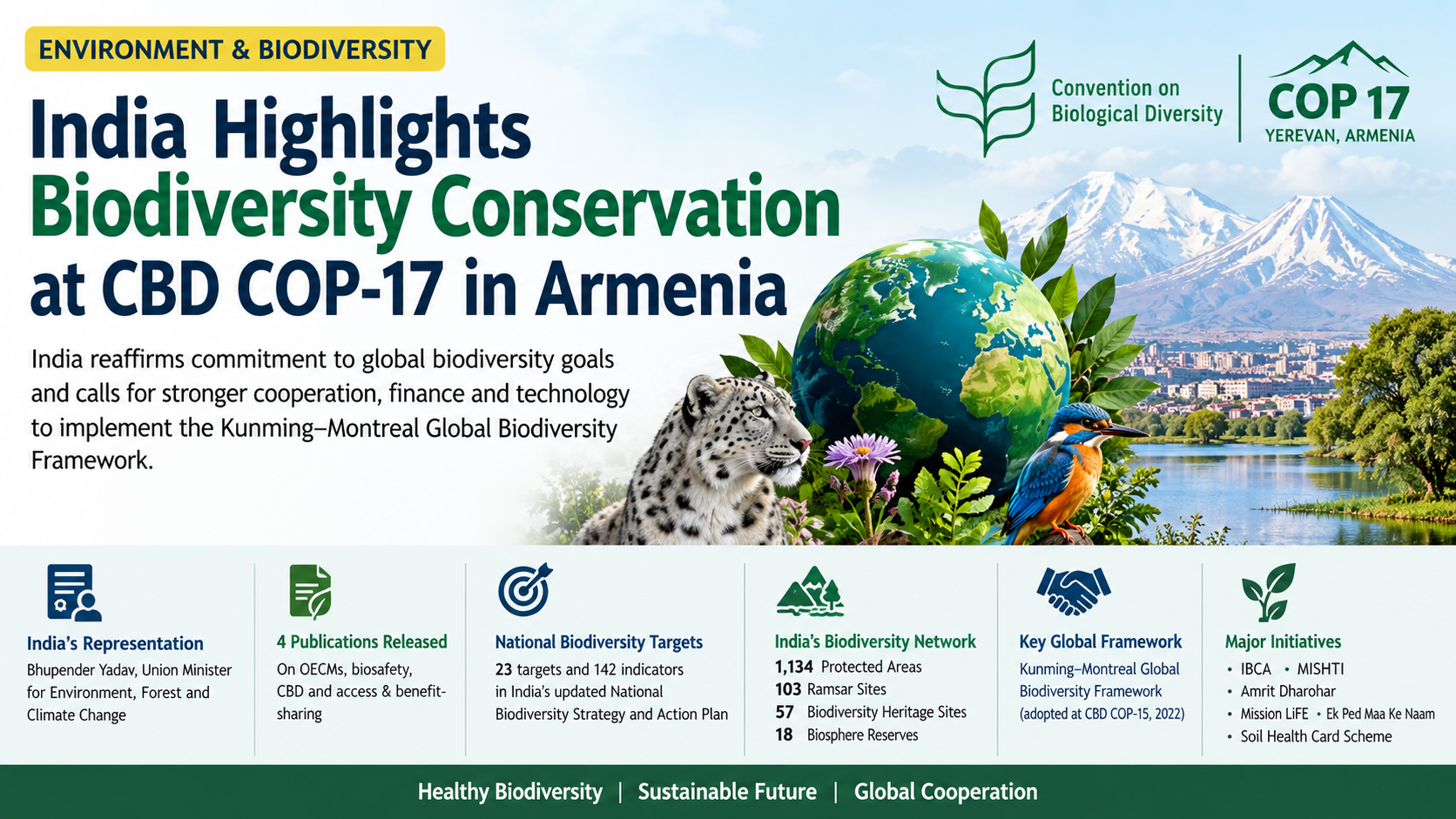
On 27 October 2026, India reaffirmed its commitment to biodiversity conservation at the 17th Conference of the Parties to the Convention on Biological Diversity (CBD COP-17), held in Yerevan, Armenia. Union Minister for Environment, Forest and Climate Change Bhupender Yadav delivered India's National Statement at the high-level segment.
On 28 October 2026, India also released four important publications related to biodiversity conservation, biosafety and access and benefit-sharing at a COP-17 side event.
1. What Is CBD COP-17?
The Conference of the Parties (COP) is the main decision-making body of the Convention on Biological Diversity (CBD). It brings together member countries to discuss biodiversity conservation, the sustainable use of biological resources and the fair sharing of benefits arising from genetic resources.
Key Facts
Event: 17th Conference of the Parties to the Convention on Biological Diversity (CBD COP-17)
Host country: Armenia
Host city: Yerevan
Indian representative: Bhupender Yadav, Union Minister for Environment, Forest and Climate Change
Main focus: Biodiversity conservation and implementation of global biodiversity commitments
2. Kunming–Montreal Global Biodiversity Framework
India emphasised that the Kunming–Montreal Global Biodiversity Framework should be implemented according to the national priorities, circumstances and laws of individual countries.
India also highlighted the need for adequate and predictable financial support, capacity-building and technology transfer from developed countries to support implementation.
The framework was adopted at the 15th Conference of the Parties to the CBD in Montreal, Canada, in December 2022. It provides global goals and targets for halting and reversing biodiversity loss by 2030.
One of its best-known targets is to conserve at least 30% of terrestrial and inland water areas, and of marine and coastal areas, by 2030.
3. India's National Biodiversity Targets
India's updated National Biodiversity Strategy and Action Plan translates the global framework into 23 National Biodiversity Targets and 142 indicators.
These targets and indicators help India plan, monitor and assess its progress towards biodiversity conservation and the sustainable use of biological resources.
Biodiversity conservation is important for maintaining ecological balance, protecting wildlife habitats, supporting agriculture and safeguarding livelihoods that depend on forests, wetlands, rivers and other ecosystems.
4. India's Biodiversity Conservation: Important Facts
India highlighted its existing network of protected and conservation areas at CBD COP-17.
Category | Number |
|---|---|
Protected Areas | 1,134 |
Ramsar Sites | 103 |
Biodiversity Heritage Sites | 57 |
Biosphere Reserves | 18 |
Biosphere Reserves in UNESCO's Man and the Biosphere Network | 13 |
Figures reported by the Ministry of Environment, Forest and Climate Change in its PIB release dated 27 October 2026.
5. Major Indian Initiatives for Biodiversity Conservation
International Big Cat Alliance (IBCA)
The International Big Cat Alliance promotes international cooperation for conserving seven big-cat species and their habitats. Cooperation between countries is important because wildlife habitats and conservation challenges can extend across national borders.
MISHTI
The Mangrove Initiative for Shoreline Habitats and Tangible Incomes (MISHTI) focuses on mangrove restoration. Mangroves help protect coastlines, support biodiversity and provide important ecosystem services.
Amrit Dharohar
Amrit Dharohar is associated with wetland conservation and the sustainable use of wetland ecosystems. Wetlands support aquatic life, migratory birds, water-related ecological processes and local livelihoods.
Mission LiFE
Mission LiFE stands for Lifestyle for Environment. It encourages individuals and communities to adopt environmentally responsible lifestyles and sustainable consumption practices.
Ek Ped Maa Ke Naam
This initiative encourages people to plant trees and participate in environmental protection.
Soil Health Card Scheme
The scheme promotes informed soil management and helps farmers understand the condition of their soil so that they can make better decisions about nutrient management and soil fertility.
6. India Releases Four Publications at CBD COP-17
At a side event held on 28 October 2026, India released four publications related to biodiversity and biosafety.
Guidelines for the Designation of India's Other Effective Area-Based Conservation Measures (I-OECMs) 2026: These guidelines support recognition of effective conservation beyond conventional protected areas, subject to appropriate criteria and governance.
5th National Report on the Cartagena Protocol on Biosafety: The report relates to India's reporting on biosafety under the Cartagena Protocol.
The Convention on Biological Diversity Handbook: Reference Guide and Indian Perspective: The handbook provides reference material to support understanding and participation in the CBD process.
India's ABS Success Story: This publication highlights India's experience with access and benefit-sharing.
7. What Is Access and Benefit-Sharing (ABS)?
Access and Benefit-Sharing refers to the process through which access to genetic resources and the sharing of benefits arising from their utilisation are addressed.
Benefits may include monetary payments, research collaboration, technology transfer and other agreed forms of benefit-sharing.
The principle is important because biological resources and associated traditional knowledge can contribute to scientific research, agriculture, medicine and commercial products. Fair benefit-sharing can help ensure that the benefits are shared appropriately, including with relevant local communities.
India highlighted its village-level biodiversity governance and decentralised participation in access and benefit-sharing.
8. What Is the Cali Fund?
The Cali Fund is associated with the multilateral mechanism for sharing benefits arising from the use of digital sequence information on genetic resources.
Digital sequence information refers to digital data about genetic sequences used in scientific research and other applications. India supported benefit-sharing through a multilateral mechanism that includes the Cali Fund.
9. What Is the Cartagena Protocol on Biosafety?
The Cartagena Protocol on Biosafety is an international agreement under the Convention on Biological Diversity. It focuses on the safe handling, transport and use of living modified organisms resulting from modern biotechnology that may have adverse effects on biodiversity, taking into account risks to human health.
At COP-17, India's release of its fifth national report under the protocol highlighted biosafety governance and reporting.
10. What Are Other Effective Area-Based Conservation Measures (OECMs)?
OECMs are geographically defined areas that achieve positive, long-term biodiversity conservation outcomes even if they are not formally designated as conventional protected areas.
They recognise that conservation can also take place through effective management of landscapes and other areas outside traditional protected-area systems.
Important Takeaways
CBD COP-17 was held in Yerevan, Armenia.
India's National Statement was delivered by Bhupender Yadav.
India's updated National Biodiversity Strategy and Action Plan contains 23 National Biodiversity Targets and 142 indicators.
India reported 1,134 Protected Areas, 103 Ramsar sites, 57 Biodiversity Heritage Sites and 18 Biosphere Reserves.
The Kunming–Montreal Global Biodiversity Framework was adopted at CBD COP-15 in Montreal in 2022.
MISHTI focuses on mangrove restoration, while Amrit Dharohar supports wetland conservation.
The Cartagena Protocol on Biosafety addresses risks related to living modified organisms resulting from modern biotechnology.
The Cali Fund is associated with benefit-sharing from the use of digital sequence information on genetic resources.
India released four publications on OECMs, biosafety, the CBD and access and benefit-sharing at COP-17.