India’s MATSYA-6000 Deep-Ocean Submersible Set for Sea Trials in Early 2027
Key points
In the News
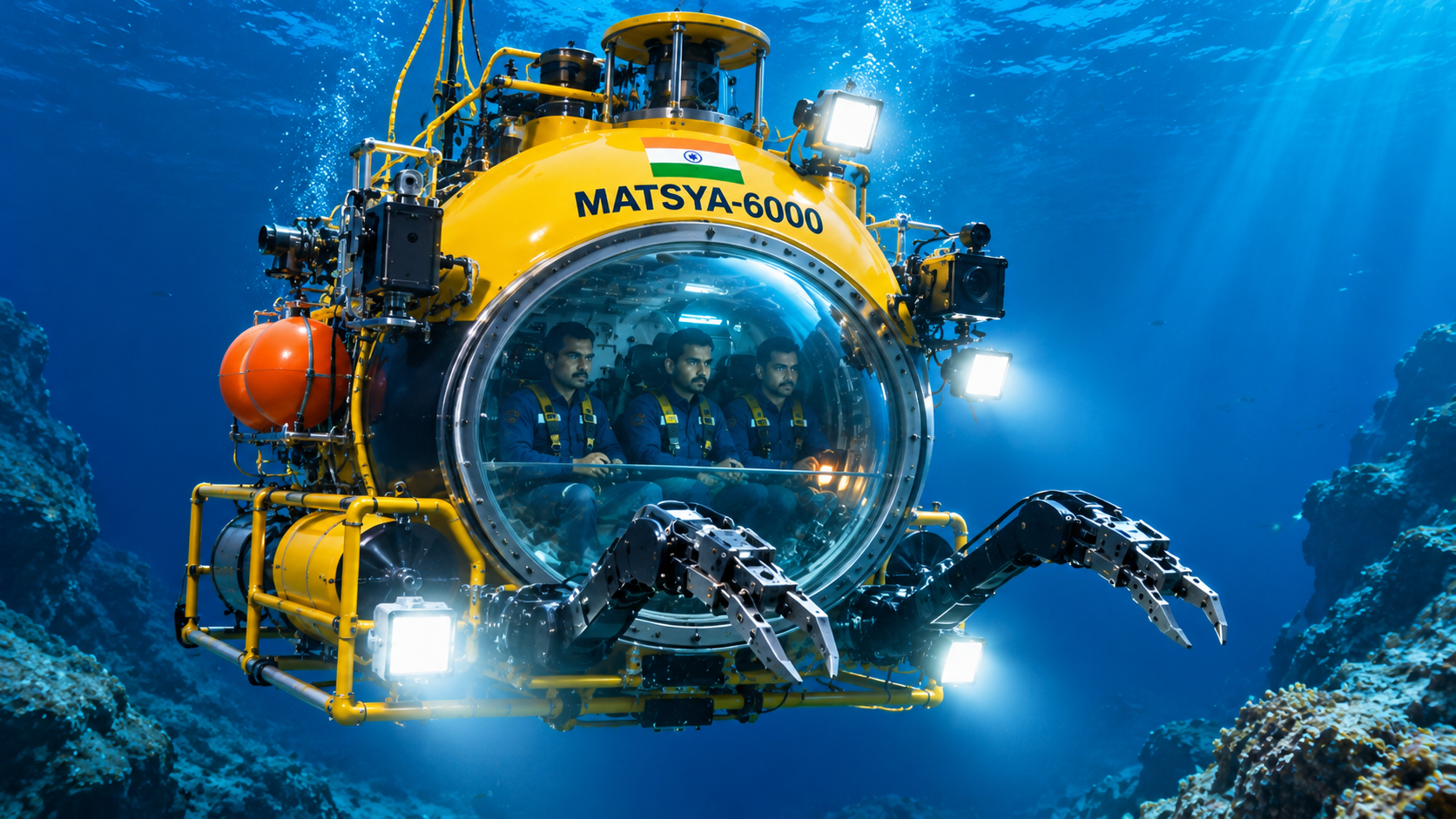
India's indigenously developed deep-ocean submersible MATSYA-6000 is expected to undergo its first 500-metre sea trial in January–February 2027 in the Bay of Bengal.
The proposed timeline was announced on 13 November 2026 by Srinivasa Kumar Tummala, Secretary of the Ministry of Earth Sciences.
The trial will be an important milestone in India's Samudrayaan Project, which aims to send three people to a depth of 6,000 metres for deep-ocean scientific exploration.
Background
MATSYA-6000 is being developed by the National Institute of Ocean Technology (NIOT), Chennai, under the Ministry of Earth Sciences.
The submersible is part of the Samudrayaan Project, a major component of India's Deep Ocean Mission.
The project aims to develop indigenous technologies for exploring deep-sea ecosystems, studying marine biodiversity and investigating underwater mineral resources.
Key Highlights
Submersible Name: MATSYA-6000.
Upcoming Trial: 500-metre sea trial.
Expected Timeline: January–February 2027.
Proposed Location: Bay of Bengal.
Developing Institution: National Institute of Ocean Technology (NIOT), Chennai.
Nodal Ministry: Ministry of Earth Sciences.
Crew Capacity: Three persons.
Maximum Target Depth: 6,000 metres.
Personnel Sphere: A 2.1-metre-diameter titanium alloy sphere designed for deep-sea operations.
Mission Duration: Up to 12 hours, with emergency life-support provisions for 96 hours.
Technical Collaboration: ISRO is involved in developing the titanium alloy personnel sphere.
Important Facts for Competitive Exams
1. Samudrayaan Project: Samudrayaan is India's human deep-ocean exploration initiative under the Deep Ocean Mission. It aims to transport three people to a depth of 6,000 metres for scientific research and ocean exploration.
2. National Institute of Ocean Technology (NIOT): Established in 1993 and headquartered in Chennai, Tamil Nadu, NIOT is an autonomous institution under the Ministry of Earth Sciences responsible for developing indigenous ocean technologies.
3. Deep Ocean Mission: Approved by the Union Cabinet in June 2021, the Deep Ocean Mission focuses on deep-sea exploration, marine biodiversity, ocean climate services, seabed mineral resources and the development of advanced underwater technologies.
4. Polymetallic Nodules: These are mineral deposits found on the deep-ocean floor containing valuable metals such as manganese, nickel, cobalt and copper. They are important for batteries, renewable energy technologies and advanced manufacturing.
5. International Seabed Authority (ISA): The ISA is an international organisation established under the United Nations Convention on the Law of the Sea (UNCLOS). Headquartered in Kingston, Jamaica, it regulates mineral-related activities in the international seabed area beyond national jurisdiction.
Quick Revision
Particulars | Details |
|---|---|
Submersible | MATSYA-6000 |
Project | Samudrayaan |
Mission | Deep Ocean Mission |
Upcoming Trial Depth | 500 metres |
Expected Trial | January–February 2027 |
Trial Location | Bay of Bengal |
Maximum Target Depth | 6,000 metres |
Developing Institute | NIOT, Chennai |
Nodal Ministry | Ministry of Earth Sciences |
Crew Capacity | 3 Persons |
Technical Partner | ISRO |