Lonar Lake in Maharashtra Added to IUGS Geological Heritage Sites List 2026
Key points
In the News
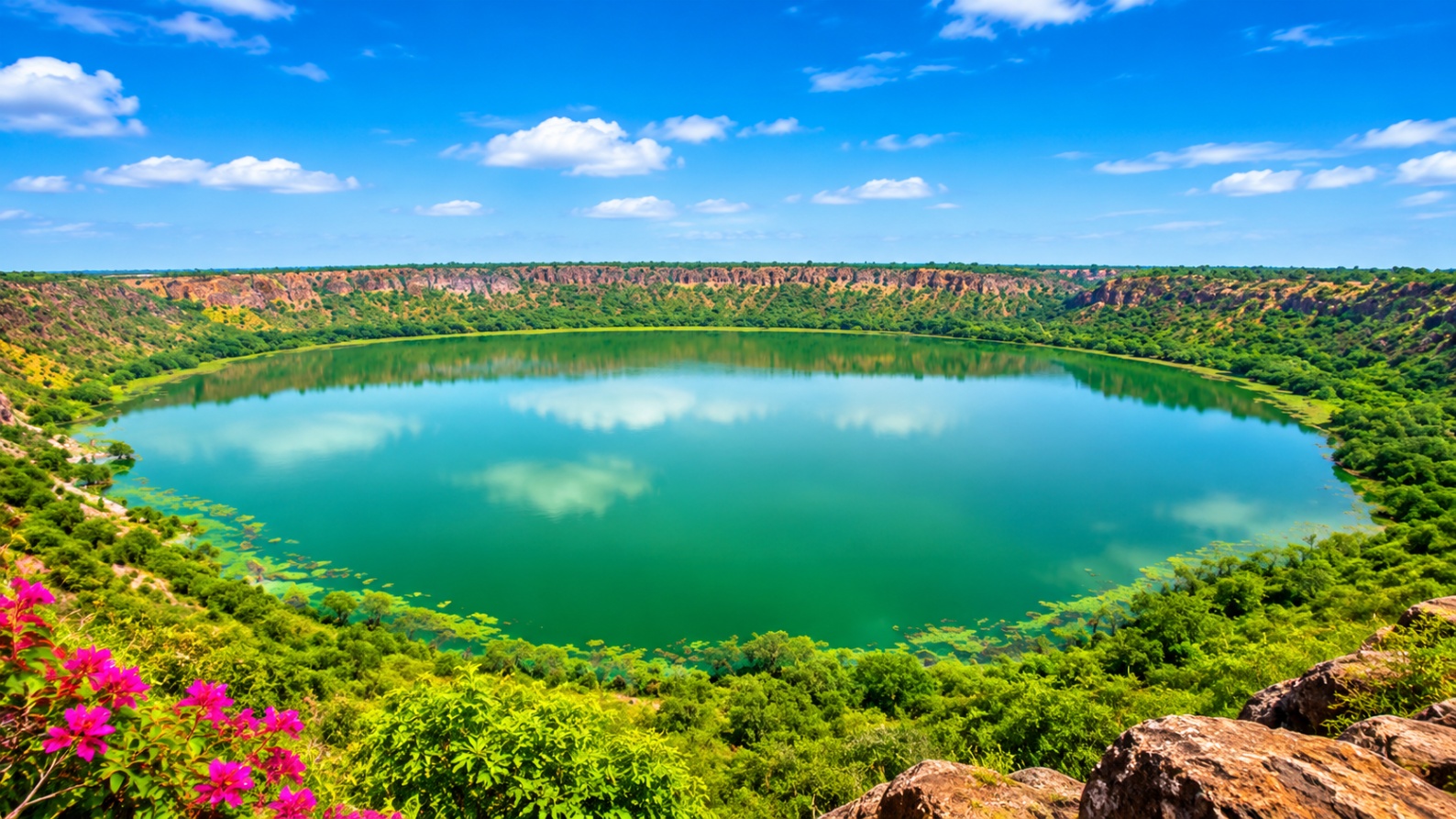
Lonar Lake Impact Crater, located in Maharashtra's Buldhana district, has been included in the prestigious Third 100 IUGS Geological Heritage Sites list by the International Union of Geological Sciences (IUGS).
The recognition was announced at the IUGS Geoheritage Event in Algarve, Portugal, highlighting the crater's exceptional geological importance and its contribution to understanding Earth's history.
Background
Lonar Lake is a unique saline and alkaline crater lake formed by the impact of a high-velocity meteorite on the basaltic rocks of the Deccan Plateau.
The crater is approximately 12,000 years old, according to the IUGS assessment, and is one of the youngest and best-preserved meteorite-impact structures on Earth.
The lake is situated within the Deccan Traps, a vast volcanic region formed approximately 65 million years ago.
Key Highlights
Location: Buldhana district, Maharashtra.
Recognition: Third 100 IUGS Geological Heritage Sites.
Recognising Organisation: International Union of Geological Sciences (IUGS).
Nominating Agency: Geological Survey of India (GSI).
Announcement Venue: Algarve, Portugal.
Crater Diameter: Approximately 1.88 kilometres.
Estimated Age: Around 12,000 years, as stated by IUGS.
Formation: Hypervelocity meteorite impact on basaltic rocks.
Geological Region: Deccan Traps.
Lake Characteristics: Saline and highly alkaline water.
Indian Significance: India's second site recognised under the IUGS Geological Heritage Sites initiative, after Meghalaya's Mawmluh Cave.
Earlier Recognition: Ramsar Wetland of International Importance in 2020.
Important Facts for Competitive Exams
About the IUGS
Full Form: International Union of Geological Sciences.
Established: 1961.
Objective: Promote international cooperation and advancement in geological sciences.
First 100 Geological Heritage Sites: Announced in Spain in 2022.
Second 100 Geological Heritage Sites: Announced in South Korea in 2024.
Third 100 Geological Heritage Sites: Announced in Portugal in 2026.
Geological Importance of Lonar Lake
Lonar is one of five known hypervelocity meteorite-impact craters formed in basaltic rock.
Its geological features provide valuable evidence of meteorite impacts.
The crater is scientifically important for comparative studies of the Moon and Mars.
Its unusual water chemistry supports research into microorganisms adapted to extreme environments.
Geological evidence includes impact-related glass, breccia and shock metamorphism.
Quick Revision
Lonar Lake is located in Buldhana district, Maharashtra.
It has been included in the Third 100 IUGS Geological Heritage Sites.
The Geological Survey of India submitted its nomination.
The IUGS Geoheritage Event was held in Algarve, Portugal.
Lonar Crater is approximately 1.88 km in diameter.
The crater was formed by a high-velocity meteorite impact.
Lonar Lake lies within the Deccan Traps.
The lake received Ramsar Site recognition in 2020.
Mawmluh Cave in Meghalaya was India's first IUGS Geological Heritage Site.