PM Modi Chairs Union Council of Ministers Meeting at Bharat Mandapam
Key points
In the News
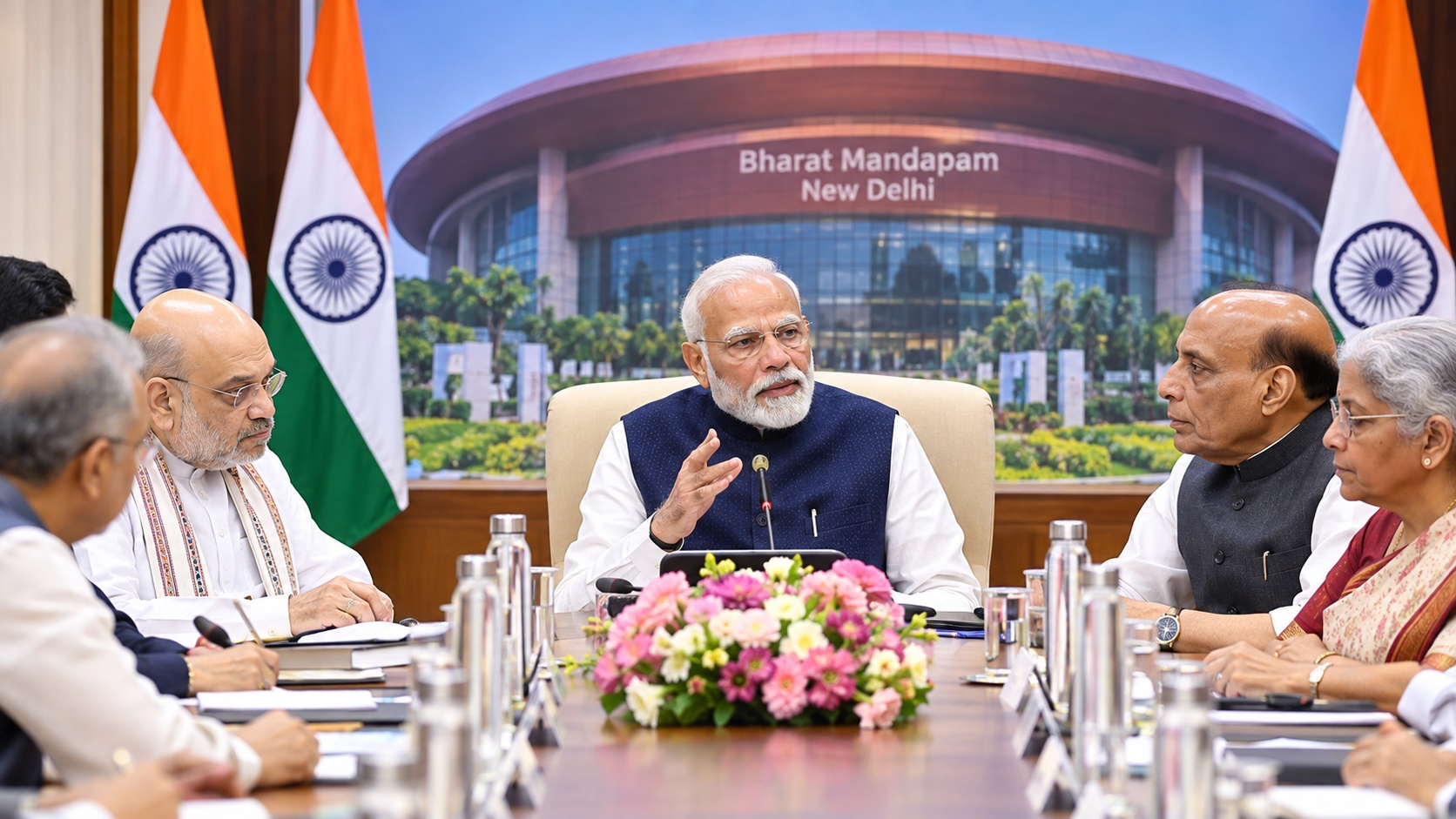
Prime Minister Narendra Modi chaired a meeting of the Union Council of Ministers at Bharat Mandapam, New Delhi, focusing on government priorities, coordination among ministries and the effective implementation of public policies.
The meeting highlights the role of the Union Council of Ministers in reviewing administrative performance and advancing the government's long-term development objectives, including Viksit Bharat 2047.
Background
The Union Council of Ministers is the constitutional executive body headed by the Prime Minister. It aids and advises the President of India in the exercise of executive functions.
The Council consists of Cabinet Ministers, Ministers of State (Independent Charge) and Ministers of State.
Its constitutional framework is primarily provided under Articles 74 and 75 of the Indian Constitution.
Key Highlights
Chairperson: Prime Minister Narendra Modi.
Venue: Bharat Mandapam, Pragati Maidan, New Delhi.
Participants: Members of the Union Council of Ministers.
Major Focus: Government priorities, policy coordination and administrative performance.
Development Vision: Viksit Bharat 2047.
Governance Objective: Improving coordination among ministries and strengthening the implementation of government programmes.
Important Facts for Competitive Exams
1. Constitutional Provisions
Article 74 – Council of Ministers
Provides for a Council of Ministers headed by the Prime Minister to aid and advise the President of India.
Article 75 – Appointment and Responsibility
The Prime Minister is appointed by the President, while other ministers are appointed by the President on the advice of the Prime Minister.
Article 75(3) – Collective Responsibility
The Union Council of Ministers is collectively responsible to the Lok Sabha.
Article 75(5) – Membership of Parliament
A minister who is not a member of either House of Parliament for six consecutive months ceases to be a minister.
2. Maximum Strength of the Council of Ministers
Under the 91st Constitutional Amendment Act, 2003, the total number of ministers, including the Prime Minister, cannot exceed 15% of the total membership of the Lok Sabha.
3. Difference Between Cabinet and Council of Ministers
The Cabinet is a smaller body of senior ministers responsible for major policy decisions.
The Council of Ministers is a larger constitutional body comprising all Union ministers, including Cabinet Ministers and Ministers of State.
4. Role of the Prime Minister
Under Article 78, the Prime Minister communicates decisions of the Council of Ministers to the President and provides information concerning Union administration and legislative proposals.
The Prime Minister also coordinates the functioning of different ministries and provides overall leadership to the government.
5. What is Viksit Bharat 2047?
Viksit Bharat 2047 is India's long-term development vision to become a developed nation by the centenary of independence in 2047.
Its broad priorities include economic development, infrastructure, technology, education, social welfare and effective governance.
6. What is Bharat Mandapam?
Bharat Mandapam is a major international convention and exhibition complex located at Pragati Maidan, New Delhi.
It was inaugurated in July 2023 and hosted the G20 Leaders' Summit in September 2023.
7. Why is Inter-Ministerial Coordination Important?
Coordination among ministries helps reduce duplication of work, improve resource utilisation, resolve implementation challenges and ensure the timely delivery of government schemes.
8. What is Collective Responsibility?
Collective responsibility means that the Council of Ministers is jointly accountable to the Lok Sabha. If the Lok Sabha passes a no-confidence motion against the government, the entire Council of Ministers must resign.
Quick Revision
Prime Minister Narendra Modi chaired the Union Council of Ministers meeting at Bharat Mandapam, New Delhi. The Council operates under Articles 74 and 75, is collectively responsible to the Lok Sabha, and is subject to a 15% ministerial strength limit. The meeting highlighted governance coordination and the broader Viksit Bharat 2047 vision.