TRAI Amends Telecommunication Interconnection Port Charges Regulations, 2026
Key points
Why in the News?
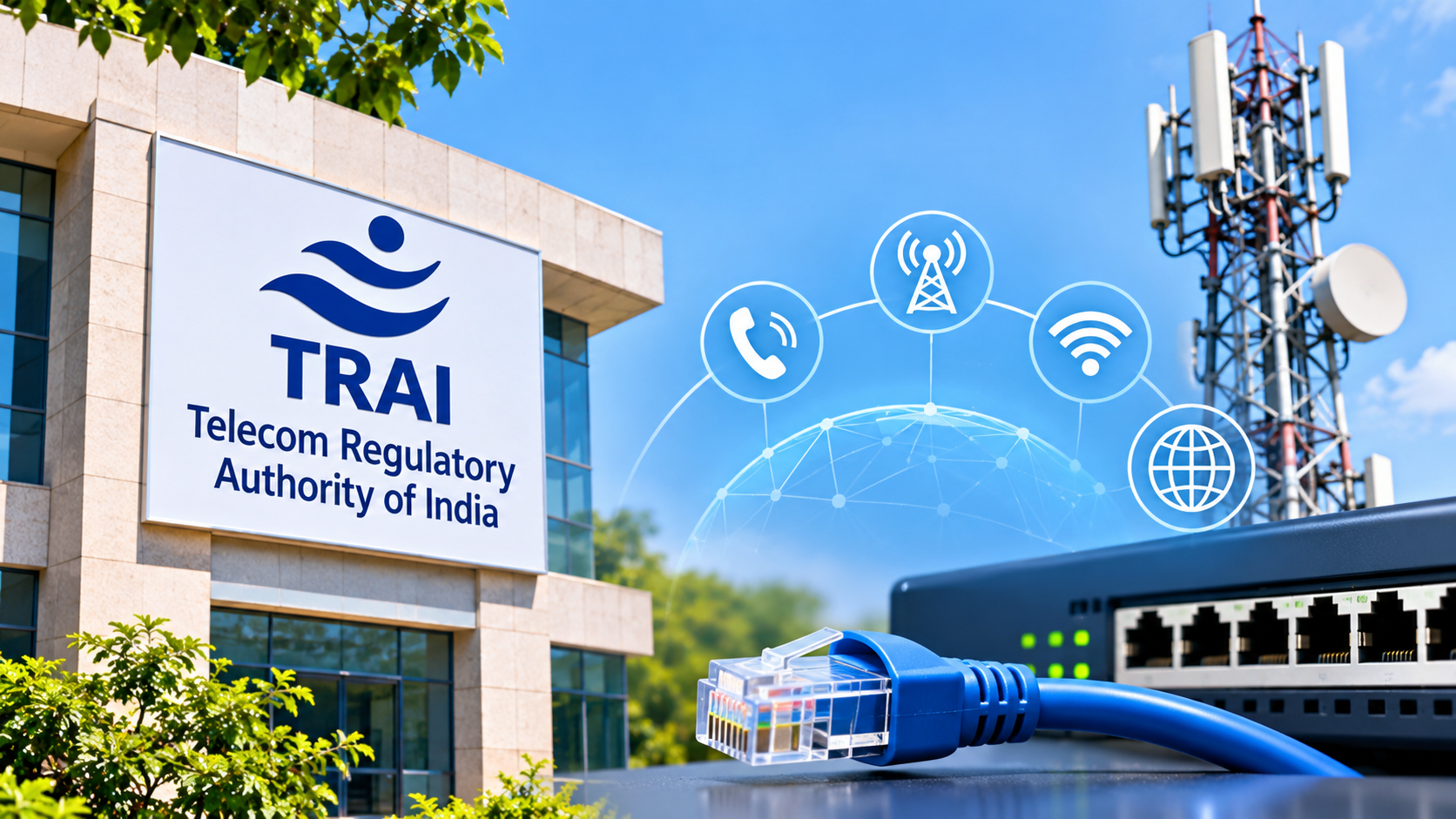
The Telecom Regulatory Authority of India (TRAI) released the Telecommunication Interconnection (Port Charges) (Third Amendment) Regulations, 2026 on 9 November 2026, introducing a revised framework for charges associated with Internet Protocol (IP)-based telecom network interconnections.
The new regulations will come into effect on 1 January 2027. TRAI has fixed annual ceiling charges of ₹5.6 lakh for a 1 Gbps IP port and ₹42.3 lakh for a 10 Gbps IP port.
The amendments aim to modernise India's telecom infrastructure, improve network connectivity, promote transparency and ensure fair competition among telecom service providers.
Key Changes Introduced by TRAI
The revised regulations introduce several important changes to India's telecom interconnection framework.
IP Port Recognition: The definition of a telecom port now includes both traditional E1 ports and modern IP-based ports.
1 Gbps Port Charges: Maximum annual charge fixed at ₹5.6 lakh.
10 Gbps Port Charges: Maximum annual charge fixed at ₹42.3 lakh.
Flexible Pricing: Telecom operators can mutually negotiate charges below the prescribed ceilings.
Uniform Application: The regulations apply to fixed-line, mobile, national long-distance and international long-distance telecom services.
Financial Penalties: A graded financial disincentive framework has been introduced, with penalties of up to ₹15 lakh per service area for each specified violation.
Why Were the Regulations Amended?
India's earlier telecom interconnection framework was primarily based on E1 and Time Division Multiplexing (TDM) technologies, which were widely used in traditional telephone networks.
The original Telecommunication Interconnection (Port Charges) Regulations were introduced in 2001, while the prescribed charges were last revised in 2012.
With the expansion of 4G, 5G and internet-based communication services, telecom networks increasingly rely on IP technology.
The revised regulations aim to:
Modernise the telecom interconnection framework.
Improve efficiency in communication between telecom networks.
Establish transparent and predictable interconnection charges.
Encourage technological upgrades.
Promote fair competition among telecom operators.
Understanding Telecom Interconnection
Telecom interconnection refers to the technical and commercial arrangements that allow different telecom networks to communicate with one another.
For example, when a customer using one telecom operator calls a customer using another operator, the networks must be interconnected to complete the call.
Internet Protocol (IP) interconnection allows communication traffic to move between telecom networks using packet-based technology.
Compared with traditional E1/TDM systems, IP-based interconnection can support greater bandwidth and more efficient network operations.
Significance for India's Telecom Sector
The amendments are expected to strengthen India's digital communication infrastructure by establishing a modern regulatory framework for telecom interconnection.
They will provide greater certainty to telecom service providers, facilitate the adoption of advanced networking technologies and support seamless communication across different networks.
The reforms also align with India's broader efforts to modernise digital infrastructure and strengthen connectivity.
Important Facts for Exams
Regulatory Authority: Telecom Regulatory Authority of India (TRAI).
Established: 20 February 1997.
Governing Legislation: TRAI Act, 1997.
Headquarters: New Delhi.
Regulations Released: 9 November 2026.
Effective Date: 1 January 2027.
Regulation Name: Telecommunication Interconnection (Port Charges) (Third Amendment) Regulations, 2026.
1 Gbps IP Port Ceiling: ₹5.6 lakh annually.
10 Gbps IP Port Ceiling: ₹42.3 lakh annually.
Traditional E1 Port Capacity: 2.048 Mbps.
Maximum Financial Disincentive: ₹15 lakh per service area for each specified contravention.
Section 11(1)(b), TRAI Act, 1997: Empowers TRAI to prescribe interconnection terms and conditions and ensure technical compatibility between service providers.
Main Objective: Modernisation, transparency, non-discrimination and fair competition in telecom interconnection.