
Class 8 Mock Tests: School Exam and NMMS Practice
Plan your Class 8 practice tests for the half-yearly, annual exam and NMMS, and learn how to review each attempt to raise your score.
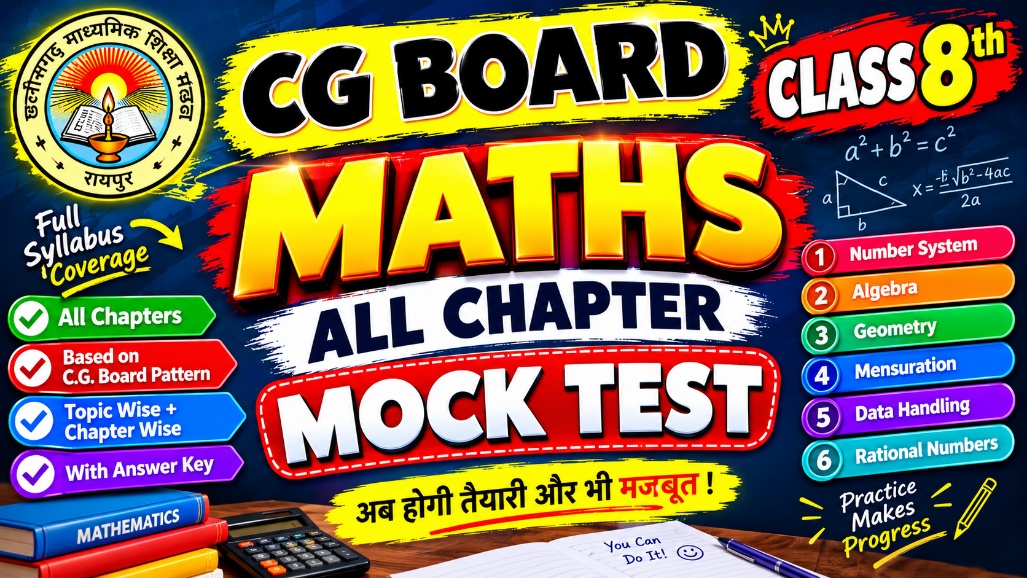
A Class 8 mock test is a practice paper taken under real exam conditions: a fixed time, no book open, and a score at the end. For the school annual exam, mock tests show whether you can write complete answers in time. For the NMMS scholarship test, they matter even more, because the paper is 90 questions in 90 minutes and speed is something you build only by practising against the clock.
This page explains which kinds of Class 8 practice tests to take and when, how to review each attempt so your score actually improves, and what numbers to track before the half-yearly exam, the annual exam and NMMS. It suits students in CBSE and NCERT-based schools, and the NMMS sections apply to every state.
Types of Class 8 Practice Tests
Test type | What it covers | When to take it |
|---|---|---|
Chapter test | One chapter, 10 to 20 questions | Within a week of finishing the chapter in class |
Unit or term test | Several chapters of one subject | Two to three weeks before a periodic test or the half-yearly exam |
Full-length school paper | A complete 80-mark paper in the school pattern | The last three weeks before the half-yearly and annual exams |
NMMS MAT test | 90 reasoning questions in 90 minutes | Weekly from about two months before the state test |
NMMS SAT test | 90 questions on Class 7 and 8 Science, Social Science and Mathematics | Weekly from about two months before the state test |
Previous year NMMS paper | Your state's actual past paper | At the start (to diagnose) and in the final month |
Practise in the Current Pattern
Practice is only useful if it matches the real paper. Three points matter for Class 8 this year:
Use the new NCERT chapters: School practice tests must follow Ganita Prakash, Curiosity, Exploring Society, Poorvi and the other new books. A test built on the old books will waste your time on chapters you are not studying.
Match your school's paper shape: If your school sets case-based and assertion-reason questions, include them in practice. Ask your teacher for a sample paper from last year.
Match NMMS timing exactly: 90 questions in 90 minutes for each paper. A practice test without a timer will give you a false sense of readiness.
A Year-Long Plan for Class 8 Mock Tests
April to July, chapter tests: One short test per chapter in Mathematics and Science, and one per two chapters in Social Science. Aim for understanding, not speed.
August, first NMMS diagnostic: If you plan to sit NMMS, take one past state paper untimed. It shows which reasoning types and which Class 7 topics are weak.
Late August to September, term practice: Two full school papers per main subject before the half-yearly exam.
October to the NMMS date, weekly NMMS tests: One MAT and one SAT test a week, plus 20 minutes of daily reasoning drills. In the last three weeks, take two of each per week.
January to March, annual exam papers: Two or three full papers per subject, with at least one covering the whole year if your school tests the full syllabus.
Before any re-exam: If you need a re-exam under the promotion rules, take one paper a week in the failed subject for the two months before it.
A Sample NMMS Practice Week
In the last two months before your state's NMMS test, a week like this keeps both papers moving without crowding out school work.
Day | Practice | Time |
|---|---|---|
Monday | Reasoning drill: series and analogies | 20 minutes |
Tuesday | SAT Science chapter set, Class 7 and 8 | 30 minutes |
Wednesday | Reasoning drill: coding-decoding and figures | 20 minutes |
Thursday | SAT Social Science fact set with maps | 30 minutes |
Friday | SAT Mathematics set: percentages, exponents, area | 30 minutes |
Saturday | Full MAT paper, then review | 90 plus 60 minutes |
Sunday | Full SAT paper, then review | 90 plus 60 minutes |
Subject-Wise Tips for School Mock Papers
Mathematics: Write every step, even in practice. Check answers by substituting back in algebra questions, and draw rough figures for geometry and area.
Science: Include at least one labelled diagram and one numerical in every practice paper. Chapters on electricity, forces, pressure and light need the most timed practice.
Social Science: Practise map questions and source-based questions, and time your long answers so each takes no more than 8 to 10 minutes.
English and Hindi: Time the writing section separately. Letters and notices lose marks for format more often than for content.
How to Review a Mock Test
Most of the benefit comes after the test, in the review. Spend at least as long reviewing as you spent writing.
Sort every lost mark into a bucket: Did not know the concept, knew it but made a careless slip, ran out of time, or misread the question.
Rework wrong answers without help: Try again with the book closed. Only then check the solution.
Find skipped-but-solvable questions: In NMMS practice, mark questions you skipped and could solve in under a minute later. These are free marks lost to poor ordering.
Log errors: Write each mistake in an error notebook with the correct method. Read this notebook before the next test.
Retest weak chapters: Take a short chapter test on the weakest area within a week.
Benchmarks to Track
Measure | School exam target | NMMS target |
|---|---|---|
Accuracy | Above 80% on 1 and 2-mark questions | Above 75% of attempted questions |
Completion | Finish the paper with 10 to 15 minutes to check | Attempt all 90 questions in each paper |
Section balance | No section below half marks | No SAT subject below half marks |
Trend | Score rising across three papers | Score above your district target in three tests in a row |
What to Do When a Score Drops
Scores do not rise in a straight line. A drop after two good tests is normal, especially when a test covers new chapters or a harder set of reasoning questions. Before you worry, check three things:
Was the test harder or on new material? Compare the chapters covered with your earlier tests.
Where did the marks go? If one section fell and the others held, the fix is narrow: one chapter or one question type.
Was it time or knowledge? Many unattempted questions point to pacing, not weak study.
Act on the one biggest cause, then retest. Two drops in a row in the same section mean that section needs a fresh round of study before more tests.
Free Practice Sources
NCERT textbooks: The in-chapter questions and end-of-chapter exercises make good chapter tests when timed.
State SCERT websites: Many states publish previous NMMS papers and answer keys.
School sample papers: Your school's last annual paper is the closest guide to this year's.
Common Mistakes With Practice Tests
Taking tests too late: Starting full papers one week before the exam leaves no time to fix what they reveal.
Checking only the score: A score without review teaches very little.
Practising without a timer: Especially harmful for NMMS, where time is the main challenge.
Ignoring Class 7: NMMS SAT questions come from Class 7 too.
Using old-syllabus papers: Questions from removed chapters do not help.
Comparing with friends instead of your own trend: Your own rising score is the measure that matters.
For the official books used in practice, go to the NCERT textbook portal.