
MPESB Departmental Nayab Tahsildar 2026 Exam Overview Mock Tests
Practice with mock tests built specifically for MPESB Departmental Nayab Tahsildar 2026 Exam Overview.
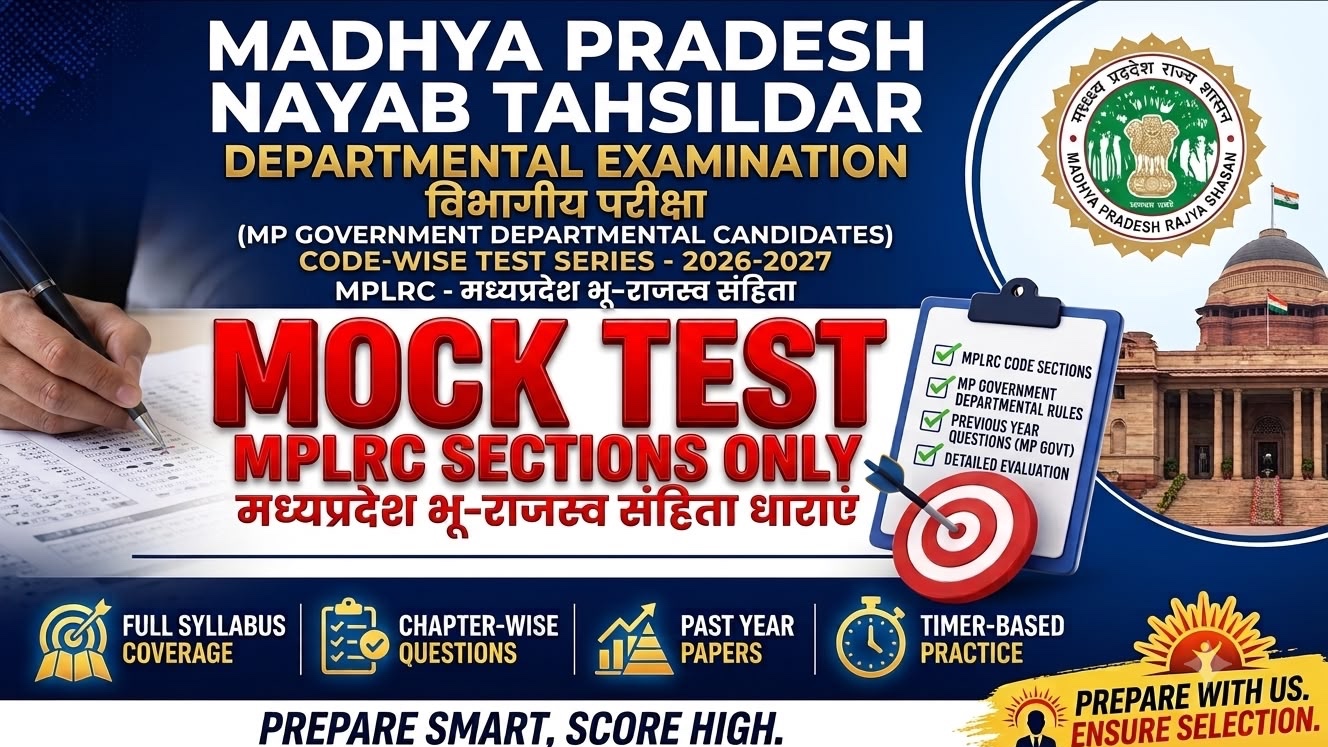
Why Mock Tests Are Crucial for the MPESB Departmental Nayab Tahsildar Exam
The MPESB Departmental Nayab Tahsildar Exam is a specialized promotional test for serving revenue personnel. Unlike open competitive exams, this test assesses your working knowledge of revenue codes, land records, and departmental procedures — often in a high-pressure, time-bound format. Attempting structured mock tests is the single most effective way to bridge the gap between knowing the syllabus and performing well on the actual exam day.
For this specific exam, mock tests serve three critical purposes:
Acclimatization to the Official Pattern: The exam has a distinct structure, marking scheme (including negative marking, if applicable), and a specific distribution of questions across revenue law and administrative topics. Mocks replicate this exact flow, so you do not face any surprises in the actual exam hall.
Mastery of Revenue-Specific Terminology: Questions are often framed using exact terminology from the MP Land Revenue Code, MP Land Records Manual, and service rules. Regular mock attempts force you to recall precise definitions, time limits, and appeal procedures, rather than just recognizing them.
Speed and Accuracy Calibration: Because you are already a serving officer, your preparation time is limited. Mocks teach you which question types (e.g., numerical land revenue calculations vs. procedural rules) to attempt first and how to eliminate options quickly without compromising accuracy.
How to Use Mock Tests Effectively for This Exam
Simply taking a test and checking your score is not enough. To move from a "qualified" to a "top-ranked" candidacy in a departmental exam, adopt a structured, iterative approach:
Phase 1 — Diagnostic (Timed Attempts from Day One): Even before you finish your syllabus, schedule a full-length mock in a strict, timer-based environment. This identifies your existing strengths (e.g., in the Land Records Manual) and your weakest sections (e.g., in the MP Civil Services Rules). Use this to allocate your study time proportionally.
Phase 2 — Sectional Intensity: After the diagnostic, do not just take full tests. Break down your mock series into sectional drills (e.g., 20 questions on the Land Revenue Code only) and practice them under a micro-timer. This builds automaticity for procedural questions that have fixed answers.
Phase 3 — Error Analysis is Non-Negotiable: For every mock you take, maintain a three-column error log: Conceptual Error (you did not know the rule), Reading Error (you misread "revision" for "review"), and Time-Pressure Error (you knew it but ran out of time). Review this log before every subsequent attempt. This is the most effective tool for converting mistakes into marks.
Phase 4 — Gradually Increasing Difficulty: Do not start with the most difficult tests available. Begin with standard-level mocks to build confidence and basic recall. As the exam approaches, shift to high-difficulty mocks that include trickier "case-based" scenario questions and lower-probability statutory exceptions. This ensures that the actual exam — which is generally of moderate difficulty — feels easier by comparison.
What to Look for in a Good Mock Test Series
Not all mock test series are created equal. Since the MPESB typically draws questions from specific, internal departmental sources, you must select a series with the following features to ensure your practice is relevant:
Strictly Syllabus-Aligned Content: The tests must strictly cover the MP REAP (Recruitment Examination and Promotion) — specifically the Nayab Tahsildar departmental syllabus, including the Panchayati Raj laws, Land Records Manual, and Public Service Conduct Rules. Avoid generic "State PSC" mocks that do not drill down to the departmental specifics.
Accurate Difficulty and Discrimination Index: A good mock should have a realistic spread of Easy (50%), Moderate (30%), and Difficult (20%) questions. If you consistently score 90%+ in your first few attempts, the series is too easy. If you score below 30%, it is likely testing irrelevant or overly obscure provisions.
Detailed, Explanatory Solutions: Look for solutions that state why an option is correct, specifically citing the relevant Section or Rule number from the MP Revenue Code (e.g., "Section 57 of the MP Land Revenue Code"). A simple answer key without legal citations is useless for revision.
Realistic Timer and Interface: The mock should simulate the actual MPESB computer-based test interface, including the option palette and question-palette navigation. Practice on a platform that forces you to "submit" at the end of the time — this builds the mental stamina needed for the real 2-3 hour window.
Performance Analytics: After the test, the platform should offer a concept-wise breakdown (e.g., your accuracy in "Appeals and Revision" vs. "Alienation of Land"). This allows you to see whether your improvement in one section is offset by a decline in another, a critical factor for promotional exam cut-offs.
Note: The exact number of questions, exam duration, and passing criteria vary year-to-year based on the official MPESB notification. Always cross-verify the actual exam pattern with the official advertisement before finalizing your mock-test strategy.