
SSC JE Civil Mock Tests: Practice in the Real Exam Format
Attempt SSC JE Civil mock tests online and learn how to turn every result into a better score.
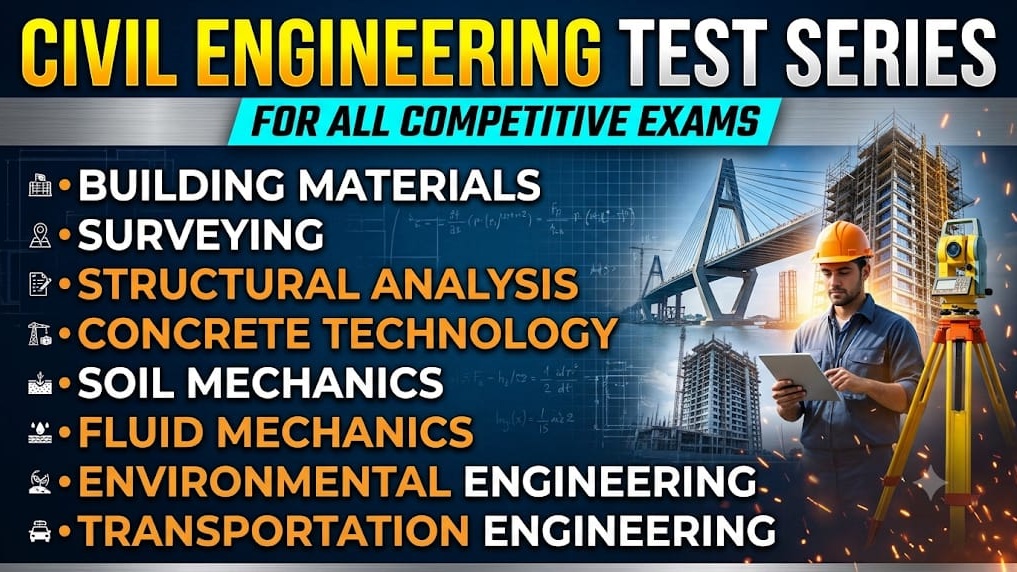
SSC JE Civil mock tests let you practise the exam in the same format you will face on the day: a timed, computer based paper with negative marking. Knowing the syllabus is only half the job. Mocks show whether you can apply it under time pressure, which is what decides a rank in a paper of 200 questions in 2 hours.
This page explains the types of tests worth taking, how to schedule them and how to analyse each one. Paper 1 of the 2026 cycle is proposed for 2 to 6 November 2026, and Paper 2 is tentatively reported for December 2026.
Table of Contents
Types of SSC JE Civil Mock Tests
Test type | What it covers | When to take it |
|---|---|---|
Topic-wise test | One engineering topic, such as surveying or soil mechanics | Right after finishing a topic |
Sectional test | Reasoning, General Awareness or Civil Engineering alone | Weekly, to build speed in one section |
Paper 1 full mock | 200 questions in 2 hours | Twice a week in the final weeks |
Paper 2 full mock | 100 Civil and Structural questions in 2 hours | Once a week, and more after Paper 1 |
Previous-year paper | Real questions from earlier cycles | To learn difficulty and question style |
How to Use Mock Tests
Start with topic tests: After each subject, take a short test to confirm that the concepts are firm.
Add sectional tests: Practise one section at a time to improve speed and accuracy.
Move to full mocks: Attempt full papers in one sitting, without breaks, at the same time of day as your exam slot.
Mix in previous papers: They show the real difficulty and the repeated topics.
Taper before the exam: In the last few days, revise your error log instead of taking many new tests.
How to Analyse a Mock Test
A mock is only useful if you review it. Spend as long on analysis as on the test itself. Sort every missed mark into one of these groups:
Wrong answers: Find whether the cause was a concept gap, a formula slip or a careless reading.
Slow questions: Note any question that took more than a minute and a half, and learn a faster method.
Skipped but solvable: Check if you left questions you could have answered, which is a confidence problem.
Guesses: Count how many guesses were right or wrong, because negative marking punishes blind guessing.
Official Practice Material from SSC
We could not verify an official mock test or sample paper page for the Junior Engineer examination on the Staff Selection Commission website. Candidates can read the notices, the syllabus and the exam instructions on the official SSC website, and should rely on it for any practice material SSC may release later