Cyclone Arnab 2026: Disaster Management and India's Response
Key points
Why in the News?
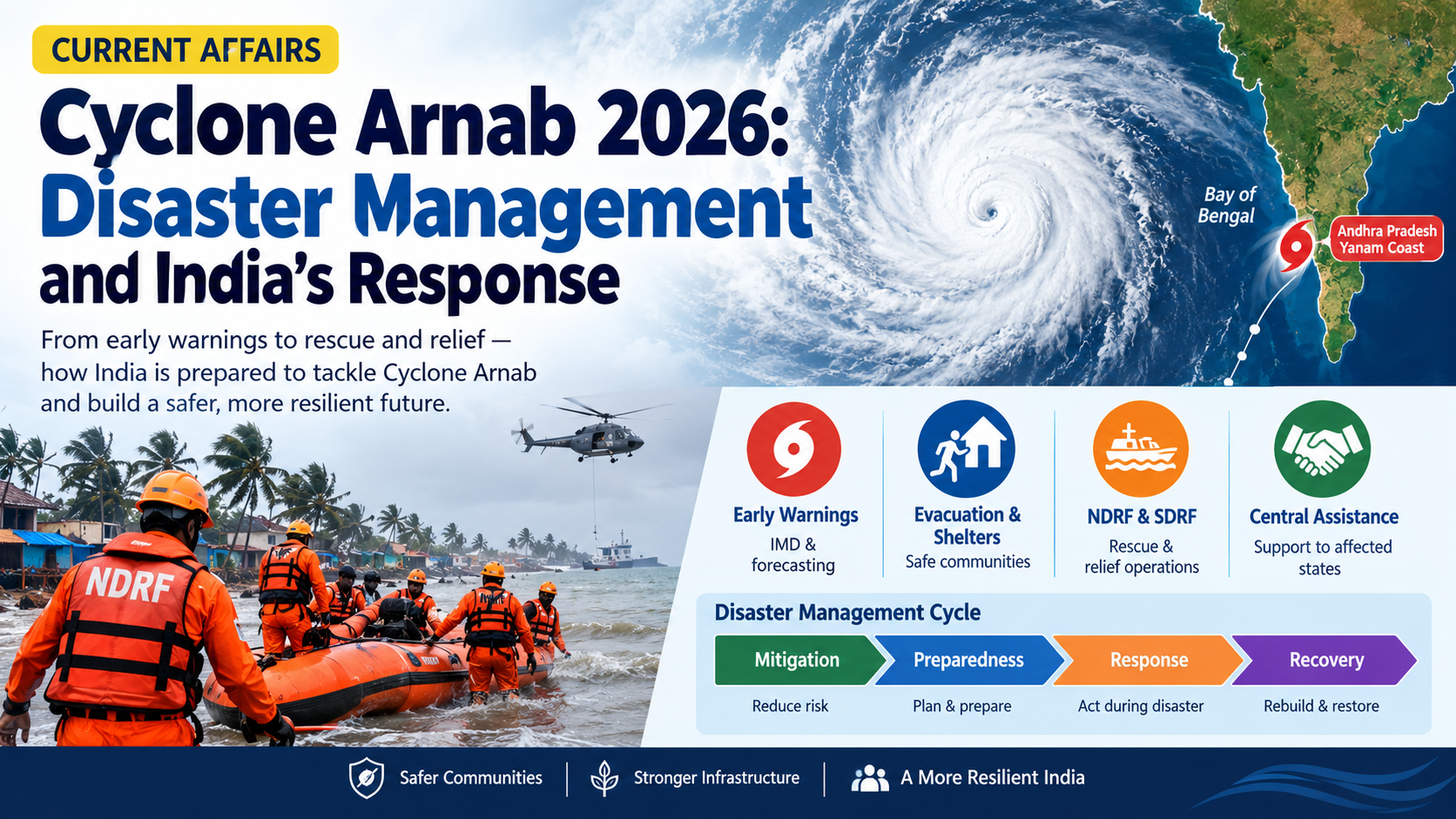
Cyclone Arnab intensified over the Bay of Bengal and crossed the Andhra Pradesh–Yanam coast on 28 October 2026. The cyclone triggered preparedness, evacuation, rescue and relief measures across affected regions.
On 29 October 2026, the Ministry of Home Affairs reported that Union Home Minister Amit Shah had spoken with the Chief Ministers of Andhra Pradesh, Puducherry, Odisha and Chhattisgarh to assure them of central assistance. National Disaster Response Force (NDRF) and State Disaster Response Force (SDRF) teams were engaged in rescue and relief operations. Inter-Ministerial Central Teams (IMCTs) were also to be sent to assess the damage and determine further assistance requirements.
Official update: Press Information Bureau (PIB), Ministry of Home Affairs.
1. What Is Cyclone Arnab?
Cyclone Arnab was a tropical cyclone that developed over the Bay of Bengal in October 2026. According to the Cabinet Secretariat's PIB release dated 26 October, the system developed from a deep depression and intensified into a cyclonic storm.
The India Meteorological Department (IMD) forecast that it would cross the Andhra Pradesh and Yanam coasts between Bapatla and Visakhapatnam as a very severe cyclonic storm on 28 October.
Key Facts
Cyclone name: Arnab
Region of formation: Bay of Bengal
Affected coastal region: Andhra Pradesh–Yanam coast
Expected landfall date: 28 October 2026
Forecast intensity before landfall: Very severe cyclonic storm
Forecast wind speed in the 26 October PIB release: 115–125 km/h, with gusts up to 140 km/h
Key agencies involved: IMD, NDRF, SDRF, NDMA, state disaster management authorities and the armed forces
These wind speeds were forecast before landfall; they should not be interpreted as a verified post-landfall measurement.
2. Government's Disaster Management Response
The Cabinet Secretary, Dr T. V. Somanathan, chaired a meeting of the National Crisis Management Committee (NCMC) on 26 October 2026 to review preparedness for Cyclone Arnab.
The meeting reviewed evacuation arrangements, shelters, deployment of response teams, emergency coordination and measures to minimise damage.
Major Preparedness Measures
Evacuation and shelters: State governments and local administrations arranged shelters and evacuation measures for vulnerable areas.
NDRF and SDRF deployment: Response teams were deployed or kept on standby for rescue and relief work.
District Control Rooms: Control rooms were activated to monitor conditions and coordinate local responses.
Fishermen's safety: Fishermen were advised not to venture into specified areas of the Bay of Bengal and along the affected coasts during the warning period.
Armed forces and Coast Guard: Rescue and relief teams of the Army, Navy, Air Force and Indian Coast Guard, along with ships and aircraft, were kept ready.
Essential services: Authorities were directed to minimise damage to infrastructure and restore essential services as quickly as possible.
3. Latest Central Government Assistance
On 29 October 2026, the Ministry of Home Affairs reported that the Union Home Minister had spoken with the Chief Ministers of Andhra Pradesh, Puducherry, Odisha and Chhattisgarh.
The government stated that NDRF and SDRF teams were conducting rescue and relief operations. Inter-Ministerial Central Teams were to assess the impact and identify further assistance required.
Damage assessment is important because it helps authorities determine the scale of losses and the support required for affected communities and infrastructure.
4. What Is Disaster Management?
Disaster management refers to the systematic process of preparing for, responding to and recovering from disasters. Its purpose is to reduce loss of life, minimise damage to property and infrastructure, and help affected communities recover.
India's disaster management approach includes four major stages:
Stage | Meaning | Cyclone-related example |
|---|---|---|
Mitigation | Reducing disaster risk over the long term | Cyclone-resistant buildings and coastal shelters |
Preparedness | Planning and readiness before a disaster | Early warnings, evacuation plans and mock drills |
Response | Immediate action during and after a disaster | Search and rescue, medical assistance and emergency shelters |
Recovery | Restoring normal life after the disaster | Rebuilding homes, restoring electricity and repairing roads |
These stages are interconnected. Effective preparedness and mitigation can reduce the impact of a cyclone, while timely response and recovery help communities return to normal life.
5. Important Institutions for Disaster Management in India
National Disaster Management Authority (NDMA)
The NDMA lays down policies, plans and guidelines for disaster management in India. It is chaired by the Prime Minister of India.
National Disaster Response Force (NDRF)
The NDRF is a specialised force responsible for responding to major natural and human-made disasters. Its activities include search and rescue, evacuation support and emergency response.
State Disaster Response Force (SDRF)
State-level response forces support disaster response within their respective states. They work with state authorities and other agencies during emergencies.
Important distinction: SDRF can also refer to the State Disaster Response Fund, a financial mechanism for providing relief following notified disasters. The context determines which meaning applies.
India Meteorological Department (IMD)
The IMD monitors weather systems, forecasts cyclones and issues meteorological warnings. Early warnings help governments and communities prepare for potential hazards.
National Crisis Management Committee (NCMC)
The NCMC coordinates the response of central ministries and agencies during major crises. In Cyclone Arnab's case, it reviewed preparedness and inter-agency coordination.
6. How Are Cyclones Classified in India?
The IMD classifies cyclonic systems over the North Indian Ocean according to their maximum sustained wind speeds.
System | Maximum sustained wind speed |
|---|---|
Depression | 31–49 km/h |
Deep Depression | 50–61 km/h |
Cyclonic Storm | 62–88 km/h |
Severe Cyclonic Storm | 89–117 km/h |
Very Severe Cyclonic Storm | 118–166 km/h |
Extremely Severe Cyclonic Storm | 167–221 km/h |
Super Cyclonic Storm | 222 km/h or more |
Note: These are IMD classification ranges. Gusts can be higher than the maximum sustained wind speed.
7. Why Is India's East Coast Vulnerable to Cyclones?
The Bay of Bengal is a major region for tropical cyclone formation. India's eastern coastline is vulnerable to cyclones because of strong winds, heavy rainfall, storm surges and coastal flooding.
Low-lying coastal settlements, river deltas, fishing communities and densely populated areas may face greater risks.
Major Cyclone Hazards
Strong winds: Can damage buildings, electricity lines and communication networks.
Heavy rainfall: Can cause river flooding and urban waterlogging.
Storm surge: An abnormal rise in sea level associated with a storm can inundate coastal areas.
Coastal erosion: Waves and storm surges can remove sand and damage shorelines.
Infrastructure disruption: Roads, airports, ports, power supplies and telecommunications may be affected.
8. Role of Early Warning Systems
Early warning systems are a key part of disaster risk reduction. The IMD provides weather forecasts and cyclone warnings, while disaster management authorities communicate alerts and organise protective action.
An effective warning system requires more than accurate forecasting. Information must reach vulnerable communities in time, be clearly understood and be linked to practical actions such as evacuation, shelter access and the protection of essential services.
9. Disaster Management Act, 2005
The Disaster Management Act, 2005 provides the legal framework for disaster management in India.
It provides for institutional arrangements at the national, state and district levels, including the NDMA, State Disaster Management Authorities (SDMAs) and District Disaster Management Authorities (DDMAs).
The framework supports disaster prevention, mitigation, preparedness, response and recovery through coordinated planning and implementation.
10. Key Lessons from Cyclone Arnab
Cyclone Arnab highlights the importance of coordination among meteorological agencies, central ministries, state governments, local administrations and emergency response forces.
Important lessons include:
Early warnings must be followed by timely protective action.
Evacuation plans and accessible shelters are essential in vulnerable areas.
Fishermen and coastal communities require clear, timely alerts.
Essential services and transport networks need contingency plans.
Rapid damage assessment helps guide relief and recovery.
Coordination between central and state authorities improves disaster response.
Important Takeaways for Competitive Exams
Cyclone Arnab affected the Bay of Bengal region and crossed the Andhra Pradesh–Yanam coast on 28 October 2026.
The Cabinet Secretary chaired an NCMC preparedness meeting on 26 October 2026.
The IMD is India's national meteorological agency responsible for weather forecasting and cyclone warnings.
The NDMA is chaired by the Prime Minister.
The NDRF is a specialised disaster response force.
The Disaster Management Act was enacted in 2005.
Disaster management includes mitigation, preparedness, response and recovery.
Storm surge is a major coastal hazard associated with tropical cyclones.
On 29 October 2026, the Ministry of Home Affairs reported central assistance and ongoing NDRF and SDRF relief operations in the wake of Cyclone Arnab.