Delhi-NCR Air Pollution 2026: GRAP Stage III Restrictions
Key points
Why in the News?
The Commission for Air Quality Management (CAQM) invoked Stage III of the Graded Response Action Plan (GRAP) across Delhi and the National Capital Region (NCR) with immediate effect.
The decision was taken as air pollution levels continued to deteriorate ahead of Diwali. Delhi's 24-hour average Air Quality Index (AQI) reached 382 on 6 November, falling within the Very Poor category and approaching the Severe category.
The restrictions were introduced as a precautionary measure to prevent further deterioration in air quality, particularly because weather forecasts indicated the possibility of severe pollution levels in the following days.
What Is the Graded Response Action Plan (GRAP)?
The Graded Response Action Plan (GRAP) is an emergency pollution-control framework implemented in Delhi-NCR to reduce air pollution.
It provides a series of measures that become progressively stricter as air quality deteriorates.
GRAP is implemented by the Commission for Air Quality Management (CAQM) in coordination with the governments and pollution-control authorities of Delhi and neighbouring NCR states.
The framework focuses on controlling emissions from vehicles, industries, construction activities, road dust and other major pollution sources.
Four Stages of GRAP
Stage | Air Quality Category | AQI Range |
|---|---|---|
Stage I | Poor | 201–300 |
Stage II | Very Poor | 301–400 |
Stage III | Severe | 401–450 |
Stage IV | Severe+ | Above 450 |
Important: GRAP Stage III can also be implemented in advance when forecasts indicate that air quality is likely to enter the Severe category. This is why Stage III was invoked even though Delhi's average AQI on 6 November was below 401.
Restrictions Under GRAP Stage III
Construction and Demolition Activities
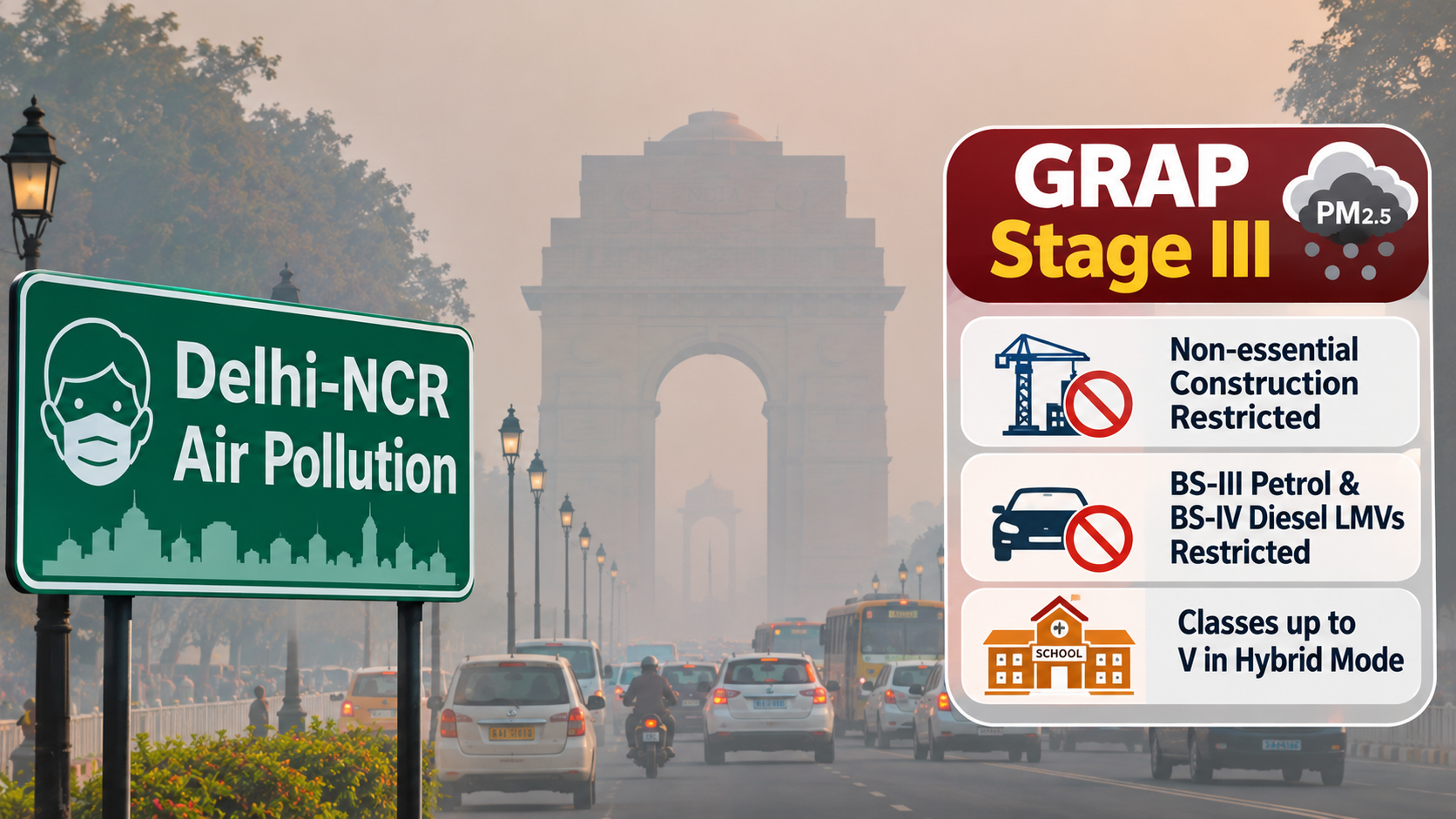
GRAP Stage III imposes strict restrictions on non-essential construction and demolition activities that generate dust.
Activities such as excavation, earthwork, trenching, piling and certain road construction operations face restrictions.
However, specified essential infrastructure projects may continue under prescribed pollution-control conditions.
Restrictions on Vehicles
Stage III restricts the movement of BS-III petrol and BS-IV diesel light motor vehicles (four-wheelers) in Delhi and designated NCR districts, subject to applicable exemptions.
These restrictions aim to reduce vehicular emissions, which are an important contributor to urban air pollution.
School Education Measures
Under the Stage III framework, schools up to Class V in Delhi and designated NCR districts are required to provide education in hybrid mode wherever online facilities are available.
This allows students to attend classes physically or online, depending on the applicable directions and available facilities.
The measure is intended to reduce children's exposure to harmful outdoor air pollution.
Dust and Industrial Pollution Control
Authorities intensify road cleaning, water sprinkling, dust suppression and enforcement against polluting activities.
Industrial units and other emission sources must comply with applicable pollution-control requirements.
State governments may also consider additional measures, including work-from-home arrangements, to reduce traffic and emissions.
What Is the Air Quality Index (AQI)?
The Air Quality Index (AQI) is a numerical indicator used to communicate the level of air pollution and its potential impact on human health.
In India, AQI is monitored and reported by the Central Pollution Control Board (CPCB) and other authorised monitoring agencies.
India's AQI Categories
AQI Range | Category |
|---|---|
0–50 | Good |
51–100 | Satisfactory |
101–200 | Moderate |
201–300 | Poor |
301–400 | Very Poor |
401–500 | Severe |
India's National AQI considers eight major pollutants: PM2.5, PM10, nitrogen dioxide (NO₂), sulphur dioxide (SO₂), carbon monoxide (CO), ozone (O₃), ammonia (NH₃) and lead (Pb).
Major Causes of Air Pollution in Delhi-NCR
Delhi-NCR experiences particularly high air pollution during the winter season because of several interacting factors.
Vehicular emissions contribute nitrogen oxides and particulate matter, while construction activities and road dust increase the concentration of suspended particles.
Industrial emissions, waste burning and seasonal agricultural residue burning also contribute to pollution.
During winter, lower temperatures, weak winds and atmospheric temperature inversions can trap pollutants close to the ground, resulting in prolonged smog conditions.
Firecracker emissions during festivals may further worsen air quality.
About the Commission for Air Quality Management (CAQM)
The Commission for Air Quality Management is a statutory body established to improve air quality management in the National Capital Region and adjoining areas.
It functions under the Commission for Air Quality Management in National Capital Region and Adjoining Areas Act, 2021.
The Commission coordinates pollution-control measures across different states and authorities, monitors implementation and issues directions for controlling air pollution.
Its jurisdiction includes the National Capital Region and specified adjoining areas.
Significance of GRAP Stage III
The implementation of GRAP Stage III highlights the need for coordinated action against severe air pollution in Delhi-NCR.
The restrictions are designed to reduce emissions from construction, transport and other polluting activities before air quality reaches more dangerous levels.
The decision also demonstrates the importance of preventive environmental governance, air-quality forecasting and cooperation between central and state authorities.
Conclusion
The implementation of GRAP Stage III in Delhi-NCR on 6 November 2026 represents a precautionary response to deteriorating air quality ahead of Diwali.
The measures focus on restricting polluting activities, reducing vehicular emissions and protecting vulnerable populations.