India Drug Import Gateways 2026
Key points
Why in the News?
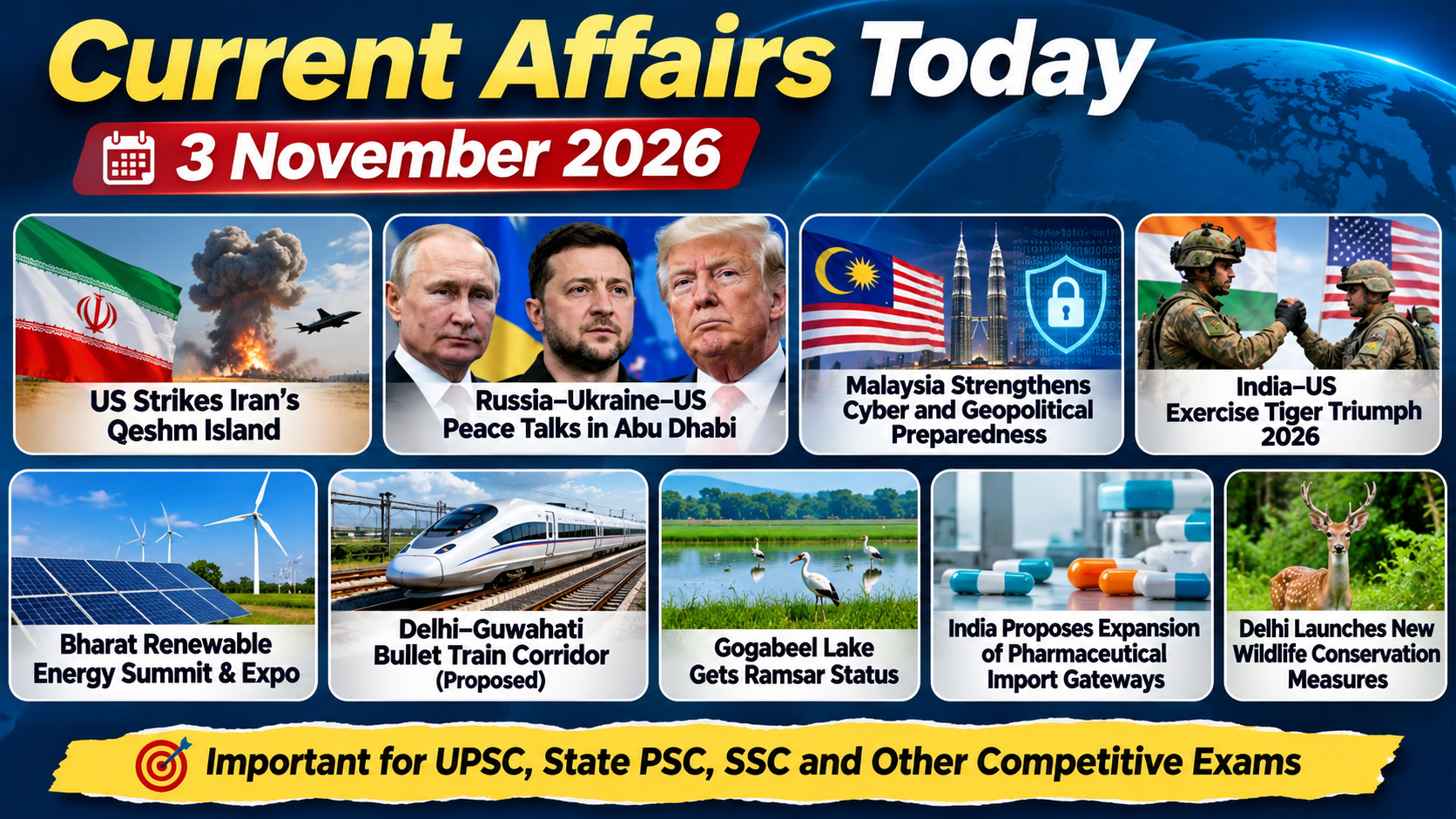
The Union Ministry of Health and Family Welfare (MoHFW) has proposed expanding India's authorised import gateways for drugs, medical devices and cosmetics.
On 3 November 2026, the Ministry announced a proposed amendment to Rule 43A of the Drugs Rules, 1945, allowing additional Inland Container Depots (ICDs), a Special Economic Zone (SEZ) and an international airport to handle pharmaceutical imports.
The initiative aims to improve logistics efficiency, reduce transportation costs, accelerate import clearance and strengthen India's healthcare supply chain.
Important: This is a proposed amendment. The additional gateways are not yet automatically authorised for imports.
Key Facts
Particulars | Details |
|---|---|
Initiative | Expansion of Drug and Medical Device Import Gateways |
Announced By | Ministry of Health and Family Welfare |
Announcement Date | 3 November 2026 |
Relevant Rules | Drugs Rules, 1945 |
Important Provision | Rule 43A |
Parent Legislation | Drugs and Cosmetics Act, 1940 |
Proposed New Locations | 10 |
States Covered | Haryana, Uttar Pradesh, Gujarat, Telangana and Karnataka |
Main Objective | Faster clearance and efficient healthcare logistics |
Current Status | Draft amendment / Proposed |
What is Rule 43A of the Drugs Rules, 1945?
Rule 43A specifies the authorised entry points through which drugs can be imported into India.
These include designated:
Seaports
Airports
Railway entry points
Road crossings
Other notified import locations
The government proposes amending this rule to expand the number of authorised import locations.
Why is the Government Expanding Import Gateways?
1. Faster Import Clearance
Additional authorised locations would allow importers to clear pharmaceutical consignments closer to their manufacturing units and distribution centres.
2. Reduced Logistics Costs
Shorter inland transportation distances can help reduce freight and handling expenses.
3. Stronger Healthcare Supply Chain
The initiative aims to improve the movement and availability of medicines, medical devices and cosmetics across India.
4. Ease of Doing Business
Expanding import infrastructure could simplify logistics operations for pharmaceutical and medical-device companies.
5. Improved Regional Connectivity
The proposal would expand access to import-clearance facilities across northern, western and southern India.
What is an Inland Container Depot (ICD)?
An Inland Container Depot (ICD) is a customs-enabled logistics facility located away from a seaport.
It allows importers and exporters to handle containerised cargo and complete customs-related procedures at inland locations.
Major Functions
Customs clearance
Cargo handling
Container storage
Import and export documentation
Transportation coordination
ICDs help connect inland industrial and commercial centres with international trade networks.
What is a Special Economic Zone (SEZ)?
A Special Economic Zone (SEZ) is a designated geographical area established to promote economic activity, investment, manufacturing and exports.
SEZs operate under a specialised regulatory and fiscal framework.
In this proposal, Bommasandra SEZ in Karnataka is among the locations identified for inclusion in the authorised healthcare-import network.
Existing Authorised Import Gateways
India already has a network of designated import gateways for pharmaceutical products.
The Ministry highlighted existing Inland Container Depots at:
Dhannad, Indore, Madhya Pradesh
Tihi, Indore, Madhya Pradesh
In July 2026, the government also notified Navi Mumbai International Airport as an authorised entry point for drug imports.
Following that notification, India had 42 notified ports of entry for drug imports.
The newly proposed gateways would expand this network after the required regulatory amendment is finalised.
Role of CDSCO
The Central Drugs Standard Control Organisation (CDSCO) is India's central drug regulatory authority.
It functions under the Directorate General of Health Services, Ministry of Health and Family Welfare.
Major Responsibilities
Regulation of drug imports
Approval of new drugs
Oversight of clinical trials
Regulation of specified medical devices
Coordination with State Drug Control Authorities
Enforcement of applicable drug-quality and safety standards
Public Consultation on the Proposed Amendment
The Ministry has invited objections and suggestions from stakeholders regarding the proposed amendment.
Submissions may be sent to:
Under Secretary (Drugs Regulation)
Ministry of Health and Family Welfare, Government of India
Kartavya Bhawan-1, New Delhi
Email: [email protected]
The government will consider the consultation process before finalising the amendment.
Conclusion
The proposed expansion of drug and medical-device import gateways is an important step towards improving India's pharmaceutical logistics infrastructure.
By allowing healthcare consignments to be cleared at additional inland locations, the government aims to reduce costs, minimise delays and improve supply-chain efficiency.