INS Sahyadri Participates in Naval Exercise with South Korea
- By Sanjay Kumar
- 4 Nov 2026, 16:38 IST
- 4 min read
Key points
Why in the News?
The Indian Navy's guided-missile stealth frigate INS Sahyadri successfully concluded its participation in the India–Republic of Korea Navy (IN–RoKN) Bilateral Exercise at Busan, South Korea, on 29 October 2026.
The Ministry of Defence officially announced the completion of the exercise on 3 November 2026.
The naval exercise involved the Indian Navy and the Republic of Korea Navy (RoKN) and aimed to strengthen maritime cooperation, improve operational coordination and enhance interoperability between the two countries.
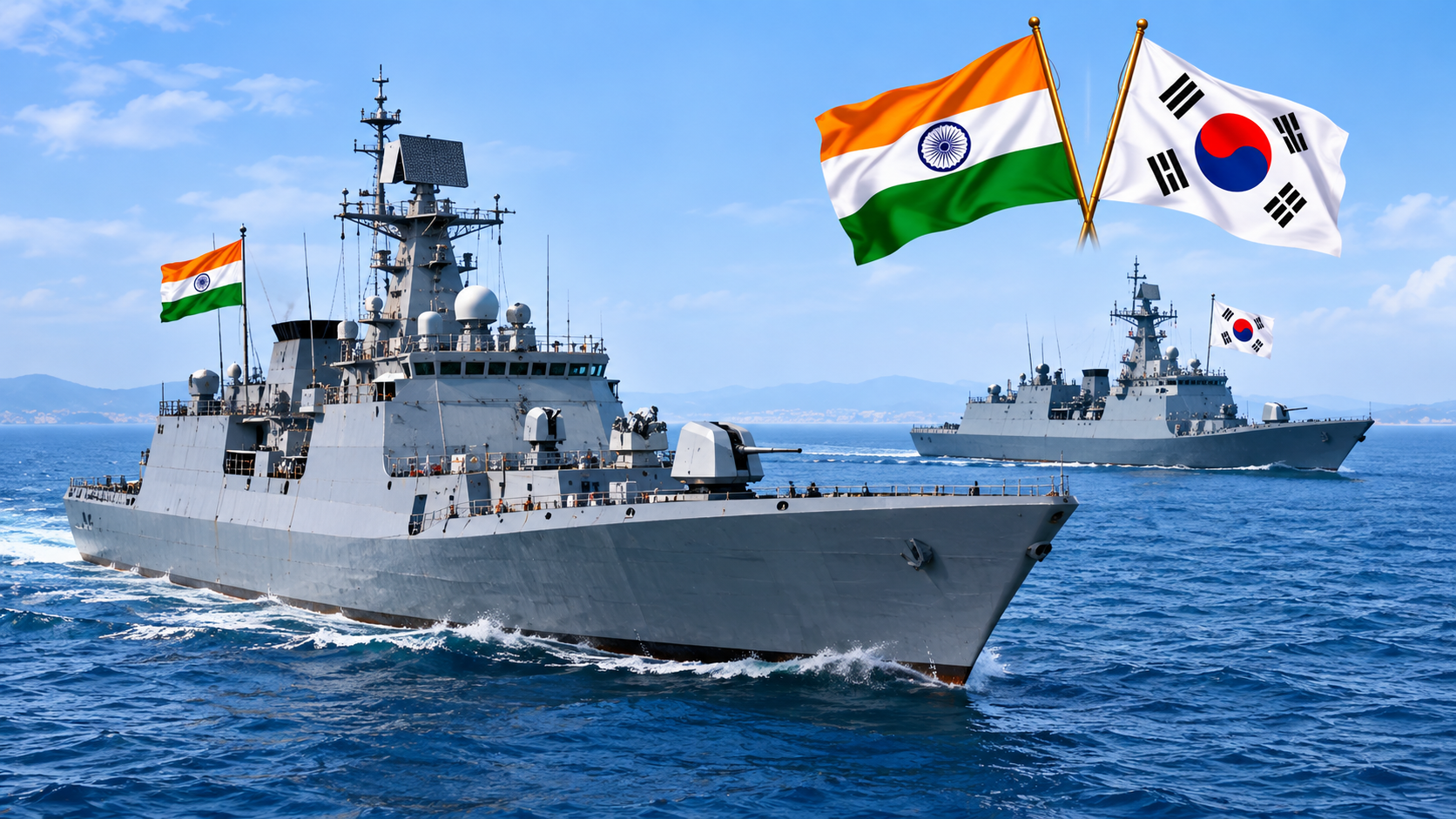
During the sea phase, INS Sahyadri and the South Korean warship ROKS Munmu the Great conducted coordinated navigation, helicopter operations and joint maritime manoeuvres.
The exercise highlighted the growing defence partnership between India and South Korea and their shared commitment to maintaining peace and security in the Indo-Pacific region.
Major Activities During the Naval Exercise
The bilateral naval exercise was conducted in two phases.
1. Harbour Phase
The harbour phase focused on professional interactions and cooperation between naval personnel.
Major Activities:
Professional discussions between naval officers.
Cross-deck visits to each other's warships.
Operational briefings.
Subject Matter Expert Exchanges.
Cultural exchange programmes.
Sporting activities.
These activities helped personnel exchange operational experiences and strengthen mutual understanding.
2. Sea Phase
The sea phase involved practical naval operations conducted by INS Sahyadri and ROKS Munmu the Great.
Major Activities:
Coordinated navigation.
Helicopter operations.
Joint maritime manoeuvres.
Operational coordination exercises.
These activities helped improve interoperability and familiarise both navies with each other's operating procedures.
About INS Sahyadri
INS Sahyadri is an indigenously designed and constructed guided-missile stealth frigate of the Indian Navy.
It belongs to the Shivalik class of stealth frigates and is an important part of India's naval fleet.
Important Facts About INS Sahyadri
Particulars | Details |
|---|---|
Name | INS Sahyadri |
Country | India |
Navy | Indian Navy |
Ship Type | Guided-Missile Stealth Frigate |
Class | Shivalik Class |
Position in Class | Third Ship |
Commissioned | 2012 |
Home Base | Visakhapatnam |
Naval Fleet | Eastern Fleet |
Naval Command | Eastern Naval Command |
Major Features
Indigenously designed and built in India.
Equipped with stealth technology to reduce detectability.
Capable of carrying out various maritime security missions.
Supports helicopter operations.
Participates in bilateral and multilateral naval exercises.
Represents India's indigenous warship-building capabilities.
INS Sahyadri reflects India's commitment to Aatmanirbhar Bharat in defence manufacturing.
About ROKS Munmu the Great
ROKS Munmu the Great is a warship of the Republic of Korea Navy.
It participated alongside INS Sahyadri in coordinated naval operations during the bilateral exercise.
The joint activities provided an opportunity for both navies to improve their operational coordination and maritime cooperation.
India–South Korea Defence Relations
India and South Korea maintain a strategic partnership covering defence, technology, trade and regional security.
Both countries cooperate in several important areas.
Major Areas of Cooperation
Naval exercises and maritime security.
Defence technology and industrial cooperation.
Military-to-military engagements.
Regional security cooperation.
Indo-Pacific stability.
Bilateral naval engagements help both countries strengthen professional ties and operational understanding.
Importance of the Indo-Pacific Region
The Indo-Pacific connects the Indian Ocean and Pacific Ocean regions.
It is strategically important because of its major international shipping routes, trade networks and maritime resources.
Why Is the Indo-Pacific Important?
Supports international maritime trade.
Contains major sea lanes of communication.
Connects important global economies.
Plays a major role in regional security.
Requires cooperation against maritime security threats.
India and South Korea share an interest in promoting a peaceful, stable and secure Indo-Pacific.
Why Is This Naval Exercise Important?
1. Strengthening Bilateral Defence Relations
The exercise promotes closer defence cooperation between India and South Korea.
2. Improving Naval Interoperability
Joint operations help the two navies understand each other's procedures and improve coordination.
3. Enhancing Maritime Security
Naval cooperation contributes to regional maritime security and stability.
4. Supporting India's Indo-Pacific Engagement
The exercise demonstrates India's continued engagement with friendly naval forces in the Indo-Pacific.
5. Promoting Mutual Trust
Professional exchanges and joint operations help strengthen confidence and cooperation between naval personnel.
Previous India–South Korea Naval Exercise
The inaugural India–Republic of Korea Navy bilateral exercise took place in October 2025.
INS Sahyadri participated in the maiden exercise after arriving at Busan Naval Harbour on 13 October 2025.
The 2026 engagement continued the growing naval cooperation between the two countries.
Conclusion
The successful completion of the India–Republic of Korea Navy Bilateral Exercise at Busan marks another step in strengthening maritime cooperation between India and South Korea.
The participation of INS Sahyadri and ROKS Munmu the Great in coordinated navigation, helicopter operations and maritime manoeuvres demonstrates the growing operational partnership between the two navies.
The exercise also reinforces the shared commitment of India and South Korea to peace, stability and security in the Indo-Pacific region.