IUCN Report 2026: All 13 South Asian Coral Reef Ecoregions Critically Endangered, Including 4 in India
Key points
Why in the News?
A new scientific assessment under the International Union for Conservation of Nature (IUCN) Red List of Ecosystems has classified all 13 coral reef ecoregions in South Asia as Critically Endangered, after incorporating projected marine heat stress over the next 50 years.
The assessment, published on 22 October 2026, was prepared with contributions from scientists of the Zoological Survey of India (ZSI).
The findings were highlighted during the 17th Conference of the Parties (COP17) to the Convention on Biological Diversity in Yerevan, Armenia.
The report warns that rising ocean temperatures, marine heatwaves and repeated coral bleaching events could severely damage coral reef ecosystems by 2075.
Key Highlights
Particulars | Details |
|---|---|
Report | Red List of Ecosystems Assessment of South Asian Coral Reefs |
Organisation | IUCN |
Indian Research Institution | Zoological Survey of India |
Publication Date | 22 October 2026 |
South Asian Ecoregions Assessed | 13 |
Critically Endangered Ecoregions | All 13, including future projections |
Coral Reef Area | Approximately 8,282.6 sq. km |
Share of Global Coral Reef Area | Approximately 4% |
Indian Coral Reef Ecoregions | 4 |
Main Threat | Marine Heatwaves and Coral Bleaching |
Climate Projection Period | 2026–2075 |
What Did the Assessment Reveal?
The researchers assessed coral reef ecosystems using historical observations and projections of future climate conditions.
Based on Historical Observations
IUCN Category | Number of Ecoregions |
|---|---|
Vulnerable | 7 |
Endangered | 4 |
Critically Endangered | 2 |
Total | 13 |
However, when projected ocean warming and marine heat stress through 2075 were included, all 13 ecoregions were classified as Critically Endangered.
Important: Critically Endangered means an extremely high risk of ecosystem collapse. It does not mean that all coral reefs have already collapsed.
Four Indian Coral Reef Ecoregions at Risk
India has four major coral reef ecoregions covered by the assessment.
Coral Reef Region | Location |
|---|---|
Andaman and Nicobar Islands | Bay of Bengal and Andaman Sea |
Lakshadweep Islands | Arabian Sea |
Gulf of Mannar and Palk Bay | Tamil Nadu Coast |
Gulf of Kutch | Gujarat Coast |
All four are classified as Critically Endangered in the assessment that incorporates future climate projections.
What Are Coral Reefs?
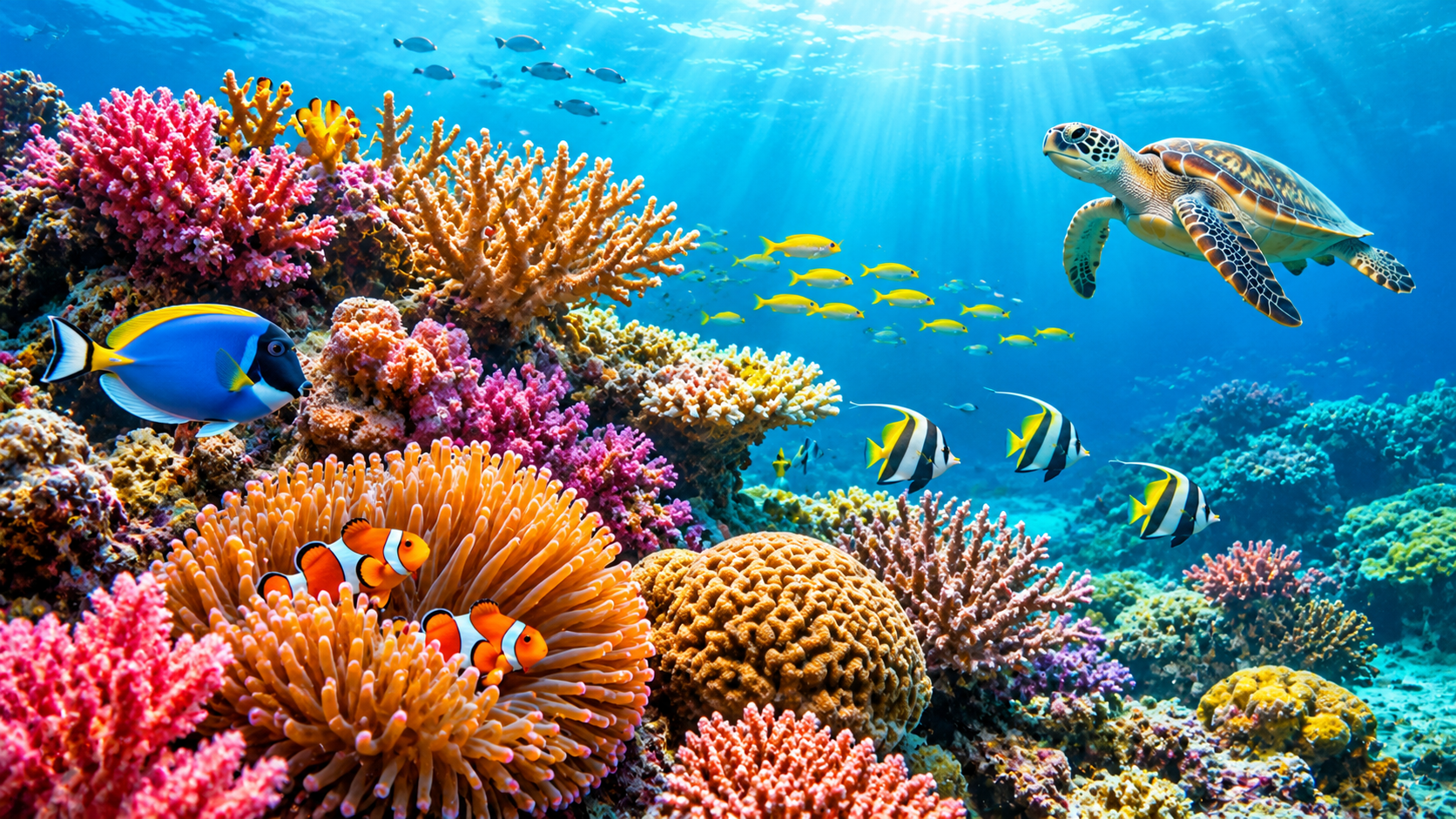
Coral reefs are underwater ecosystems formed primarily by colonies of tiny marine animals called coral polyps.
Many reef-building corals produce calcium carbonate skeletons, which gradually form complex reef structures.
Coral reefs are commonly known as the Rainforests of the Sea because they support extraordinary marine biodiversity.
Importance of Coral Reefs
Provide habitats for marine fish and other organisms.
Protect coastlines from waves and erosion.
Support fisheries and coastal livelihoods.
Promote tourism and recreation.
Maintain marine biodiversity.
Support complex marine food chains.
Although coral reefs occupy less than 1% of the ocean floor, they support approximately 25% of marine fish species.
What Is Coral Bleaching?
Coral bleaching occurs when corals experience environmental stress, particularly unusually high water temperatures.
During prolonged heat stress, corals may expel the symbiotic algae living in their tissues.
These algae provide much of the energy corals need through photosynthesis and contribute to their colour.
When the algae are expelled, corals appear white or bleached.
Major Causes
Rising sea temperatures.
Marine heatwaves.
Ocean pollution.
Changes in water quality.
Other environmental stresses.
Bleaching does not always cause immediate coral death. Corals can recover if favourable conditions return, but prolonged or repeated stress can cause widespread mortality.
Major Threats to South Asian Coral Reefs
1. Climate Change
Rising global temperatures increase ocean temperatures and the frequency of marine heatwaves.
2. Mass Coral Bleaching
Repeated bleaching events reduce coral growth and survival.
3. Ocean Acidification
Increasing carbon dioxide absorption by seawater makes it harder for reef-building organisms to form calcium carbonate structures.
4. Overfishing
Excessive fishing can disrupt the ecological balance between fish, algae and corals.
5. Coastal Development
Dredging, construction and sedimentation can damage reef habitats.
6. Marine Pollution
Plastic waste, sewage and chemical pollutants negatively affect coral reef health.
Global Coral Reef Assessment 2026
The IUCN assessment also examined coral reef ecosystems worldwide.
Important Global Findings
Indicator | Finding |
|---|---|
Coral Reef Ecoregions Assessed | 127 |
Critically Endangered | 122 |
Percentage Critically Endangered | 96% |
Share of Assessed Reef Area in This Category | 99.8% |
Collapsed Ecosystem | Western Galápagos Islands |
Data Deficient Ecoregions | 4 |
The results indicate that projected marine heat stress is a major driver of the growing risk of coral reef ecosystem collapse.
What Is the IUCN Red List of Ecosystems?
The IUCN Red List of Ecosystems is a scientific framework used to assess the risk of ecosystem collapse.
Unlike the IUCN Red List of Threatened Species, which evaluates individual species, this framework evaluates entire ecosystems.
Five Assessment Criteria
Criterion | Focus |
|---|---|
A | Reduction in Geographic Distribution |
B | Restricted Geographic Distribution |
C | Environmental Degradation |
D | Disruption of Biotic Processes |
E | Quantitative Risk of Ecosystem Collapse |
Measures Needed to Protect Coral Reefs
Reducing Greenhouse Gas Emissions
Limiting global warming is essential to reduce future marine heat stress.
Expanding Marine Protected Areas
Protected areas can reduce harmful local activities and support biodiversity conservation.
Controlling Marine Pollution
Reducing sewage, plastic pollution and coastal runoff can improve reef health.
Sustainable Fishing
Responsible fishing practices can help maintain healthy marine food webs.
Coral Reef Restoration
Restoration programmes may help damaged reefs recover where environmental conditions remain suitable.
Strengthening Scientific Monitoring
Satellite observations and underwater surveys can help track coral bleaching and ecosystem changes.
Why Is This Report Important for India?
India's coral reefs support marine biodiversity, fisheries, tourism and coastal protection.
The assessment highlights the vulnerability of important reef ecosystems in Lakshadweep, the Andaman and Nicobar Islands, the Gulf of Mannar and the Gulf of Kutch.
It also emphasises the need for stronger marine conservation policies, improved monitoring and international cooperation on climate change.
Conclusion
The IUCN assessment identifying all 13 South Asian coral reef ecoregions as Critically Endangered under future climate projections is a major warning for marine biodiversity conservation.
The findings highlight the urgent need to reduce greenhouse gas emissions, protect marine habitats and strengthen coral reef monitoring and restoration efforts.