RBI Directs Tata Sons to Comply with Upper Layer NBFC Listing Rules
Key points
In the News
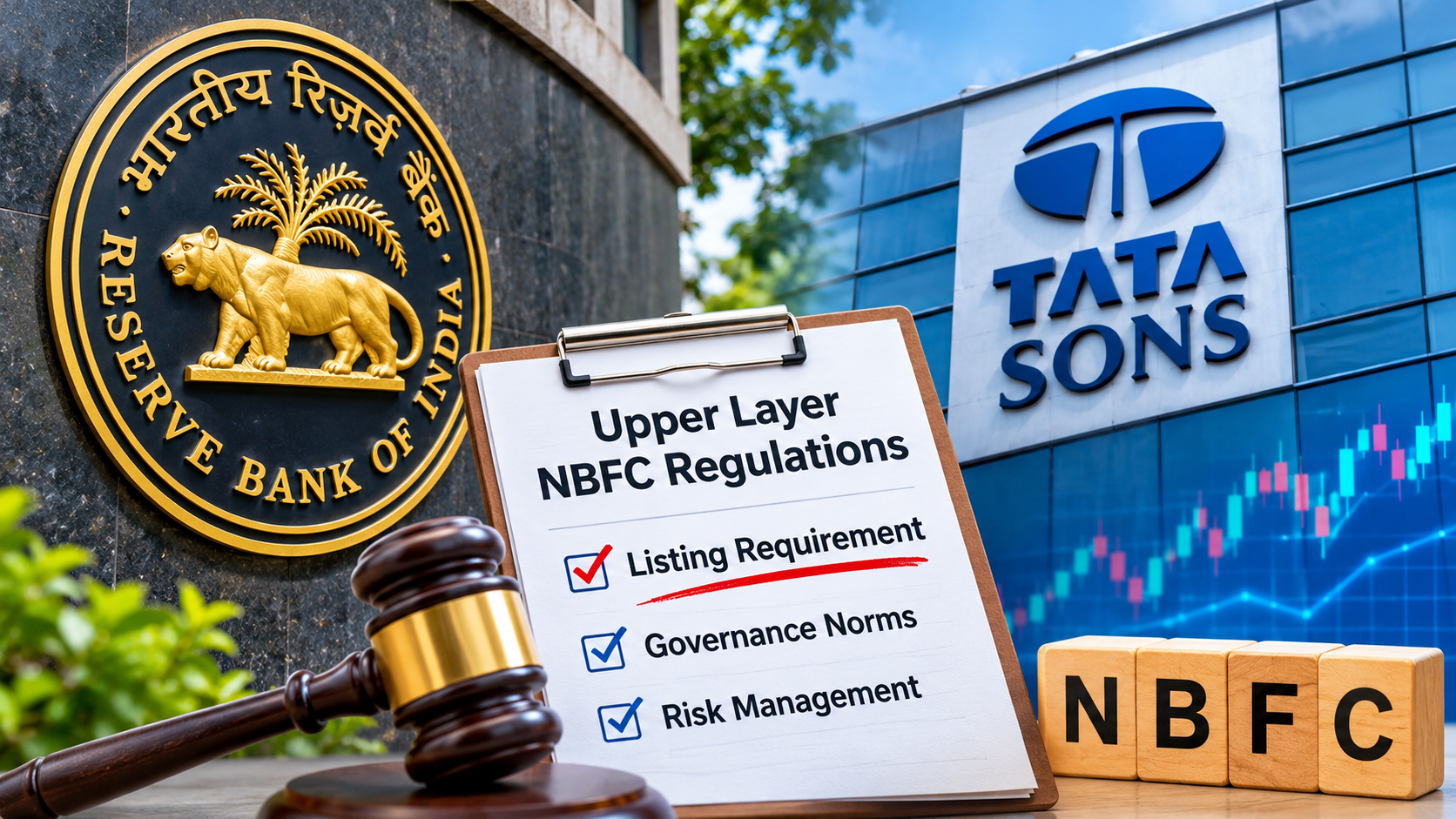
The Reserve Bank of India (RBI) has directed Tata Sons, the holding company of the Tata Group, to comply with regulations applicable to Upper Layer Non-Banking Financial Companies (NBFC-UL), including mandatory stock market listing.
In a letter dated 16 November 2026, the RBI reiterated that Tata Sons must follow the listing requirements under its Scale-Based Regulation (SBR) framework.
The development has renewed discussions over Tata Sons' proposed Initial Public Offering (IPO), as the company has remained privately held despite the expiry of its original listing deadline.
Background
Tata Sons is the principal holding company of the Tata Group, with investments in major businesses such as Tata Consultancy Services, Tata Motors, Tata Steel and Air India.
In September 2022, the RBI classified Tata Sons as an Upper Layer NBFC under its Scale-Based Regulation framework.
Under the applicable rules, Upper Layer NBFCs must list their shares within three years of being identified in this category.
Tata Sons' original listing deadline expired on 30 September 2025.
In March 2024, the company applied to surrender its registration as a Core Investment Company (CIC) after repaying its borrowings. However, the RBI rejected the application on 11 September 2026.
Key Highlights
1. RBI Reiterates Mandatory Listing Requirement
The RBI's communication dated 16 November 2026 instructed Tata Sons to comply with all applicable Upper Layer NBFC regulations, including the listing requirement.
The communication followed Tata Sons' request for regulatory guidance submitted on 6 October 2026.
2. RBI's Scale-Based Regulation Framework
The RBI introduced Scale-Based Regulation to strengthen the supervision of NBFCs according to their size, activities and systemic risk.
The framework divides NBFCs into four regulatory layers:
Base Layer (NBFC-BL): Smaller and lower-risk NBFCs.
Middle Layer (NBFC-ML): NBFCs subject to additional regulatory requirements.
Upper Layer (NBFC-UL): Large and systemically significant NBFCs requiring enhanced supervision.
Top Layer (NBFC-TL): Reserved for NBFCs presenting exceptionally high systemic risk.
3. Why Tata Sons Falls Under the Upper Layer
Tata Sons was classified as an Upper Layer NBFC in September 2022 because of its size and systemic significance.
Upper Layer NBFCs are subject to stricter governance, risk management, disclosure and regulatory requirements.
4. Tata Sons' Deregistration Request Rejected
Tata Sons sought to surrender its CIC registration in March 2024.
However, the RBI rejected the request in September 2026, maintaining that the company must comply with the applicable NBFC regulations.
5. Differences Over Public Listing
The listing issue has generated differences among major Tata Sons shareholders.
Tata Trusts, which collectively control approximately 66% of Tata Sons, favour keeping the company privately held.
The Shapoorji Pallonji Group, holding approximately 18%, supports listing as a potential way to unlock the value of its investment.
6. Upcoming Tata Sons Board Meeting
The Tata Sons board is scheduled to meet on 26 November 2026.
The meeting is expected to discuss the RBI's regulatory position and possible restructuring proposals.
No new listing deadline or IPO date has been officially announced.
Important Facts for Competitive Exams
Reserve Bank of India (RBI): India's central bank, established on 1 April 1935 under the Reserve Bank of India Act, 1934. It regulates and supervises banks and NBFCs.
Non-Banking Financial Company (NBFC): A company engaged in financial activities such as lending and investment without holding a full banking licence. NBFCs generally cannot accept demand deposits.
Scale-Based Regulation (SBR): An RBI regulatory framework that classifies NBFCs into four layers according to size, activity and systemic risk.
Upper Layer NBFC: A category of NBFCs identified for enhanced supervision due to their systemic importance and risk profile.
Core Investment Company (CIC): A specialised NBFC primarily engaged in holding investments in group companies, subject to prescribed regulatory conditions.
Initial Public Offering (IPO): The process through which a company offers its shares to the public for the first time.
Quick Revision
RBI Directive: On 16 November 2026, the RBI reiterated that Tata Sons must comply with Upper Layer NBFC regulations, including mandatory stock market listing.
Regulatory Classification: Tata Sons was identified as an Upper Layer NBFC in September 2022 under the RBI's Scale-Based Regulation framework.
Listing Deadline: The original three-year listing deadline expired on 30 September 2025, but Tata Sons remained unlisted.
Deregistration Request: Tata Sons applied to surrender its Core Investment Company registration in March 2024. The RBI rejected the request in September 2026.
Shareholder Positions: Tata Trusts favour retaining private ownership, while the Shapoorji Pallonji Group supports listing.
Regulatory Importance: The case highlights the RBI's efforts to strengthen transparency, corporate governance and financial stability among systemically significant NBFCs.
Conclusion
The RBI's latest direction to Tata Sons highlights the importance of regulatory compliance under India's Scale-Based Regulation framework.
The issue is significant for understanding NBFC classification, mandatory listing requirements, corporate governance and the RBI's supervisory role.
For competitive examinations, the most important topics are NBFC-UL, Scale-Based Regulation, Core Investment Companies, IPOs and RBI regulations.