RBI Microfinance Rules 2026: 50% Repayment Limit and Borrower Protection
Key points
In the News
The Reserve Bank of India (RBI) has reaffirmed the importance of responsible lending and borrower protection in India's microfinance sector.
In November 2026, the RBI reportedly opposed proposals to relax the 50% household loan repayment limit, emphasising that lending institutions must assess borrowers' actual repayment capacity before extending credit.
The central bank has also raised concerns about rising loan sizes, high borrowing costs, excessive indebtedness and aggressive loan recovery practices.
The development highlights the need to balance financial inclusion with responsible lending practices.
Background
Microfinance provides small loans and other financial services to low-income households, particularly those with limited access to traditional banking.
In March 2022, the RBI introduced the Regulatory Framework for Microfinance Loans, which became effective on 1 April 2022.
Under this framework, a microfinance loan is defined as a collateral-free loan provided to a household with an annual income of up to ₹3 lakh.
The regulations aim to prevent excessive borrowing, improve transparency and protect financially vulnerable households.
Key Highlights
Regulatory Authority: Reserve Bank of India (RBI).
Main Framework: RBI Regulatory Framework for Microfinance Loans, 2022.
Income Eligibility: Annual household income up to ₹3 lakh.
Collateral Requirement: Microfinance loans must be collateral-free.
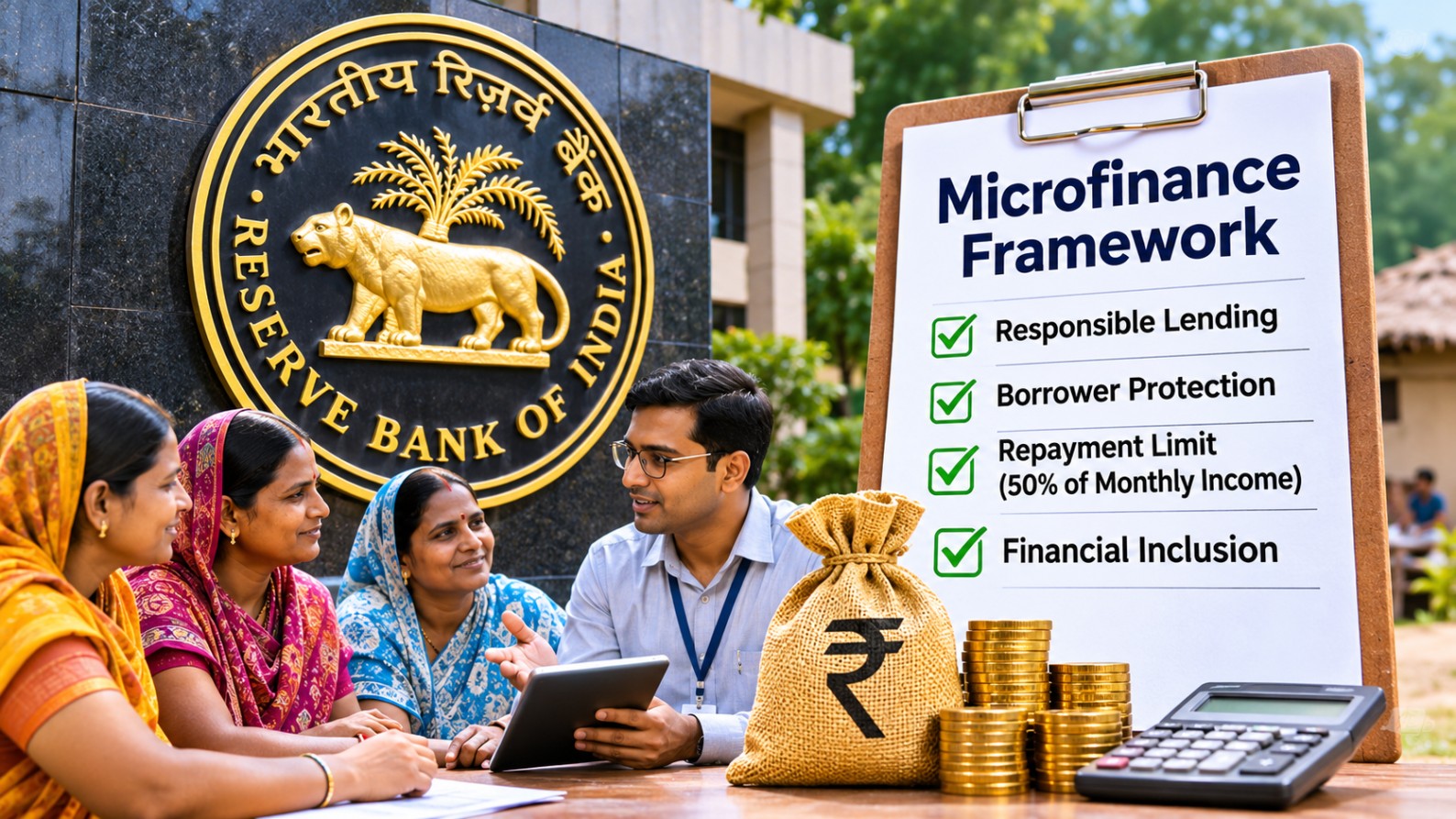
Repayment Limit: Total monthly household loan repayment obligations must not exceed 50% of monthly household income.
Responsible Lending: Lenders must assess household income and existing debt obligations.
Interest Rate Transparency: Lenders must disclose applicable interest rates and charges.
Borrower Protection: Harassment, intimidation and coercive recovery practices are prohibited.
Consumer Consent: Additional products, including insurance, cannot be made compulsory as a condition for obtaining a microfinance loan.
RBI's 50% Household Repayment Rule
The RBI requires regulated lenders to ensure that a household's total monthly loan repayment obligations remain within 50% of its monthly income.
This calculation includes repayment obligations from both microfinance and other outstanding loans.
Example:
Particulars | Amount |
|---|---|
Monthly household income | ₹20,000 |
Maximum permitted monthly loan repayments | ₹10,000 |
Repayment-to-income ratio | 50% |
The rule aims to prevent over-indebtedness and ensure that households retain income for essential living expenses.
Borrower Protection Measures
1. Transparent Loan Pricing
Lenders must clearly disclose interest rates, fees and other applicable charges so borrowers can understand the actual cost of borrowing.
2. Protection Against Harassment
Recovery agents cannot use threatening language, intimidation, public humiliation or other coercive methods to collect repayments.
3. No Collateral Requirement
Microfinance loans must be provided without collateral, protecting borrowers from having to pledge assets as security.
4. No Prepayment Penalty
Borrowers can repay microfinance loans before the scheduled maturity without incurring a prepayment penalty.
5. Flexible Repayment Options
Borrowers must be given flexibility in repayment periodicity according to their requirements.
6. Voluntary Additional Products
Insurance and other non-credit products cannot be imposed as compulsory conditions for obtaining a microfinance loan.
Important Facts for Competitive Exams
1. What is microfinance?
Microfinance refers to financial services, particularly small loans, provided to low-income households and individuals who may have limited access to conventional banking.
2. What is the RBI's 50% repayment rule?
The rule limits a household's total monthly loan repayment obligations to 50% of its monthly income to reduce excessive indebtedness.
3. What is the annual household income limit for microfinance loans?
Under the RBI framework, microfinance loans are collateral-free loans provided to households with annual income up to ₹3 lakh.
4. What is an NBFC-MFI?
A Non-Banking Financial Company–Microfinance Institution (NBFC-MFI) is an RBI-regulated financial institution specialising in microfinance lending.
5. What is financial inclusion?
Financial inclusion means providing affordable and accessible financial services, including banking, credit, insurance and payments, to underserved sections of society.
6. What is responsible lending?
Responsible lending involves evaluating repayment capacity, disclosing loan conditions, preventing excessive borrowing and ensuring fair treatment of borrowers.
7. What is over-indebtedness?
Over-indebtedness occurs when borrowers accumulate debt beyond their repayment capacity, creating financial stress and increasing the risk of default.
8. Why is borrower protection important in microfinance?
Borrower protection helps prevent exploitative lending, unfair recovery practices and debt traps while promoting sustainable financial inclusion.
Quick Revision
The RBI's Responsible Microfinance Framework focuses on financial inclusion, responsible lending and borrower protection. Microfinance loans are collateral-free loans for households earning up to ₹3 lakh annually. The RBI limits total monthly household loan repayments to 50% of monthly income. The framework also requires transparent pricing, fair recovery practices, flexible repayment options and voluntary purchase of additional financial products.