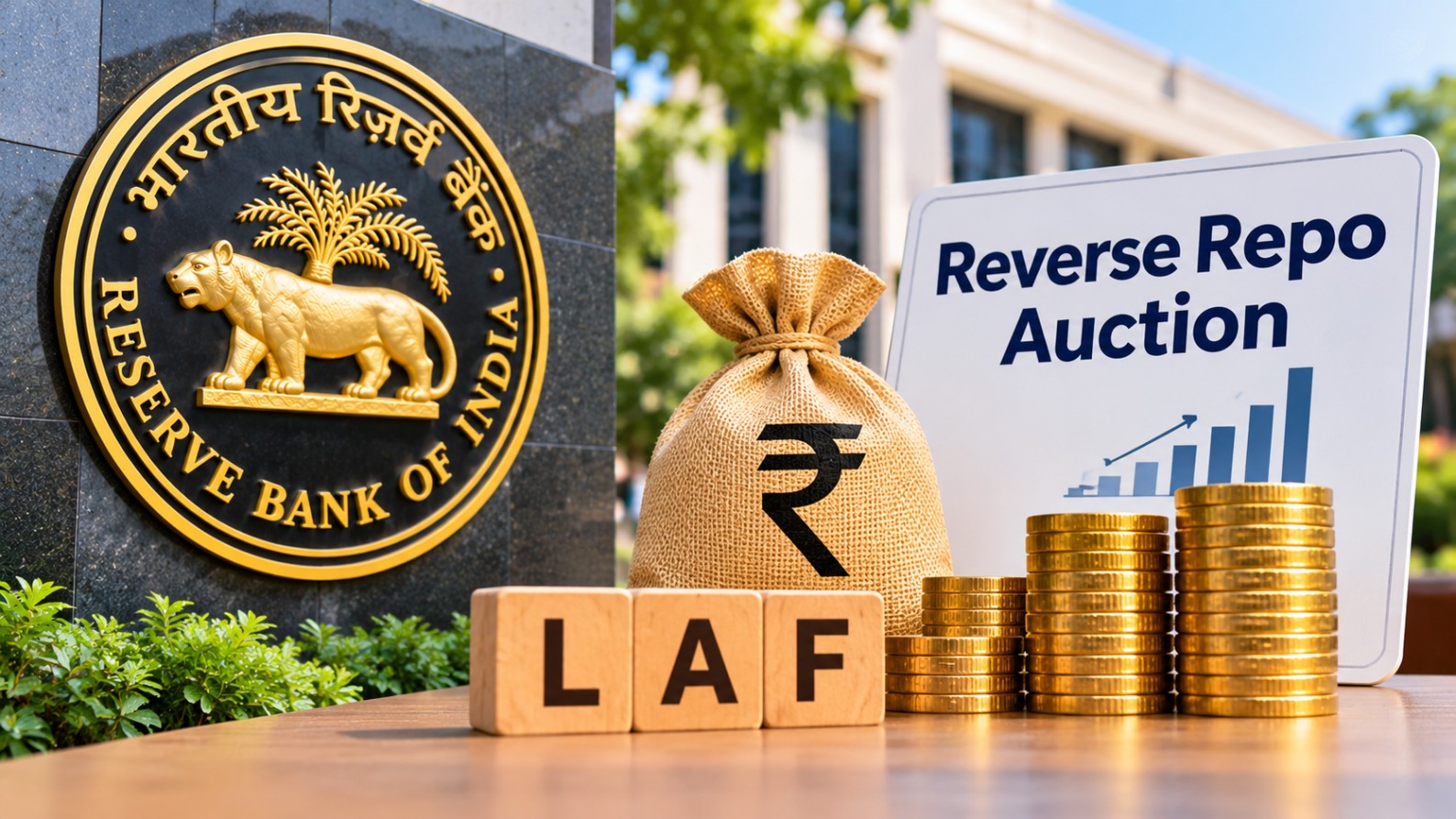
RBI Announces ₹50,000 Crore Overnight Reverse Repo Auction Under LAF
Key points
In the News
The Reserve Bank of India (RBI) announced an overnight Variable Rate Reverse Repo (VRRR) auction of ₹50,000 crore under the Liquidity Adjustment Facility (LAF) for 18 November 2026.
The announcement was made on 17 November 2026, following a review of current and evolving liquidity conditions in the banking system.
The operation is designed to temporarily absorb surplus liquidity from banks and support stability in short-term money market interest rates.
Background
The Liquidity Adjustment Facility (LAF) is an important monetary policy mechanism used by the RBI to manage short-term liquidity in the banking system.
Through repo operations, the RBI injects liquidity into banks, while reverse repo operations absorb excess liquidity.
In a Variable Rate Reverse Repo (VRRR) auction, banks place surplus funds with the RBI at interest rates determined through a competitive auction process.
Such operations help the RBI manage banking system liquidity and support the effective transmission of monetary policy.
Key Highlights
Announcing Authority: Reserve Bank of India.
Operation: Overnight Variable Rate Reverse Repo (VRRR) auction.
Notified Amount: ₹50,000 crore.
Announcement Date: 17 November 2026.
Auction Date: 18 November 2026.
Auction Timing: 9:30 AM to 10:00 AM.
Tenor: One day.
Date of Reversal: 19 November 2026.
Monetary Policy Instrument: Liquidity Adjustment Facility (LAF).
Main Objective: Temporarily absorb surplus liquidity from the banking system.
The notified amount represents the auction size, not necessarily the final amount accepted by the RBI.
What Is a Variable Rate Reverse Repo Auction?
A Variable Rate Reverse Repo (VRRR) is a liquidity management operation through which the RBI absorbs funds from banks for a specified period.
Unlike a fixed-rate operation, the interest rate is determined through competitive bidding.
How It Works
The RBI announces the auction amount, timing and maturity.
Eligible banks submit bids specifying the amount and interest rate.
The RBI accepts bids according to the auction mechanism.
Funds are temporarily absorbed from the banking system.
On maturity, the RBI returns the funds along with applicable interest.
The process helps manage short-term liquidity without necessarily changing the policy repo rate.
Repo Rate vs Reverse Repo vs VRRR
Instrument | Main Function |
|---|---|
Repo | RBI provides liquidity to banks |
Reverse Repo | RBI absorbs liquidity from banks |
VRRR | RBI absorbs liquidity through competitive interest-rate bidding |
Standing Deposit Facility (SDF) | Banks can place surplus funds with RBI without collateral |
Marginal Standing Facility (MSF) | Banks obtain overnight liquidity from RBI at the applicable MSF rate |
Why Is the Auction Important?
1. Surplus Liquidity Management
The RBI can temporarily withdraw excess funds from the banking system when liquidity conditions require adjustment.
2. Short-Term Interest Rate Stability
Liquidity operations help align overnight money market rates with the monetary policy operating framework.
3. Monetary Policy Transmission
Effective liquidity management supports the transmission of monetary policy decisions to financial markets and lending conditions.
4. Banking System Stability
Temporary liquidity absorption can reduce fluctuations caused by short-term mismatches between the availability and demand for funds.
Important Facts for Competitive Exams
1. What is the Liquidity Adjustment Facility (LAF)?
LAF is an RBI monetary policy mechanism that manages short-term banking system liquidity through repo and reverse repo operations.
2. What is a Variable Rate Reverse Repo?
VRRR is an auction-based instrument used by the RBI to temporarily absorb surplus funds from banks at competitively determined interest rates.
3. What was the notified amount of the RBI's latest overnight VRRR auction?
The RBI announced a ₹50,000 crore overnight VRRR auction under the Liquidity Adjustment Facility.
4. What is the difference between repo and reverse repo?
A repo operation injects liquidity into the banking system, while a reverse repo operation absorbs liquidity.
5. What is the Standing Deposit Facility?
The Standing Deposit Facility (SDF) enables eligible institutions to deposit surplus funds with the RBI without requiring collateral. It serves as the floor of the LAF interest-rate corridor.
6. What is the Marginal Standing Facility?
The Marginal Standing Facility (MSF) allows eligible banks to obtain overnight liquidity from the RBI against eligible securities at the prescribed MSF rate.
7. What is the Weighted Average Call Rate (WACR)?
The WACR is the weighted average interest rate on overnight unsecured interbank borrowing. It serves as the operating target of India's monetary policy framework.
8. Does a VRRR auction mean the RBI has increased the repo rate?
No. A VRRR auction is a liquidity management operation and does not, by itself, indicate a change in the policy repo rate.
Quick Revision
The RBI announced a ₹50,000 crore overnight Variable Rate Reverse Repo auction for 18 November 2026 under the Liquidity Adjustment Facility. The auction was scheduled from 9:30 AM to 10:00 AM, with a one-day tenor and reversal on 19 November 2026. VRRR operations temporarily absorb surplus liquidity from banks and support monetary policy transmission and short-term interest-rate stability.