Supreme Court Questions on Electoral Roll Revision 2026
Key points
Why in the News?
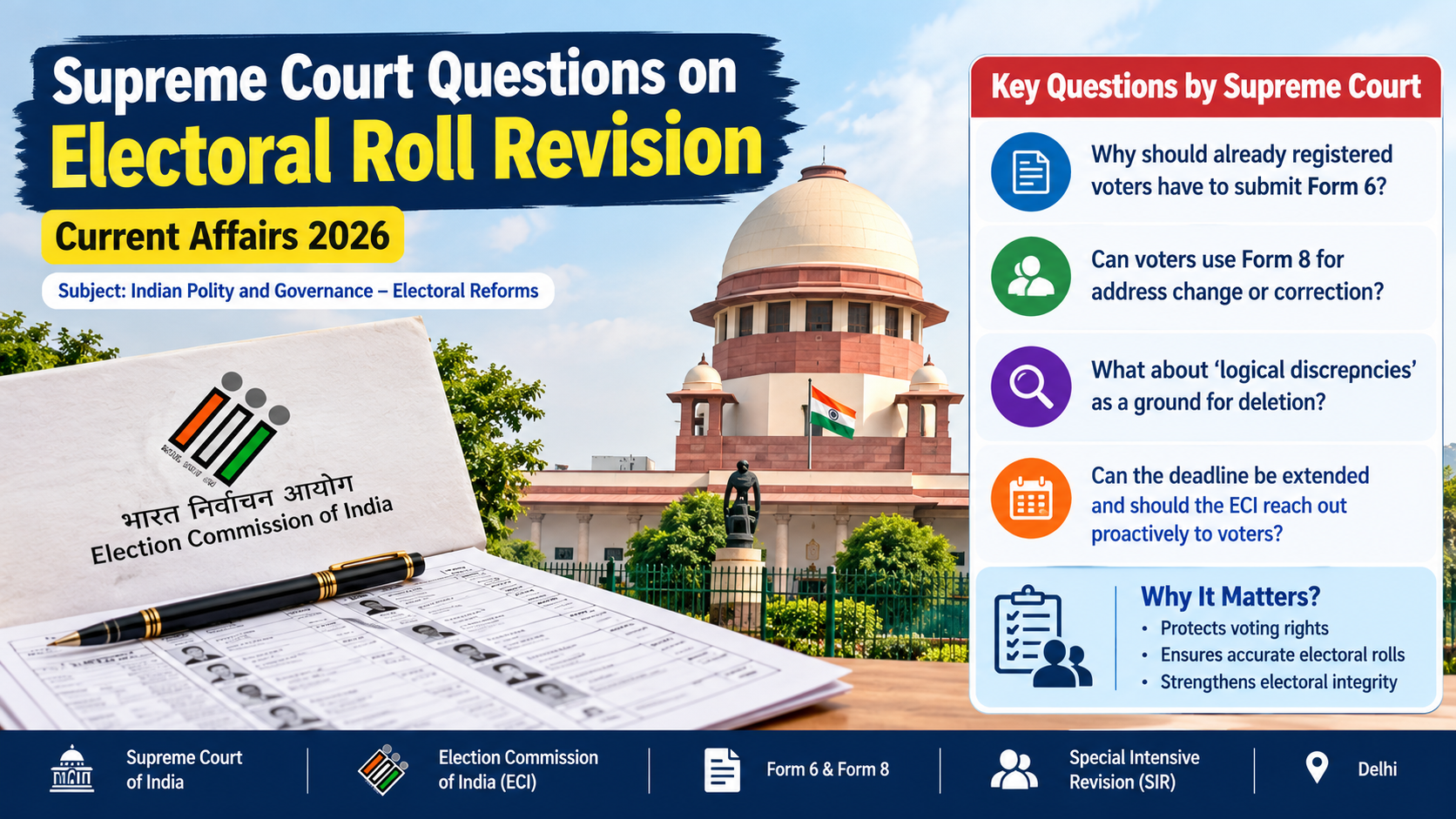
On 28 October 2026, the Supreme Court of India questioned the Election Commission of India (ECI) about the procedure for restoring the names of voters omitted from Delhi’s draft electoral rolls during the Special Intensive Revision (SIR) process. The Court raised concerns about asking already registered voters to submit Form 6 to get their names included again.
Key Details
Court: Supreme Court of India
Institution involved: Election Commission of India (ECI)
Issue: Restoration of names omitted from draft electoral rolls during SIR
Location under discussion: Delhi
Main concern: The procedure voters must follow to restore their names.
What Did the Supreme Court Ask?
The Supreme Court questioned why voters who were already registered should be required to submit Form 6, which is generally used to apply for inclusion in the electoral roll, particularly by new voters.
The Court discussed whether existing voters could instead use enumeration forms or Form 8, which is used for corrections and changes such as shifting residence. It also emphasized the importance of informing affected voters about the process and considering adequate time to complete the required formalities.
The Election Commission indicated that it would consider the Court’s suggestions. Reports also stated that the deadline was expected to be extended. However, the Court did not itself issue a final order extending the deadline at that hearing.
Important Data from Delhi’s Draft Electoral Roll
According to reports concerning the proceedings:
Voters in the initial roll: Approximately 1.45 crore
Enumeration forms submitted: Approximately 97.54 lakh
Forms not returned: Approximately 47.57 lakh
Voters reportedly issued notices over logical discrepancies: Approximately 19.34 lakh
These figures relate to the reported Delhi revision exercise and should be read in that context.
What Is Special Intensive Revision (SIR)?
Special Intensive Revision is a detailed exercise conducted by the Election Commission to verify and update electoral rolls. Its purpose is to improve the accuracy of voter lists by identifying eligible voters, correcting records and addressing cases requiring verification.
Electoral roll revision is important because only eligible persons whose names appear on the relevant electoral roll can ordinarily cast their votes in an election.
Difference Between Form 6 and Form 8
Form 6: Generally used to apply for inclusion of a name in the electoral roll, particularly for new electors.
Form 8: Used for purposes such as correcting entries in the electoral roll, changing residence details and replacing an Elector Photo Identity Card (EPIC), as applicable under the prescribed procedure.
Voters should follow the latest instructions issued by the Election Commission or the relevant electoral registration officer for their particular case.
What Is a Logical Discrepancy?
A logical discrepancy refers to an inconsistency or mismatch in information contained in electoral records that may require verification. The issue before the Supreme Court included concerns about using such discrepancies as a ground for issuing notices or removing names from electoral rolls.
The Court clarified that it had not finally decided the legality or constitutionality of using “logical discrepancy” as a ground for deletion. The issue therefore remained subject to further consideration.
Constitutional Provision: Article 324
Article 324 of the Constitution of India provides for the Election Commission’s superintendence, direction and control of elections to Parliament, state legislatures, and the offices of the President and Vice-President, subject to the constitutional framework.
The Election Commission plays a key role in preparing and revising electoral rolls to help ensure that elections are conducted in accordance with the law.
Why Is This Issue Important?
The case highlights the balance between maintaining accurate electoral rolls and protecting eligible citizens’ voting rights. Clear procedures, accessible information and reasonable opportunities to respond are important when voters’ names are missing from draft lists or their records require verification.
The Supreme Court matter also raises broader questions about transparency, due process and the responsibilities of election authorities during electoral roll revision.
Key Facts for Competitive Exams
Article related to the Election Commission: Article 324
Election authority: Election Commission of India
Form 6: Application for inclusion in the electoral roll
Form 8: Correction of entries and other prescribed changes, including shifting residence
SIR: Special Intensive Revision
Main issue: Procedure for restoring omitted voter names and the use of logical discrepancies during electoral roll revision
Court involved: Supreme Court of India