
ECGC PO
ECGC PO is a recruitment exam for the recruitment of Probationary Officers, relevant to candidates preparing for insurance and financial-sector recruitment.
ECGC PO Study Material
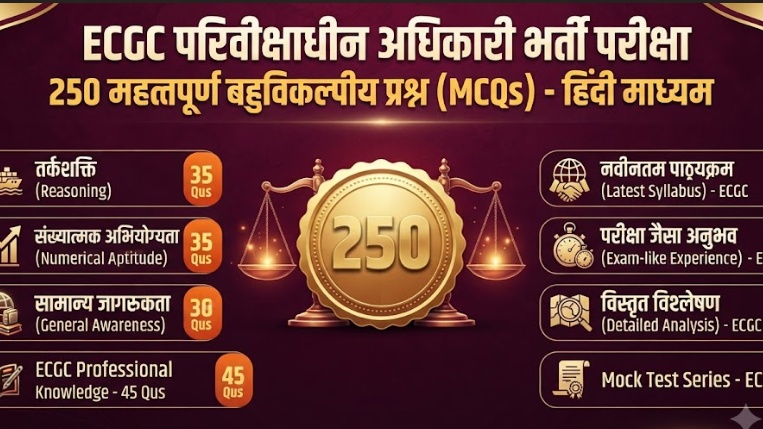
The ECGC PO exam is the recruitment process through which ECGC Ltd., a Government of India enterprise that provides credit risk insurance to exporters, hires Probationary Officers in its Executive Officer cadre. This guide covers the 2025-26 cycle, the most recent one with a full notification, and explains what each stage asks of you.
You will find the dates, vacancies, eligibility, exam pattern, selection rules and pay in one place, along with a practical way to prepare. Figures come from ECGC's detailed advertisement for this cycle. ECGC has not announced a later cycle in the sources we checked, so confirm the current status on the official website before you plan around any date.
Table of Contents
ECGC PO
Particular | Details |
|---|---|
Conducting body | ECGC Ltd. (Export Credit Guarantee Corporation of India) |
Post | Probationary Officer, Executive Officer cadre (Generalist and Specialist) |
Cycle covered | 2025-26 |
Vacancies | 30 (28 Generalist and 2 Specialist), tentative |
Qualification | Graduation in any discipline for Generalists; a Master's degree in Hindi or English combinations for the Rajbhasha specialist post |
Age limit | 21 to 30 years as on 1 November 2025, with category relaxation |
Stages | Online examination (objective plus descriptive), then interview |
Final merit weightage | Online examination and interview in the ratio 80:20 |
Pay scale | Rs. 88,635 to Rs. 1,69,025 (stated scale) |
Official website | ecgc.in |
Notification and important dates
ECGC published the detailed advertisement on or before 10 November 2025 and ran online registration from 11 November 2025 to 2 December 2025. The online examination was scheduled for 11 January 2026, from 2:00 p.m. to 5:00 p.m., and is described in the advertisement as tentative.
Event | Date (2025-26 cycle) |
|---|---|
Detailed advertisement published | On or before 10 November 2025 |
Online registration and fee payment | 11 November 2025 to 2 December 2025 |
Edit window for the application | 6 December 2025 to 7 December 2025 |
Pre-examination training for SC, ST, OBC (non-creamy layer) and PwBD candidates | From 15 December 2025 onwards |
Online examination | 11 January 2026 (tentative) |
Result of online examination | 31 January 2026 onwards (tentative) |
Interview | February or March 2026 (tentative) |
Tentative dates come from the notification schedule and can change. Track the official recruitment page on ecgc.in and your registered email for the latest updates.
Vacancy details
The advertisement lists 30 vacancies arising up to 31 March 2026, with no backlog vacancies. ECGC states that the number is tentative and may change, and that it can choose to fill fewer posts.
Category | Vacancies |
|---|---|
SC | 5 |
ST | 0 |
OBC | 10 |
EWS | 3 |
Unreserved | 12 |
Total | 30 |
Of the 30 posts, 28 are in the Generalist stream and 2 in the Specialist (Rajbhasha) stream. One post is marked for orthopaedically challenged candidates under horizontal PwBD reservation. Selected officers can be posted to any department or office across India.
Eligibility in brief
Qualification
Generalist candidates need a Bachelor's degree in any discipline from a recognised university, with a valid mark-sheet or degree certificate on the day of registration. The result must have been declared on or before 1 November 2025. Rajbhasha candidates need a Master's degree in the Hindi and English combinations listed in the advertisement, with at least 60% marks (55% for SC and ST).
Age limit
The age limit is 21 to 30 years as on 1 November 2025, meaning a date of birth between 2 November 1995 and 1 November 2004, both dates inclusive. Relaxation applies to SC and ST (5 years), OBC non-creamy layer (3 years) and persons with benchmark disabilities (10 years), among others. The full rules, including nationality, are on the ECGC PO eligibility page.
Application fee and how to apply
Category | Fee |
|---|---|
SC, ST and PwBD candidates | Rs. 175 (intimation charges) |
All other candidates | Rs. 950 (application fee inclusive of intimation charges) |
Bank transaction charges for online payment are borne by the candidate. Fees are not refunded once paid.
Open the recruitment link on the official website, ecgc.in, during the registration window.
Register with a personal email ID and mobile number that you will keep active until results are declared.
Fill in the application, including your graduation percentage to two decimals.
Upload your photograph (4.5 cm by 3.5 cm), signature, left thumb impression and a handwritten declaration in English. Capital letters are not accepted for the signature or the declaration.
Capture the live photograph when asked, pay the fee online and keep a printout of the submitted application.
Common reasons for rejection include a declaration written by someone else, a smudged thumb impression, a signature in capital letters and a category claim without the right certificate. ECGC does not allow a change of category after registration.
Exam pattern
The online examination has two parts: an objective test of 200 marks and a descriptive paper of 40 marks. The objective test for Generalists has five tests with their own time limits, 140 minutes in total.
Test (Generalist) | Questions | Marks | Time |
|---|---|---|---|
Reasoning Ability | 50 | 50 | 40 minutes |
English Language | 40 | 40 | 30 minutes |
Computer Knowledge | 20 | 20 | 10 minutes |
General Awareness | 40 | 40 | 20 minutes |
Quantitative Aptitude | 50 | 50 | 40 minutes |
Total | 200 | 200 | 140 minutes |
The descriptive paper (essay and precis for Generalists) carries 40 marks in 40 minutes. Each wrong answer in the objective test costs one fourth of the marks for that question; blank answers are not penalised. The ECGC PO exam pattern page has the specialist paper, sectional rules and a time plan.
Syllabus summary
ECGC names the tests in its advertisement but does not publish a topic-wise syllabus. The table below is a working checklist built from the test names and from the topics these tests usually cover. It is not an official list.
Test | Important topics |
|---|---|
Reasoning Ability | Puzzles, seating arrangement, syllogism, inequalities, coding-decoding, blood relations |
English Language | Reading comprehension, cloze test, error spotting, para jumbles, vocabulary |
Computer Knowledge | Hardware and software basics, MS Office, networking, internet, security |
General Awareness | Banking, insurance and economy, current affairs, static GK, export and trade basics |
Quantitative Aptitude | Data interpretation, number series, simplification, quadratic equations, arithmetic |
Descriptive | Essay and precis writing in English |
Read the topic-wise breakdown on the ECGC PO syllabus page.
Selection process
Online examination: objective test plus descriptive paper, with a sectional cut-off and an overall cut-off. Normalisation is applied if the exam runs in multiple sessions.
Interview: 60 marks, held at Delhi or Mumbai. The minimum qualifying mark is 40% (35% for SC, ST, OBC and PwBD).
Final merit: online examination and interview combined in the ratio 80:20. Ties are broken in favour of the older candidate.
The descriptive paper is evaluated only for candidates who qualify the objective test and rank high enough. ECGC evaluates it for at least 12 times the number of vacancies in each category, subject to availability.
Salary, bond and career
The stated pay scale is Rs. 88,635-4385(14)-1,50,025-4750(4)-1,69,025, plus Dearness Allowance, House Rent Allowance or lease reimbursement, Transport Allowance, Medical Allowance and other benefits listed in the advertisement. ECGC puts the current cost to company for a Probationary Officer posted in Mumbai at approximately Rs. 20,00,000 a year. This is the employer's figure, not your monthly in-hand pay, and it varies by city.
Selected candidates execute a bond equal to three months' salary to serve for a minimum of three years, and a three-month notice period applies in addition. Posting is on an all-India basis.
How to prepare
Start with the test that carries the most marks per minute. Reasoning and Quantitative Aptitude together make up half of the objective marks, so build speed there first. Add daily reading for English and General Awareness, with extra attention to insurance, banking and trade topics because the employer works in export credit.
Weeks 1 to 6: concepts in Reasoning and Quantitative Aptitude, a reading habit, and short monthly current-affairs notes.
Weeks 7 to 10: sectional tests with strict time limits, plus weekly essay and precis practice.
Final weeks: full-length mocks in the exam sequence, same-day analysis and revision from an error log.
For timed practice in this pattern, you can attempt ECGC PO online tests on Testkart and use the section-wise analysis to plan your revision. Pair them with previous year papers to understand the real difficulty level, and use the ECGC PO mock tests page to see what is currently available.
Cut-off reference
The advertisement states that cut-offs are applied twice: on each section, including the descriptive paper, and on the total score. The actual marks depend on the number of vacancies and the difficulty of the paper, and the cut-off is decided by ECGC after the exam. Details are on the ECGC PO cut-off page.
Cut-offs change every year with difficulty, vacancies and the number of applicants. Treat last year's figures as a benchmark only, and aim for a clear margin above them rather than a bare pass. Always confirm details on the official website, ecgc.in.