
Railway Exams Mock Tests: Practice Guide
Practise RRB and RPF exams in the current CBT pattern and learn how to plan, take and analyse railway mocks.
Ancient History Mock Test [250 MCQ (Hindi Medium)] for SSC GD, SSC CGL, SSC MTS, SSC GD, RRB, Police, UPPSC, Banking, CTET/TETNDA/CDS and other competitive exam

₹9
ALP Reasoning Full Syllabus Mock Test (PYQ Based)

₹6
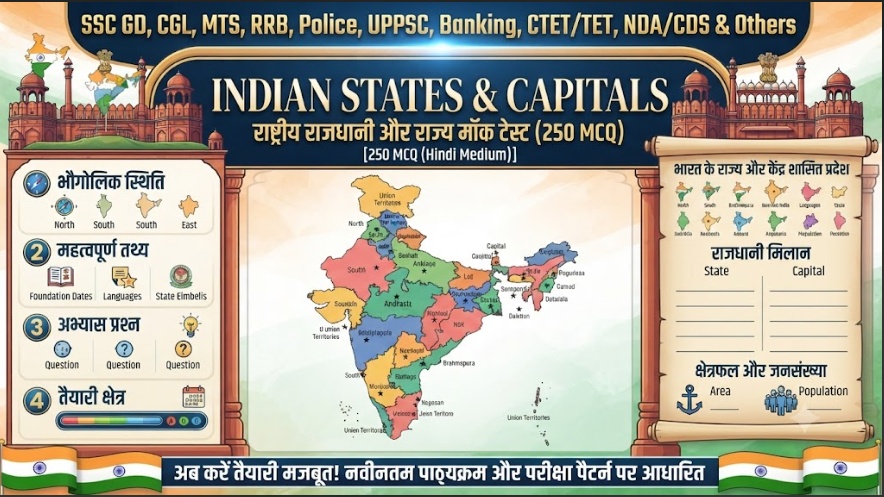
Indian States & Capitals Mock Test [250 MCQ (Hindi Medium)] for SSC GD, SSC CGL, SSC MTS, SSC GD, RRB, Police, UPPSC, Banking, CTET/TETNDA/CDS and other competitive exam v
₹99₹9
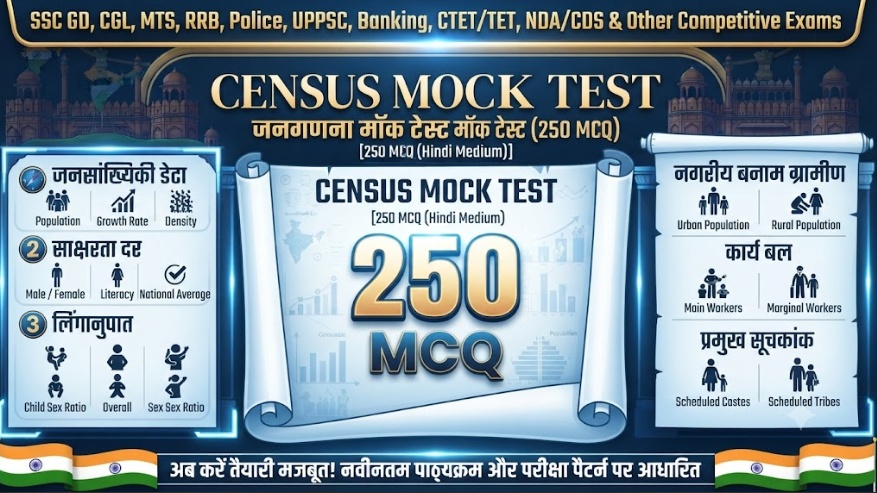
Census Mock Test 250 MCQ Hindi Medium for SSC GD, SSC CGL, SSC MTS, SSC GD, RRB, Police, UPPSC, Banking, CTET/TETNDA/CDS and other competitive exam
₹99₹9
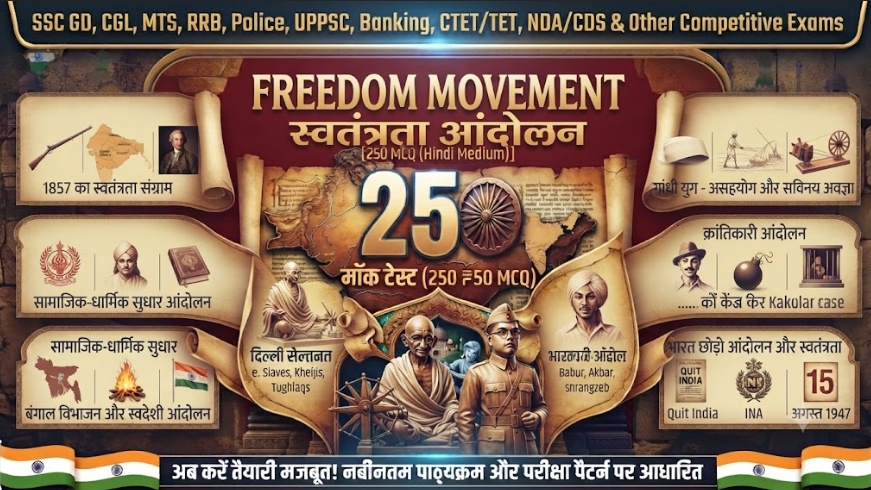
Freedom Movement Mock Test [250 MCQ (Hindi Medium)] for SSC GD, SSC CGL, SSC MTS, SSC GD, RRB, Police, UPPSC, Banking, CTET/TETNDA/CDS and other competitive exam
₹99₹9
Indian Geography Mock Test [250 MCQ (Hindi Medium)] for all competitive exam

₹99₹9
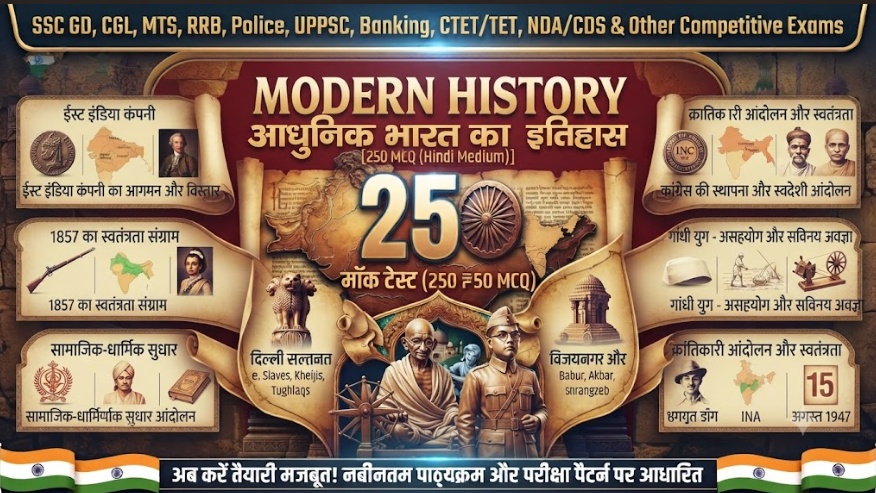
Modern History Mock Test 250 MCQ Hindi Medium for SSC GD, SSC CGL, SSC MTS, SSC GD, RRB, Police, UPPSC, Banking, CTET/TETNDA/CDS and other competitive exam
₹9
Medieval History 250 MCQ Mock Test Hindi Medium for SSC GD, SSC CGL, SSC MTS, SSC GD, RRB, Police, UPPSC, Banking, CTET/TETNDA/CDS and other competitive exam
₹99₹9
Art & Culture Mock Test 250 MCQ in Hindi for SSC GD, SSC CGL, SSC MTS, SSC GD, RRB, Police, UPPSC, Banking, CTET/TETNDA/CDS and other competitive exam
₹99₹9
All-in-One Government Exam Mock Test Series
₹499₹329
RRB Railway Tier 1 Full-Length Mock Test Series
₹299₹249
RRB NTPC Undergraduate CBT 1 Mock Test Series 2026 - 10 Full-Length Mocks
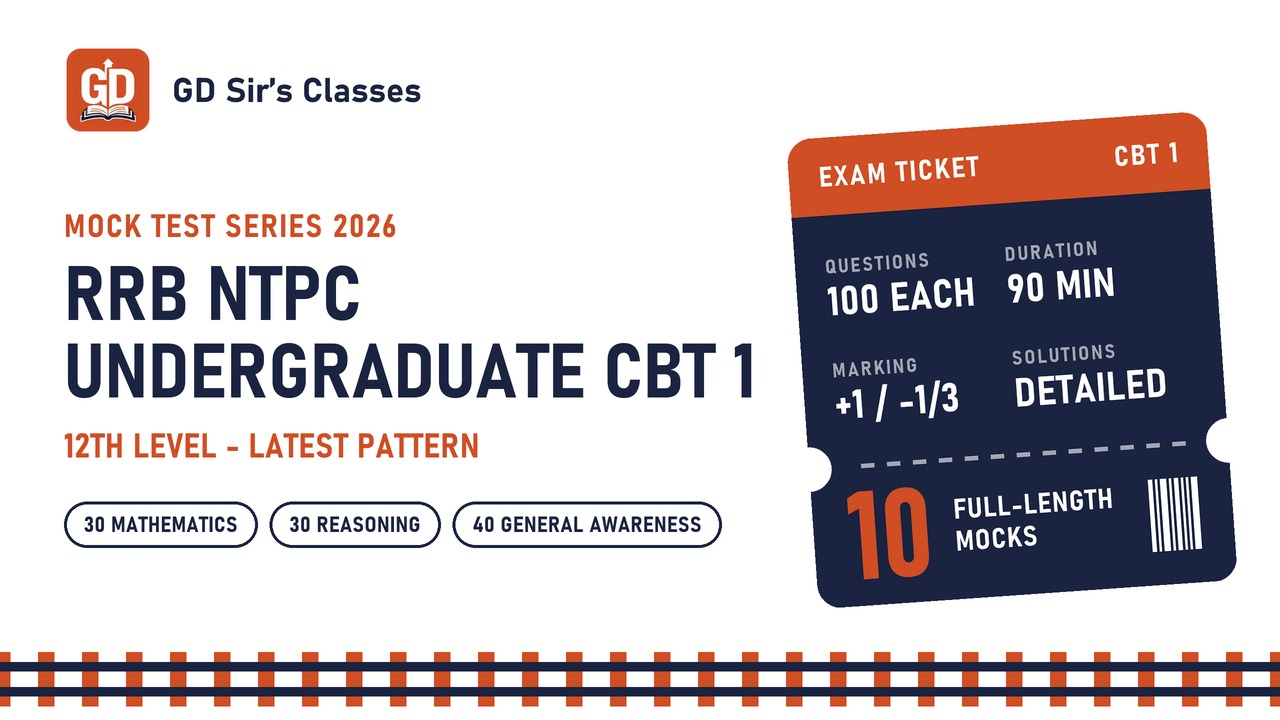
₹800₹699
Railway exams mock tests matter more than in most recruitment exams, because every RRB paper is a race against the clock. A typical CBT gives you 90 minutes for 100 questions, and NTPC CBT 2 gives you 90 minutes for 120. Each wrong answer costs a third of a mark, and the CBT is held over many shifts and normalised. The only reliable way to know whether you can score under those conditions is to practise under them.
This page explains which kinds of railway mock tests to take and when, how to read your results, which benchmarks to track for each exam, and the mistakes that waste practice time. It works for NTPC, Group D, ALP, Technician, JE and RPF aspirants, since they share most of the same sections.
Types of Railway Mock Tests
Test type | What it covers | When to take it |
|---|---|---|
Topic test | One chapter, for example percentages or syllogism, 15 to 25 questions | Right after finishing a chapter |
Sectional test | One full section such as mathematics or general awareness, 20 to 30 minutes | From the middle of your preparation |
Full-length mock | The complete CBT in the current pattern and time limit | Weekly at first, then two or three a week |
Previous year paper | An actual RRB shift paper | Early, to see the level; late, as a final check |
Current affairs quiz | Recent events, 20 to 50 questions | Weekly and monthly |
Technical or trade test | ITI trade, engineering or professional subject | For ALP, Technician, JE and Paramedical, from the second month |
Practise in the Current Pattern
A mock is only useful if it copies the paper you will sit. Check the question count, time and section split of your mock against the latest CEN before you rely on its score.
Exam | Mock format to use |
|---|---|
NTPC CBT 1 | 100 questions in 90 minutes: GA 40, Maths 30, Reasoning 30 |
NTPC CBT 2 | 120 questions in 90 minutes: GA 50, Maths 35, Reasoning 35 |
Group D | 100 questions in 90 minutes: Science 25, Maths 25, Reasoning 30, GA 20 |
ALP CBT 1 | 75 questions in 60 minutes |
ALP CBT 2 | Part A 100 questions in 90 minutes; Part B 75 trade questions in 60 minutes |
Technician Grade III | 100 questions in 90 minutes: Science 40, Maths 25, Reasoning 25, GA 10 |
JE CBT 2 | 150 questions in 120 minutes, 100 of them technical |
RPF Constable | 120 questions in 90 minutes: Arithmetic 35, Reasoning 35, GA 50 |
The RRBs also put official mock links on their website before each CBT so you can get used to the interface. Use them in the last fortnight.
How to Use Mock Tests: A Phased Plan
Phase 1, baseline (week 1): Take one full-length mock or previous year paper without preparing. Note your score and which section ran out of time.
Phase 2, concepts and topic tests (weeks 2 to 8): After each chapter, take a topic test. Aim for 80% accuracy before moving on.
Phase 3, sectional speed (weeks 6 to 10): Two or three sectional tests a week on your weakest section, timed tighter than the real exam.
Phase 4, full mocks (weeks 9 onward): One full-length mock a week, rising to two or three. Take them at the time of day your shift is likely to run.
Phase 5, final fortnight: Alternate a full mock one day with analysis and error-log revision the next. Stop taking new mocks two days before the exam.
A sample week in Phase 4
Day | Mock work | Time |
|---|---|---|
Monday | Full-length mock at your likely shift time | 90 minutes |
Tuesday | Analysis and error-log entries from Monday's mock | 90 to 120 minutes |
Wednesday | Two sectional tests on the weakest section | 60 minutes |
Thursday | Full-length mock or previous year paper | 90 minutes |
Friday | Analysis, plus topic tests on the chapters it exposed | 90 minutes |
Saturday | Weekly current affairs quiz and technical test if your exam has one | 60 minutes |
Sunday | Error-log revision only, no new test | 60 minutes |
How to Analyse a Railway Mock
Analysis is where the marks come from. Spend at least as long reviewing a mock as you spent taking it.
Wrong answers: Classify each one as a concept gap, a calculation slip, a misread question or a guess. Each type needs a different fix.
Slow questions: Any question that took over 90 seconds is a cost even if you got it right. Find a faster method or learn to skip it on the first pass.
Skipped but solvable: Questions you skipped and later solved in under a minute show where your nerve, not your knowledge, is costing marks.
Negative marks lost: Add up the marks lost to wrong answers. If it is more than 4 or 5 in a 100-mark paper, cut down on guessing.
Error log: Write every mistake in one notebook or sheet with the correct method. Revise it before each new mock.
Benchmarks to Track
Measure | Target to work towards |
|---|---|
Overall accuracy | 85% or more of attempted questions |
Attempts in a 100-question CBT | 85 to 95, depending on accuracy |
General awareness time | About 20 seconds a question |
Mathematics time | Under 60 seconds a question on average |
Score trend | Steady rise over five mocks; a flat line means analysis is not being applied |
Score versus cut-off | Consistently 5 to 8 marks above the last cut-off of your RRB and category |
Exam-Specific Mock Advice
NTPC
General awareness carries 40 to 50 questions, so mocks will expose GK gaps fast. Keep a running list of every GK question you miss and revise it weekly. CBT 2 is tighter on time, so practise finishing 120 questions with 10 minutes to spare.
Group D and Technician Grade III
Science decides these papers. If your science section is below 70% accuracy in mocks, return to 10th level NCERT chapters before taking more full tests.
ALP and JE
Take separate mocks for the technical part. ALP Part B needs 35% to qualify, and JE CBT 2 has 100 technical questions, so a strong general section cannot carry a weak technical one.
RPF and Group D physical tests
Mocks cover only the CBT. Run timed practice for the PET alongside, because PET training cannot be done in the weeks between result and test.
Common Mock Test Mistakes
Taking mocks without analysis: Ten analysed mocks do more than thirty unreviewed ones.
Practising an old pattern: Check section counts against the current CEN, especially for NTPC and Technician.
Chasing a single score: One good or bad mock means little. Look at the average of the last five.
Ignoring the clock: Pausing a mock or extending time hides the real problem.
Guessing to finish: In a one-third negative marking paper, random guesses do not raise your expected score.