
Reserve Bank of India Grade B Officer
A prestigious exam for direct recruitment of officers in the Reserve Bank of India.
The RBI Grade B exam is one of the most respected recruitment exams in the Indian banking and finance sector. It is conducted by the Reserve Bank of India to recruit Officers in Grade B, a manager-level role at the country's central bank. Each year, graduates and postgraduates compete for a limited number of posts in three streams: DR (General), DEPR (Department of Economic and Policy Research) and DSIM (Department of Statistics and Information Management).
This guide covers the RBI Grade B 2026 notification, important dates, vacancies, eligibility, exam pattern, syllabus, salary, selection process and preparation strategy. Figures are based on the 2026 notification and reports available as of September 2026; always confirm details on RBI's official recruitment website.
RBI Grade B 2026
Particular | Details |
|---|---|
Conducting body | Reserve Bank of India |
Post | Officers in Grade B (DR) – General, DEPR, DSIM |
Vacancies (2026) | 60 |
Application window | 29 April to 20 May 2026 |
Selection stages | Phase I, Phase II, Interview |
Exam mode | Online (Phase I and Phase II) |
Basic pay | ₹78,450 per month |
Official website | opportunities.rbi.org.in |
What Is RBI and the Grade B Post?
The Reserve Bank of India, established in 1935, is India's central bank. It manages monetary policy, regulates and supervises banks and non-banking financial companies, issues currency, manages foreign exchange and acts as banker to the government.
A Grade B officer joins RBI at the managerial level. Depending on the posting, the work may involve bank supervision, regulation, currency management, foreign exchange, financial inclusion, economic research or data analysis. DEPR officers support economic and policy research, while DSIM officers work with statistics, data systems and surveys.
RBI Grade B 2026 Notification and Important Dates
RBI released the Grade B 2026 notification on 29 April 2026. The key dates are:
Event | Date |
|---|---|
Notification release | 29 April 2026 |
Online application | 29 April to 20 May 2026 |
Phase I – DR (General) | 13 June 2026 |
Phase I – DEPR and DSIM | 14 June 2026 |
Phase II – DR (General) | 25 July 2026 |
Phase II – DEPR and DSIM | 26 July 2026 |
Interview | After the Phase II result (August–September) |
As of late September 2026, the Phase II result has been released and the interview stage is under way. Aspirants targeting the next cycle should expect the notification around a similar time of year, but should wait for RBI's official announcement.
RBI Grade B Vacancy 2026
The 2026 cycle has 60 vacancies across three streams:
Stream | UR | EWS | OBC | SC | ST | Total |
|---|---|---|---|---|---|---|
DR (General) | 16 | 4 | 9 | 7 | 4 | 40 |
DR (DEPR) | 4 | 1 | 1 | 3 | 1 | 10 |
DR (DSIM) | 4 | 1 | 4 | 1 | 0 | 10 |
Total | 24 | 6 | 14 | 11 | 5 | 60 |
Vacancies change from year to year. The 2025 cycle, for example, was notified with 120 vacancies, so the 2026 intake was smaller.
RBI Grade B Eligibility Criteria
Nationality
Candidates must be citizens of India, or belong to the other categories allowed in the notification, such as subjects of Nepal or Bhutan.
Age Limit
For the 2026 cycle, candidates had to be between 21 and 30 years of age, with the age calculated as on the cut-off date given in the notification. Relaxation is given to reserved categories:
Category | Upper age relaxation |
|---|---|
OBC (non-creamy layer) | 3 years |
SC / ST | 5 years |
PwBD | As per notification, higher for PwBD with SC/ST/OBC |
M.Phil / Ph.D holders | Additional relaxation as per notification |
Educational Qualification by Stream
Stream | Minimum qualification |
|---|---|
DR (General) | Graduation in any discipline with at least 60% marks, or post-graduation with at least 55% (relaxed for SC/ST/PwBD) |
DR (DEPR) | Master's degree in Economics, Finance or related fields, or equivalent, with at least 55% (relaxed for SC/ST/PwBD) |
DR (DSIM) | Master's degree in Statistics, Mathematics, Econometrics or related fields, or eligible four-year degree, with minimum marks as per notification |
Check the exact list of accepted subjects in the notification before applying for DEPR or DSIM.
Number of Attempts
For the DR (General) stream, General and EWS candidates can attempt Phase I a maximum of six times. The limit does not apply to SC, ST, OBC and PwBD candidates. An attempt is counted when you appear in Phase I.
Application Fee and How to Apply
Category | Fee (2026) |
|---|---|
General / OBC / EWS | ₹850 + 18% GST (₹1,003) |
SC / ST / PwBD | ₹100 + 18% GST (₹118) |
RBI staff | Nil |
How to apply:
Visit the RBI recruitment portal and open the Grade B notification.
Register with your name, mobile number and email ID.
Fill in personal, educational and category details.
Upload your photograph, signature, thumb impression and handwritten declaration as specified.
Pay the fee online and submit the form.
Save the application and payment confirmation for future reference.
Admit cards are released on the same portal before each phase.
RBI Grade B Selection Process
Selection happens in three stages:
Phase I (online objective exam): A screening test. You must clear the sectional cut-offs and the overall cut-off.
Phase II (online, objective and descriptive): Its marks count towards the final merit.
Interview: Preceded by a psychometric test that carries no marks.
Final merit = Phase II marks + Interview marks. Phase I marks are not added to the final score.
RBI Grade B Exam Pattern
Phase I Exam Pattern (DR General)
Section | Questions | Marks | Time |
|---|---|---|---|
General Awareness | 80 | 80 | 25 min |
Reasoning | 60 | 60 | 45 min |
English Language | 30 | 30 | 25 min |
Quantitative Aptitude | 30 | 30 | 25 min |
Total | 200 | 200 | 120 min |
Each section has its own time limit. One-fourth of the marks assigned to a question is deducted for a wrong answer.
Phase II Exam Pattern (DR General)
Paper | Format | Marks | Time |
|---|---|---|---|
Paper I: Economic and Social Issues (ESI) | 30 objective questions (50 marks) + descriptive section, attempt 4 of 6 (50 marks) | 100 | 30 + 90 min |
Paper II: English (Writing Skills) | Descriptive: essay, précis and reading comprehension | 100 | 90 min |
Paper III: Finance and Management (FM) | 30 objective questions (50 marks) + descriptive section, attempt 4 of 6 (50 marks) | 100 | 30 + 90 min |
Total | 300 |
Descriptive answers are typed on the computer. Negative marking applies to the objective parts.
Interview
The interview carries 75 marks. Candidates first take a psychometric test, which carries no marks but may be used during the interview.
DEPR and DSIM
The DEPR and DSIM streams have their own Phase I and Phase II papers, based on economics and finance for DEPR, and statistics for DSIM, along with an English writing component. They also end with an interview.
RBI Grade B Syllabus
Phase I
Reasoning: Puzzles, seating arrangement, syllogism, inequalities, coding-decoding, blood relations, data sufficiency.
Quantitative Aptitude: Data interpretation, simplification, number series, quadratic equations, arithmetic (percentage, ratio, profit and loss, interest, time and work, speed and distance).
English: Reading comprehension, error spotting, cloze test, para jumbles, vocabulary.
General Awareness: Mostly current affairs, especially banking, economy, RBI policy, government schemes, international events and appointments, plus some static GK.
Phase II
Economic and Social Issues: Growth and development, Indian economy, globalisation, social structure, inclusion, poverty and welfare schemes.
Finance and Management: Financial system and regulators, financial markets, risk management, recent developments in finance; management principles, leadership, motivation, communication and corporate governance.
English (Writing Skills): Essay, précis and comprehension writing.
RBI Grade B Previous Year Papers
RBI does not publish its Phase I and Phase II question papers. Memory-based papers compiled after each exam are widely used. Solve them to understand the question style, the heavy weight of current affairs in General Awareness, and the depth expected in ESI and FM.
RBI Grade B Salary
RBI Grade B offers one of the best salary packages in the government sector.
Component | Details |
|---|---|
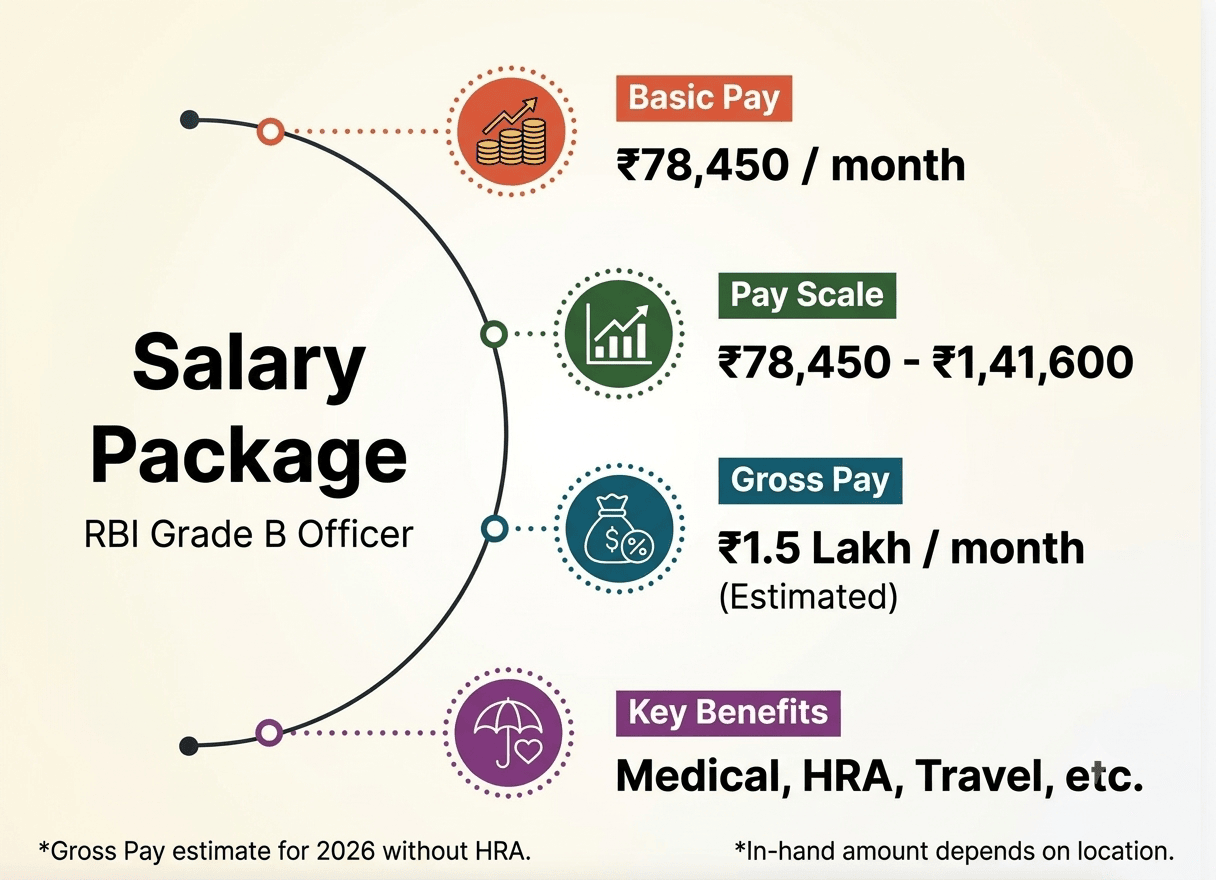
Basic pay | ₹78,450 per month |
Pay scale | ₹78,450 – ₹1,41,600 |
Gross monthly pay | About ₹1.5 lakh (without HRA, as reported for 2026) |
Other benefits | Dearness allowance, special allowance, leave fare concession, medical facilities, housing or HRA, and other perks as per RBI rules |
The in-hand amount depends on the posting location, deductions and whether RBI housing is provided.
RBI Grade B Cut Off
RBI releases cut-offs for Phase I (sectional and overall) and Phase II, category-wise, along with results. Cut-offs vary each year with the number of vacancies, candidates and paper difficulty. Check the official result notices for exact figures, and use previous years' trends to set your target score.
Job Profile and Career Growth
A Grade B officer may be posted in RBI's central office departments or regional offices. Typical work includes:
Supervising banks and non-banking financial companies.
Framing and implementing regulations.
Managing currency, foreign exchange and government accounts.
Supporting research, policy analysis and data management (especially in DEPR and DSIM).
With experience and internal promotion, officers can move up through Grades C, D, E and F to senior leadership roles.
Training
Newly selected officers undergo induction training at RBI's training establishments, followed by on-the-job exposure across departments. The training introduces central banking functions, regulation and the RBI's working systems.
How to Prepare for RBI Grade B
Start with the syllabus: Map every Phase I and Phase II topic and plan them together, since the gap between phases is short.
Build current affairs early: General Awareness is heavily weighted; cover at least the last six to eight months of banking and economy news.
Master Phase I speed: Sectional time limits mean you must be quick in Reasoning and Quant.
Prepare ESI and FM in depth: Read government reports, RBI publications and budget documents for examples.
Practise typing descriptive answers: Phase II answers are typed, so practise writing on a computer.
Take regular mock tests: Full-length mocks with sectional timing are essential for Phase I.
RBI Grade B is a demanding exam, but its structure is clear: a fast objective Phase I, an in-depth Phase II in ESI, FM and English, and an interview. Know your stream's eligibility, follow the official notification closely, cover current affairs and Phase II subjects together, and practise with timed mock tests. With a steady plan, a manager-level career at India's central bank is within reach.