
RPSC APO Mock Test 2026: Online Test Series Guide
Practise for RPSC APO in the current pattern with timed tests for law, General Hindi and General English.
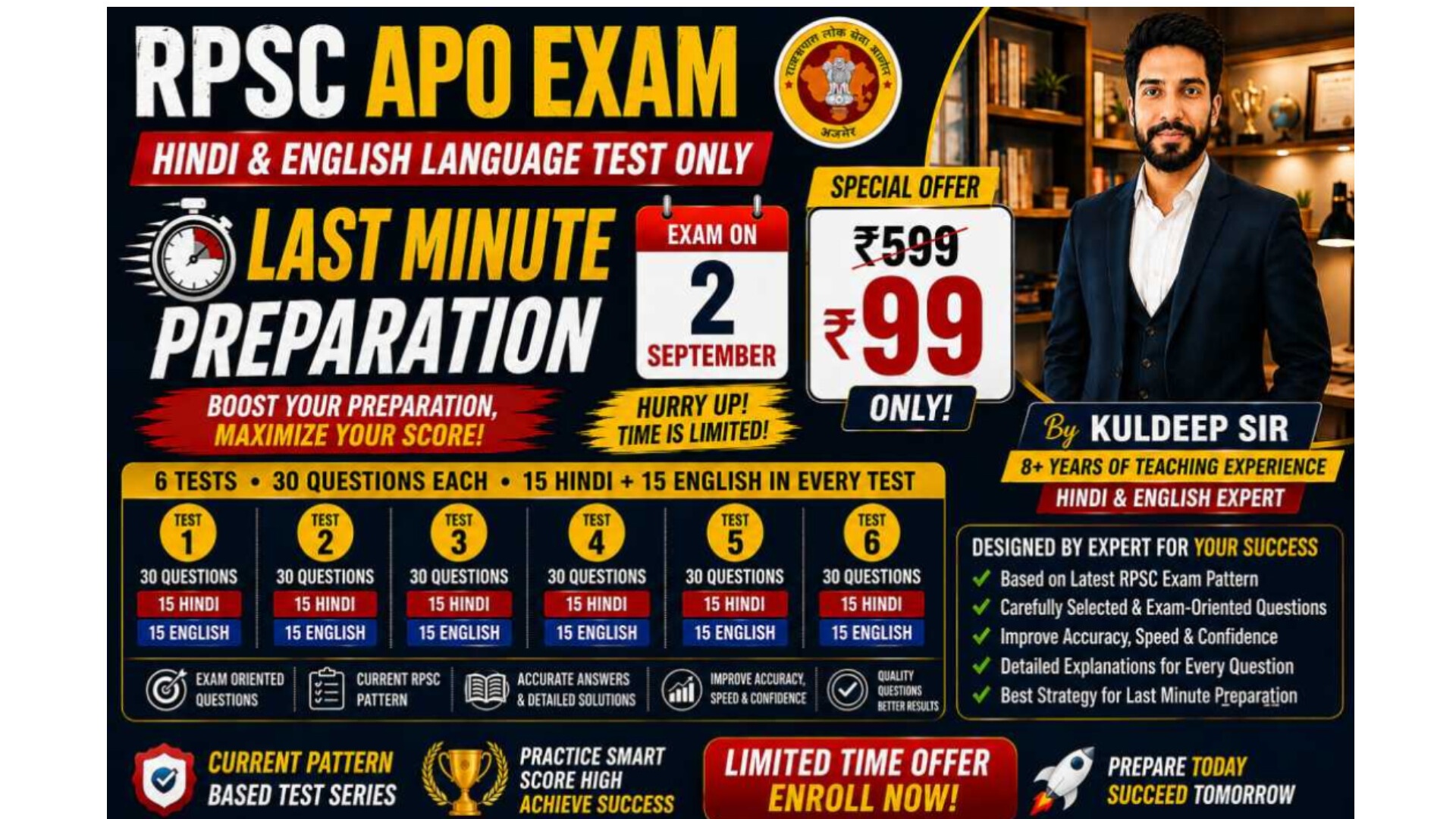
RPSC APO mock tests matter because the prelims punishes careless attempts. Every wrong answer, and every question left without a bubble, costs one-third of a mark, and leaving more than 10% of questions unmarked disqualifies you. Knowing the law is not enough; you need practice deciding which questions to attempt within 2 hours.
This guide covers the types of tests to use, how often to take them, how to analyse each one and which benchmarks to track for the Rajasthan Public Service Commission's Assistant Prosecution Officer exam. With the 2026 mains on 27 December 2026, it also covers how to practise for the written stage.
Types of RPSC APO tests
Test type | What it covers | When to take it |
|---|---|---|
Topic-wise test | One Act or chapter, for example BNS general exceptions or BNSS arrest | Right after finishing that topic |
Old and new code test | Matching questions across IPC and BNS, CrPC and BNSS, Evidence Act and BSA | Once both versions of a code are read |
Sectional test | Law only, or General Hindi and English only | Weekly from the second month |
Full-length mock | 100 questions in 2 hours in the current pattern | Weekly, then twice a week in the last month |
Previous year paper | RPSC's actual question papers | Early to see the level, and again near the exam |
Mains answer practice | Written law answers and language exercises | From the start, increasing after the prelims |
Current pattern to practise in
The prelims has 100 questions for 100 marks in 2 hours: 70 on law, 15 on General Hindi and 15 on General English. Each question has five options, and option 5 means not attempted. The mains has Paper I Law (300 marks, 3 hours) and Paper II Language (100 marks, 2 hours), and each paper needs at least 40% (35% for SC and ST). Full details are on the RPSC APO exam pattern page.
How to use RPSC APO mock tests
Foundation phase: Take one topic-wise test after each Act. Aim for accuracy, not speed.
Building phase: Add two sectional tests a week, one on law and one on Hindi and English.
Full-length phase: Take one full mock a week in the exam slot of 12:00 noon to 2:00 pm, and fill the OMR exactly as you would on the day.
Final month: Two full mocks a week, each followed by analysis on the same day.
How to analyse a mock
Wrong answers: Find the section or rule you misread and note it in an error log with the correct section number.
Slow questions: Mark questions that took more than 90 seconds and decide whether to attempt or skip such questions next time.
Skipped but solvable: Check skipped questions where you could have ruled out options; these are marks the penalty does not justify losing.
Old versus new code errors: Track mistakes caused by mixing IPC and BNS or CrPC and BNSS numbers; they are common and fixable.
Benchmarks to track
Measure | What to aim for |
|---|---|
Accuracy | Rising over time; every wrong answer costs a third of a mark |
Attempts | Questions where you can rule out at least one option, not a fixed number |
Law score | Steady gains toward a clear margin above the latest cut-off |
Language score | Close to full marks on the 30 language questions |
Time | About 20 to 25 minutes for language, leaving the rest for law |
A sample weekly test plan
Day | Test | Follow-up |
|---|---|---|
Monday | Topic test on the Act you finished | Update the error log |
Wednesday | Sectional test on General Hindi and English | Revise the word lists you missed |
Friday | Two mains answers on law, timed | Compare with the bare Act |
Sunday | Full-length mock at 12:00 noon | Same-day analysis of wrong, slow and skipped questions |
Practising for the mains
Objective tests build recall, but the mains is written. Practise answering law questions in a fixed time with the section, its ingredients and their application to the facts. RPSC says the law paper tests practical knowledge, including framing charges, so include charge-framing exercises on short fact situations.
For Paper II, set yourself one Hindi task and one English task each week: a translation of legal sentences, a precis, an official letter or an essay in Hindi, and a comprehension, precis, paragraph or notice in English. Keep to the word limits in the syllabus.
Using RPSC's own question papers
RPSC publishes its question papers and final answer keys. Solve the most recent prelims paper under exam conditions, then check it against the final answer key. Older APO papers from 2015 predate the 2023 criminal codes, so use them for the special Acts and language parts, and treat their IPC and CrPC questions as practice for the matching BNS and BNSS sections.
Common mistakes
Leaving bubbles empty: This costs a third of a mark each time and can lead to disqualification.
Only reading, never testing: Bare Act reading without timed tests hides weak recall of section numbers.
Ignoring the language part: The 30 language marks are the most predictable in the paper, and the mains needs 40% in language on its own.
No mains writing until after prelims: The gap between prelims and mains is short, so writing practice should start early.
Taking mocks without analysis: A mock you do not review teaches little; the analysis is where most of the improvement comes from.
Practising in an outdated pattern: Tests that ignore the 2023 criminal codes or the five-option OMR do not match the current exam.
On Testkart, the RPSC APO practice available includes a test series focused on General Hindi and General English, built to strengthen the language section that counts in both the prelims and the mains. Use it alongside your law preparation so the language marks stay secure.