
RRB NTPC Undergraduate Mock Test 2026
Practice with mock tests built specifically for RRB NTPC UG.
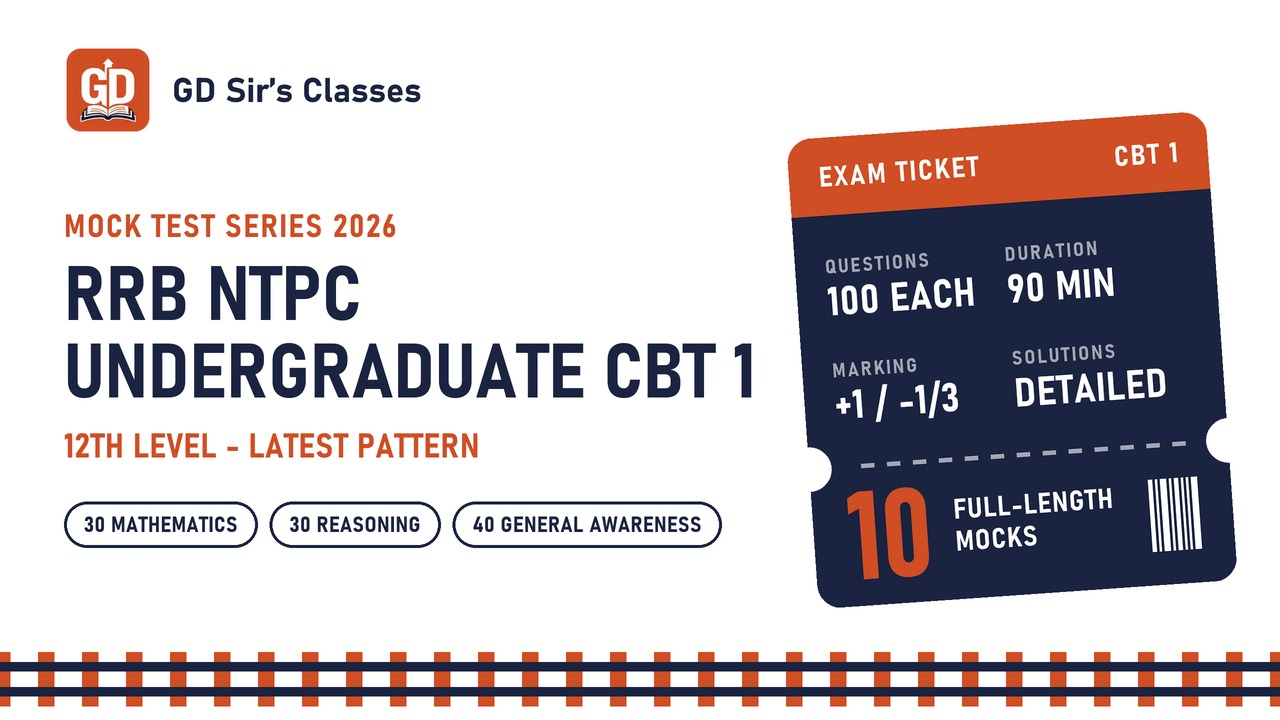
Knowing the RRB NTPC UG syllabus tells you what to study. Knowing the exam pattern tells you how the paper is structured. Neither one tells you whether you can actually manage your own pacing across 100 questions in 90 minutes with no sectional locks, or whether your Mathematics accuracy holds up when General Awareness has already eaten into your remaining time. That's what mock tests are for and for this exam specifically, the skill they build is different from what most candidates assume.
This guide explains how to use RRB NTPC UG mock tests effectively, how CBT 1 and CBT 2 practice should differ, and how to read your results beyond just the final score.
Why Mock Tests Matter for RRB NTPC UG Specifically
RRB NTPC UG has a structural feature that makes self-paced practice essential: neither CBT 1 nor CBT 2 has sectional timing. You get one composite block 90 minutes for each stage across Mathematics, General Intelligence & Reasoning, and General Awareness, and you decide entirely how to split that time yourself.
This sounds like flexibility, but it's actually a skill that needs deliberate practice. Without a fixed sectional cap, it's easy to spend too long on a difficult Mathematics question chasing a solution, only to realise with ten minutes left that General Awareness a comparatively fast, high-yield section hasn't been touched yet. Mock tests, taken under the real composite format, are what train you to catch this before it costs you marks.
What CBT 1 Mock Tests Should Build
CBT 1 is a normalised screening stage your score here doesn't carry forward to your final result, only your ability to clear the cut-off and move to CBT 2 does. That changes what your mock test practice should optimise for:
Consistent clearing speed, not a maximised score. Since CBT 1 marks aren't added to your final merit, the goal is comfortably clearing your category's qualifying threshold with room to spare not squeezing out every possible mark at the cost of over-preparing for a stage that doesn't count toward selection.
Building your personal time-allocation habit early. This is the stage to experiment with section order try General Awareness first in one mock, Mathematics first in another and see which sequence suits your strengths, since you'll carry this habit into the higher-stakes CBT 2.
Establishing baseline accuracy across all three subjects. CBT 1 mocks are where you first discover which subject is your weak point, well before the tougher CBT 2 stage raises the difficulty on that same weakness.
What CBT 2 Mock Tests Should Build
CBT 2 is where your actual selection is decided, with more questions, a higher difficulty level, and importantly a post-specific paper depending on which pay level you've applied under. Your mock practice here should shift focus:
Practise at CBT 2's actual difficulty level, not CBT 1-level questions run for longer. Using CBT 1-standard mocks to prepare for CBT 2 creates a false sense of readiness, since the real exam steps up complexity, particularly in Mathematics and Reasoning.
Track performance against your category's qualifying percentage, not a generic score. Since UR/EWS, OBC-NCL, SC, and ST candidates clear at different thresholds, comparing your mock score to the wrong benchmark either overstates or understates how close you actually are.
Refine your time allocation with the stakes in mind. With 120 questions in the same 90 minutes, the margin for spending too long on any one question is even tighter than in CBT 1 mock practice here should sharpen your "when to move on" instinct specifically.
How to Analyse a Mock Test (Beyond the Score)
The final score is the least actionable number on your mock test report. What actually improves your next attempt:
Time spent per subject, not just per question. Since there's no sectional lock, tracking how long you actually spent on each subject versus how long you planned to spend reveals where your pacing plan breaks down in practice.
Subject-wise accuracy against your qualifying threshold. A strong overall score hiding a weak Mathematics accuracy is a real risk if that weakness would drag your CBT 2 subject performance below what your category needs.
Questions you spent long on and still got wrong. These indicate a genuine concept gap, not a speed problem, and are better addressed through topic revision than through more mock attempts alone.
Patterns across multiple mocks, not one test. A single weak Mathematics mock might just be an off day; the same section underperforming across five consecutive mocks tells you exactly where your next study block should go.
A Practice Plan Aligned to the Exam's Structure
A sensible way to sequence your mock test practice as the exam approaches:
Early preparation phase: Subject-wise topic tests, lightly timed, to build accuracy in Mathematics, Reasoning, and General Awareness individually before combining them under exam conditions.
CBT 1 preparation phase: Full 90-minute composite mocks at CBT 1's 100-question, 100-mark format, focused on establishing a stable time-allocation strategy across all three subjects.
After comfortable with CBT 1 pacing: Shift to CBT 2-level mocks 120 questions, 90 minutes, with harder question standards to build tolerance for the increased pace and complexity.
Final weeks before each stage: Full-length, exam-identical mocks with a dedicated review session immediately after each one, since a mock attempted without review captures far less of its potential value.
If you're applying for a typist-designated post, run typing speed practice in parallel with this entire plan rather than starting it after CBT 2 the Typing Skill Test is a separate qualifying hurdle that builds gradually and shouldn't be left for the final weeks.
Common Mock Test Mistakes to Avoid
Practising CBT 2 with CBT 1-level questions. This builds false confidence, since the real CBT 2 paper is meaningfully harder, not just longer.
Ignoring your specific category's qualifying percentage. Comparing your score against a generic pass mark, rather than the UR/OBC-NCL/SC/ST threshold that actually applies to you, misrepresents how prepared you really are.
Skipping the review step after a mock. The ten minutes spent analysing wrong answers and time usage teaches you more than the test itself.
Overinvesting in CBT 1 scoring at the expense of CBT 2-level preparation, given that CBT 1 marks are normalised and don't carry into your final result.
Leaving typing practice until after CBT 2, for candidates targeting typist posts, when it should run alongside subject preparation from the start.