
SSC JE Mock Test 2026
Practice with mock tests built specifically for Staff Selection Commission Junior Engineer.
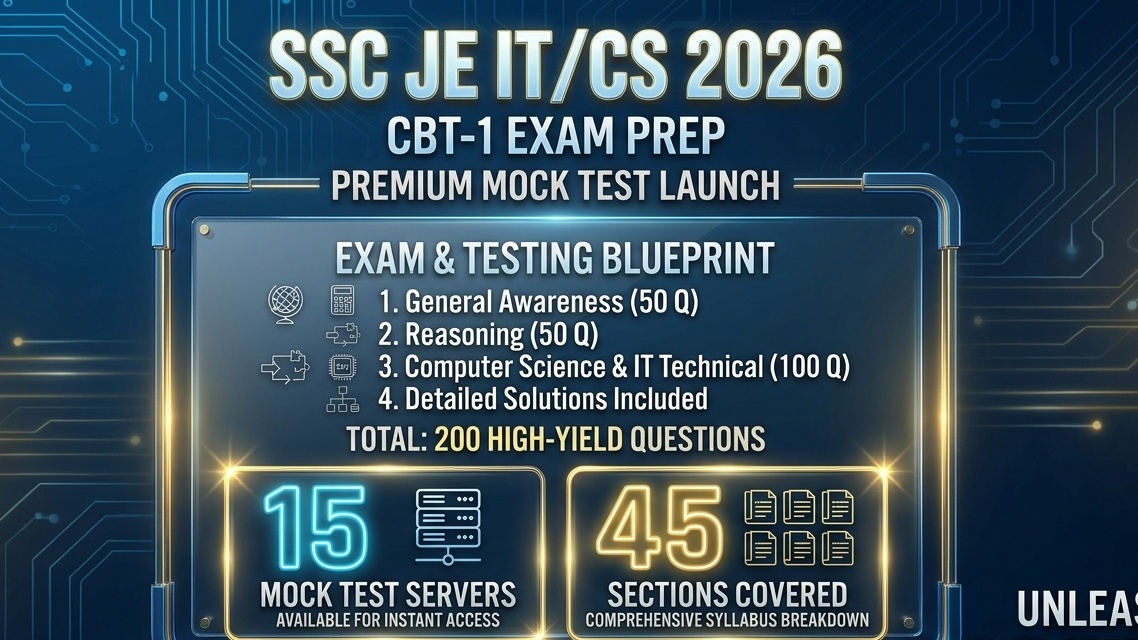

This guide explains how to use an SSC JE mock test effectively in 2026: which types of test to take, how to check that a mock matches the current pattern, how many to attempt before each paper, and how to analyse your results. Exam details are based on the official SSC Junior Engineer Examination 2026 notice on ssc.gov.in.
Why Mock Tests Matter More in SSC JE 2026
Four features of the 2026 exam make timed practice essential:
Paper II decides your rank. Paper I only qualifies you, so your final merit depends on 100 technical questions worth 300 marks.
Negative marking is heavier in Paper II. Each wrong answer costs 1 mark against 3 for a correct one, so guessing habits directly affect your rank.
Paper I is a speed test. With 200 questions in 120 minutes, you get about 36 seconds per question.
The exam is fully on-screen. You use an on-screen scientific calculator and, where needed, IS 456 and steam tables under a "Useful Data" button. Physical calculators are not allowed.
Types of SSC JE Mock Tests
Test Type | What It Covers | Best Used For |
|---|---|---|
Chapter-wise test | One unit, such as Soil Mechanics or Electrical Machines | Checking a topic right after you study it |
Sectional test | Reasoning, General Awareness or General Engineering alone | Building speed in one section |
Full-length Paper I mock | 200 questions, 2 hours, +1/−0.25 | Rehearsing section order and time split |
Full-length Paper II mock | 100 questions, 2 hours, +3/−1 | Practising accuracy under the merit paper's conditions |
Previous-year paper (PYQ) mock | Actual past SSC JE questions | Understanding question style and repeated topics |
A sensible order is chapter-wise tests while you cover the syllabus, then sectional tests, then full-length mocks in the final weeks. Keep PYQ mocks throughout, but note that Paper II has been objective only since the 2023 cycle, so PYQs from before then will not match its format.
How to Check if a Mock Test Matches the 2026
Not every "SSC JE mock test" online has been updated. Before you invest time in a test series, check it against this list:
Check | What the Real 2026 Exam Has |
|---|---|
Paper I structure | 50 Reasoning + 50 General Awareness + 100 General Engineering questions, 200 marks, 2 hours |
Paper II structure | 100 technical questions, 300 marks, 2 hours |
Marking | +1/−0.25 in Paper I; +3/−1 in Paper II |
Your subject part | Civil (Part A), Electrical (B), Mechanical (C), IMD parts (D, E, F) or Telecom (G) |
Syllabus | Includes units named in the 2026 notice, such as Power Electronics, Metrology and Advanced Manufacturing |
Tools | On-screen calculator practice, not a handheld one |
Language | Hindi and English, as in the real exam |
Analysis | Solutions, section-wise scores and time spent per question |
If a series still describes Paper II as descriptive, or says Paper I counts towards your final score, it has not been updated for 2026.
How Many SSC JE Mock Tests Should You Take?
There is no magic number. Quality of analysis matters more than volume. With Paper I tentatively scheduled for October/November 2026 and Paper II for December 2026, a practical plan looks like this:
Phase | Mock Plan |
|---|---|
Until 6 weeks before Paper I | Chapter-wise tests after each unit; one sectional test per week |
6 to 2 weeks before Paper I | 2 full-length Paper I mocks per week, plus sectional tests on weak areas |
Final 2 weeks before Paper I | 3 to 4 full mocks in total; revise from your error log |
Between Paper I and Paper II | 2 to 3 full-length Paper II mocks per week, plus chapter tests on weak units |
Across the whole cycle, 12 to 20 full-length mocks, each properly analysed, is enough for most candidates. Taking 40 mocks without reviewing them helps far less.
How to Analyse an SSC JE Mock Test
Spend at least as long reviewing a mock as you spent taking it. Use these four steps.
1. Break Down Your Score
Note correct, wrong and skipped questions for each section. Your net score alone hides the story. A score of 150 made up of 160 correct and 40 wrong is very different from 150 correct and 0 wrong.
2. Keep an Error Log
Put every wrong answer into one of three groups:
Concept gap: You did not know the idea. Revise the topic.
Calculation error: You knew the method but slipped. Practise more numericals on the on-screen calculator.
Misreading: You misread the question or the options. Slow down on long statements and units.
Work on the largest group first. Scores rise faster when you fix error types instead of simply taking more tests.
3. Check Time per Section
Record how long each section took. If General Engineering in Paper I regularly runs over time, move a few minutes from Reasoning or General Awareness, or practise faster recall.
4. Know Your Break-Even Accuracy
With four options per question, the maths of negative marking works out like this:
Paper II: An attempt adds marks on average only if your chance of being right is above 25% (+3/−1).
Paper I: The break-even point is 20% (+1/−0.25).
In practice, attempt Paper II questions only when you can eliminate at least one option. Track your accuracy by unit in each mock. If a unit's accuracy stays low, revise it before you attempt its questions freely in the exam.
Free vs Paid SSC JE Mock Tests
Free mocks are useful for an honest first diagnosis and for sampling a platform before paying. Paid series usually offer more full-length tests, branch-wise coverage and detailed analysis.
Whichever you choose, apply the pattern checklist above, check that your subject part is covered, and make sure solutions explain the method rather than just giving the answer. Candidates for the new JE (Telecom) and Scientific Assistant (IMD) posts should check this especially carefully, because fewer test series cover Parts D to G.
Common SSC JE Mock Test Mistakes
Taking mocks too early. Full-length tests before finishing most of the syllabus mainly show gaps you already know about.
Pausing or retaking a mock. Real exam conditions mean one sitting and no breaks.
Using a physical calculator. Practise with the on-screen tool you will get on exam day.
Practising only Paper I. Paper II decides merit, so give it full-length practice too, especially after Paper I.
Chasing the score. Mock scores vary with difficulty. Watch the trend in your accuracy and your error log.
Testkart offers SSC JE practice tests, including free CBT-1 Civil Engineering tests and a free reasoning test. Use them for chapter-level and section-level practice alongside the full-length plan above. Explore SSC JE tests on Testkart and add them to your weekly schedule.