
Union Public Service Commission Combined Defence Services
For recruitment into the Indian Military Academy, Officers Training Academy, Indian Naval Academy, and Indian Air Force Academy.
UPSC CDS Study Material
Study Notes
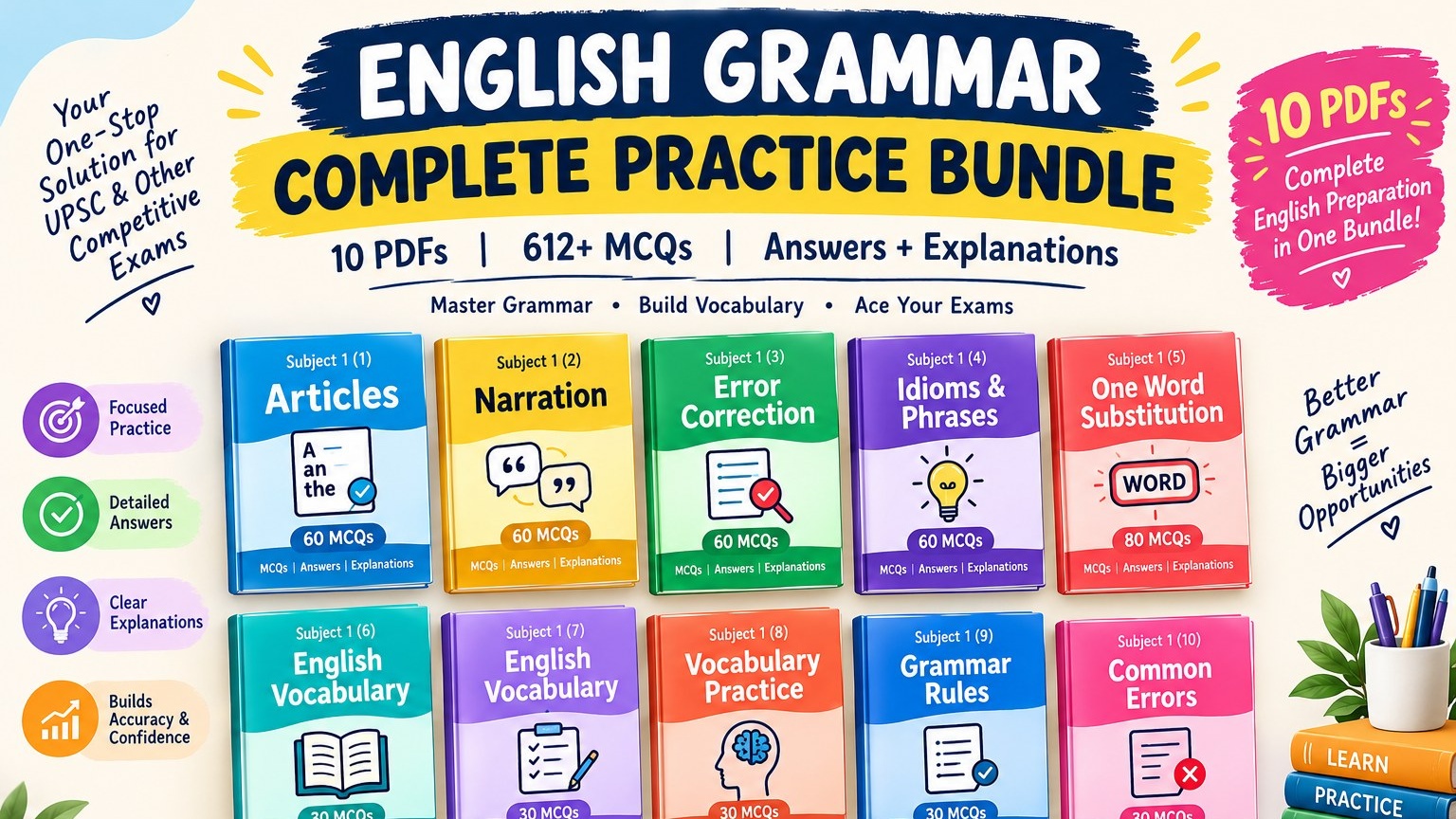
View allOne Word Substitution in English | 80 MCQs with Answers & Explanations | UPSC Practice PDF
32 pages₹9
Active & Passive Voice | 60 MCQs with Answers & Explanations for UPSC Exams
24 pages₹9
English Master Practice Bundle | 10 Topic-Wise PDF Question Banks with Answers & Explanations
221 pages · 9 files₹300
**Articles in English Grammar | 60 MCQs with Answers & Explanations for UPSC Exams**
23 pages₹9
The CDS Exam 2026 is the Combined Defence Services Examination conducted by the Union Public Service Commission (UPSC) twice a year to select graduates for officer training at the Indian Military Academy (IMA), Indian Naval Academy (INA), Air Force Academy (AFA) and Officers Training Academy (OTA). Candidates who clear the written test go on to a Services Selection Board (SSB) interview and a medical examination before joining their academy as officer cadets.
As of October 2026, the CDS II 2026 written exam was held on 13 September 2026 for 451 vacancies, and the result is awaited. The next cycle, CDS I 2027, is listed in the UPSC calendar for notification on 2 December 2026. This guide covers dates, vacancies, academy-wise eligibility, fees, the exam pattern, syllabus, SSB, salary, cut-offs and a practical preparation plan.
Table of Contents
CDS Exam 2026 at a Glance
Particular | Details |
|---|---|
Exam name | Combined Defence Services Examination (CDS) |
Conducting body | Union Public Service Commission (UPSC) |
Frequency | Twice a year: CDS I and CDS II |
Academies | IMA Dehradun, INA Ezhimala, AFA Hyderabad (Dundigal), OTA Chennai |
Vacancies (CDS II 2026) | 451 |
Minimum qualification | Graduation (engineering degree for INA; Physics and Mathematics at 10+2 or engineering degree for AFA) |
Age limit | 19 to 25 years, depending on the academy |
Who can apply | Men for all four academies; women for OTA only |
Exam mode | Offline, objective (OMR sheet) |
Selection stages | Written exam, SSB interview, medical examination, final merit |
Negative marking | One-third of the marks of the question |
Starting pay (Lieutenant) | Level 10: Rs. 56,100 to Rs. 1,77,500, plus Military Service Pay |
Official websites |
CDS Latest Updates and Important Dates
UPSC runs two CDS cycles a year, and they overlap. While one batch waits for its written result, the previous batch is attending SSB interviews. The table below brings both 2026 cycles and the next notification together.
Event | CDS I 2026 | CDS II 2026 |
|---|---|---|
Notification | 10 December 2025 | 20 May 2026 (Notice No. 11/2026-CDS-II) |
Online application | 10 to 30 December 2025 | 20 May to 9 June 2026 |
Written exam | 12 April 2026 | 13 September 2026 |
Written result | Declared in May 2026 | Awaited (expected around October 2026) |
SSB interviews | From mid-2026 | IMA, INA, AFA: around February to March 2027; OTA: around April to June 2027 |
Course begins | January 2027 (IMA, INA, AFA); April 2027 (OTA) | July 2027 (IMA, INA, AFA); October 2027 (OTA) |
For the next cycle, the UPSC calendar lists the CDS I 2027 notification on 2 December 2026, the last date to apply on 22 December 2026 and the written exam on 11 April 2027. CDS II 2027 is listed for notification on 12 May 2027 and the exam on 19 September 2027.
These calendar dates are tentative and can change. Track the examination notices on upsc.gov.in and your registered email, because UPSC does not send admit cards by post.
CDS Vacancy 2026
UPSC notified 451 vacancies for CDS II 2026, the same total as CDS I 2026. The count is set by each service and printed in the notification.
Academy | Course | Vacancies |
|---|---|---|
Indian Military Academy, Dehradun | 163rd (DE) Course | 100 |
Indian Naval Academy, Ezhimala | Executive Branch (General Service/Hydro) | 26 |
Air Force Academy, Hyderabad | Pre-Flying Training Course (Flying Branch) | 32 |
Officers Training Academy, Chennai (Men) | 126th SSC (Men) Course | 275 |
Officers Training Academy, Chennai (Women) | SSC (Women) Non-Technical Course | 18 |
Total | 451 |
The IMA figure includes 13 posts for NCC 'C' certificate (Army Wing) holders, and INA and AFA also keep a small number of posts for NCC certificate holders. Vacancies can be revised by the services before the final result, so treat these figures as indicative until the merit list is out.
CDS Eligibility Criteria
Eligibility differs by academy, so check each preference you plan to choose. A candidate who is eligible for IMA may still be ineligible for INA or AFA.
Educational qualification
Academy | Qualification |
|---|---|
IMA and OTA | Bachelor's degree from a recognised university or equivalent |
INA | Degree in Engineering from a recognised university or institution |
AFA | Bachelor's degree with Physics and Mathematics at 10+2 level, or a Bachelor of Engineering degree |
Final-year students can apply provisionally. They must submit proof of passing by the deadline given in the notification, which is linked to the course start date, so a pending backlog can cost you the seat even after clearing the SSB.
Age limit (CDS II 2026)
Academy | Age | Date of birth window |
|---|---|---|
IMA | 19 to 24 years | 2 July 2003 to 1 July 2008 |
INA | 19 to 24 years | 2 July 2003 to 1 July 2008 |
AFA | 20 to 24 years (up to 26 with a valid Commercial Pilot Licence) | 2 July 2003 to 1 July 2007 (CPL holders: 2 July 2001 to 1 July 2007) |
OTA (Men and Women) | 19 to 25 years | 2 July 2002 to 1 July 2008 |
There is no category-based age relaxation in CDS. The windows shift by six months each cycle, so recheck them in the CDS I 2027 notification.
Marital status, nationality and physical standards
Marital status: IMA, INA and OTA (Men) candidates must be unmarried. For AFA, candidates below 25 years must be unmarried. OTA (Women) is open to unmarried women and to widows or divorcees who have not remarried.
Nationality: Candidates must be citizens of India, or belong to the other categories listed in the notification, such as subjects of Nepal.
Physical standards: Minimum height is 157.5 cm for IMA and OTA (Men), 157 cm for INA, 162.5 cm for AFA and 152 cm for OTA (Women), with relaxation for certain regions. AFA has stricter vision standards.
Number of attempts: There is no cap. You can appear as long as you are within the age window.
CDS Application Fee and How to Apply
Category | Fee |
|---|---|
General, OBC and EWS (men) | Rs. 200 |
Women, SC and ST candidates | Exempt |
The fee can be paid through net banking, debit or credit card, UPI or in cash at an SBI branch. Fees once paid are not refunded.
Complete One Time Registration (OTR): Register once on upsconline.nic.in. The OTR profile is reused for every UPSC exam.
Open the CDS application: Select the active CDS notification and fill in the exam-specific form.
Choose academy preferences carefully: List every academy you are eligible for and want, in order. Preferences cannot be changed after submission.
Upload photo, signature and ID: Follow the size and format rules in the notification.
Pay the fee and submit: Download the confirmation page and keep it safe.
Common reasons for rejection include a date of birth outside the window, missing the required subjects for AFA, a blurred photograph and applying after the 6:00 pm cut-off on the last day.
CDS Exam Pattern
The written exam is a pen-and-paper objective test. Candidates for IMA, INA and AFA take three papers, while OTA candidates take only English and General Knowledge.
For IMA, INA and AFA
Paper | Questions (recent papers) | Marks | Time |
|---|---|---|---|
English | 120 | 100 | 2 hours |
General Knowledge | 120 | 100 | 2 hours |
Elementary Mathematics | 100 | 100 | 2 hours |
Total | 340 | 300 | 6 hours |
For OTA
Paper | Questions (recent papers) | Marks | Time |
|---|---|---|---|
English | 120 | 100 | 2 hours |
General Knowledge | 120 | 100 | 2 hours |
Total | 240 | 200 | 4 hours |
One-third of the marks assigned to a question is deducted for each wrong answer. Unanswered questions carry no penalty. The Elementary Mathematics paper is set at matriculation level, while English and General Knowledge are set at the level expected of a graduate.
What this means for you
Each English and GK question is worth about 0.83 marks: A wrong answer costs about 0.28 marks, so three wrong guesses wipe out one correct answer.
Maths questions carry 1 mark each: A wrong answer costs 0.33 marks. Maths is also where accuracy improves fastest with practice.
OTA is a two-paper race: Without Maths, every English and GK mark weighs more, so a weak English score is hard to recover.
Time is tight in English and GK: 120 questions in 120 minutes leaves one minute per question, so reading speed matters as much as knowledge.
CDS Syllabus Summary
Paper | Level | Important topics |
|---|---|---|
English | Graduate | Spotting errors, synonyms and antonyms, reading comprehension, sentence arrangement, fill in the blanks, idioms and phrases, cloze test |
General Knowledge | Graduate | Current affairs, Indian history, geography, polity, economy, physics, chemistry, biology, defence and awards |
Elementary Mathematics | Matriculation | Arithmetic, number theory, algebra, trigonometry, geometry, mensuration, statistics |
UPSC publishes a detailed unit-wise syllabus for Elementary Mathematics but only a short description for English and General Knowledge. The topic list for those two papers comes from questions asked in previous years.
Selection Process and SSB Interview
Written exam: UPSC sets minimum qualifying marks in each paper and in aggregate, separately for each academy.
SSB interview: Qualified candidates are called by the service headquarters for a five-day SSB. Stage I includes the Officer Intelligence Rating (OIR) test and the Picture Perception and Description Test (PP&DT). Only those who clear Stage I go to Stage II, which covers psychology tests, group testing tasks, the personal interview and the conference.
CPSS for AFA: Air Force Academy candidates must also clear the Computerised Pilot Selection System. A candidate who has failed CPSS or the Pilot Aptitude Battery Test earlier is not eligible for AFA.
Medical examination: Recommended candidates undergo a detailed medical check by a Services medical board.
Final merit: Merit is prepared by adding written and SSB marks. The SSB carries 300 marks for IMA, INA and AFA (total 600) and 200 marks for OTA (total 400).
Because the SSB carries as much weight as the written exam, a candidate with average written marks and a strong SSB can still rank well. The reverse is also true.
CDS Salary and Career Growth
Officer cadets receive a fixed stipend of Rs. 56,100 per month during training. On commissioning as a Lieutenant (or the equivalent rank in the Navy and Air Force), officers move to Pay Level 10.
Rank (Army) | Pay level | Pay range |
|---|---|---|
Lieutenant | Level 10 | Rs. 56,100 to Rs. 1,77,500 |
Captain | Level 10B | Rs. 61,300 to Rs. 1,93,900 |
Major | Level 11 | Rs. 69,400 to Rs. 2,07,200 |
Lieutenant Colonel | Level 12A | Rs. 1,21,200 to Rs. 2,12,400 |
Officers also receive Military Service Pay of Rs. 15,500 per month, Dearness Allowance and other allowances based on posting. IMA, INA and AFA lead to a permanent commission, while OTA leads to a Short Service Commission. The actual in-hand amount varies with posting and allowances, so treat any single monthly figure you see online as an estimate.
CDS Cut-off
UPSC publishes two cut-offs: the aggregate marks of the last candidate who qualified the written exam, and the marks of the last candidate finally recommended.
Academy (CDS I 2025) | Written cut-off | Final cut-off |
|---|---|---|
IMA | 120 / 300 | 243 / 600 |
INA | 104 / 300 | 230 / 600 |
AFA | 128 / 300 | 253 / 600 |
OTA (Men) | 81 / 200 | 163 / 400 |
OTA (Women) | 81 / 200 | 171 / 400 |
Cut-offs change every cycle with paper difficulty, vacancies and the number of candidates. Treat these figures as a benchmark only, and aim for a clear margin above them rather than a bare pass. .
How to Prepare for the CDS Exam
English: Read one editorial a day and note new words with their usage. Practise 20 error-spotting and sentence-arrangement questions daily, since these appear in every paper.
General Knowledge: Use NCERT books from Class 6 to 10 for history, geography and science, then add polity and economy basics. Keep monthly current affairs notes with a separate list for defence exercises, appointments and awards.
Elementary Mathematics: Work through Class 9 and 10 mathematics first, then speed up with arithmetic shortcuts. Trigonometry, geometry and mensuration together carry a large share of the paper.
SSB from day one: Start a short daily habit of reading news, writing a few lines on current issues and staying physically fit. SSB preparation cannot be done in the two weeks after the result.
Mock tests and previous year papers
Begin with topic tests after the first month, move to sectional tests, and take full-length papers under the actual two-hour limit in the last six to eight weeks. After every paper, sort mistakes into three groups: concept gaps, careless errors and wrong guesses. The third group tells you when to stop attempting.