Chandrayaan-3 Reveals Three Lunar Soil Layers at Shiv Shakti Point
Key points
In the News
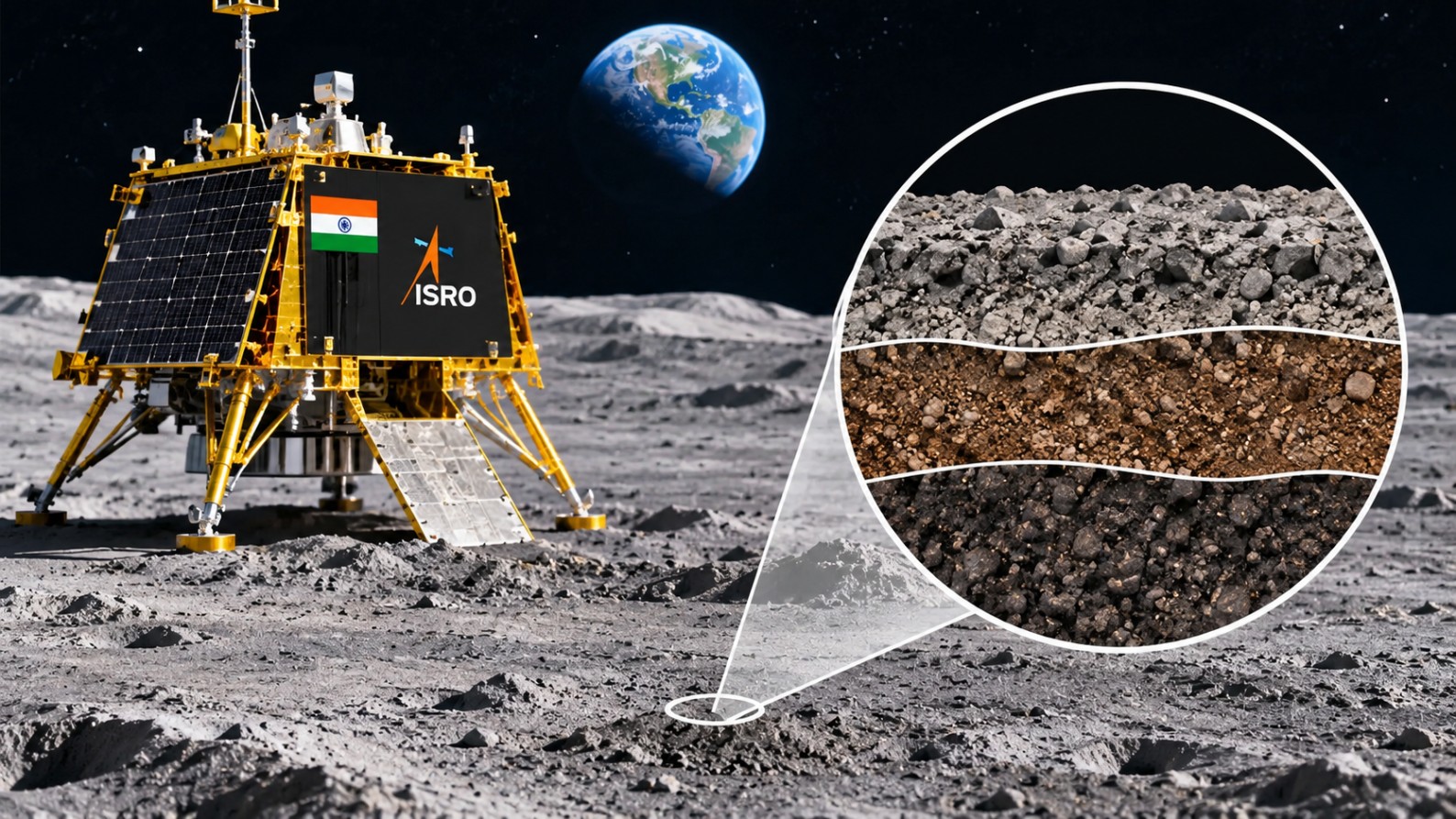
A new scientific analysis of Chandrayaan-3's ChaSTE experiment data, published on 17 November 2026, has revealed three distinct layers of lunar soil within the upper 10 centimetres at Shiv Shakti Point, near the Moon's south polar region.
The research, led by K. Durga Prasad of the Physical Research Laboratory (PRL), Ahmedabad, provides new insights into the Moon's soil structure, density and thermal properties.
Background
India's Chandrayaan-3 mission, developed by the Indian Space Research Organisation (ISRO), successfully landed the Vikram lander and Pragyan rover near the lunar south pole on 23 August 2023.
The Chandra's Surface Thermophysical Experiment (ChaSTE) aboard the Vikram lander was designed to measure lunar surface and subsurface temperatures and investigate the thermal properties of lunar soil.
The landing site is officially known as Shiv Shakti Point.
Key Highlights
Mission: Chandrayaan-3
Research Institution: Physical Research Laboratory (PRL), Ahmedabad
Lead Researcher: K. Durga Prasad
Instrument: Chandra's Surface Thermophysical Experiment (ChaSTE)
Landing Site: Shiv Shakti Point
Discovery: Three distinct lunar soil layers
Depth Studied: Upper 10 centimetres
Research Journal: npj Space Exploration (Nature Portfolio)
Three Layers of Lunar Soil
Layer 1: Upper Porous Layer (0–3 cm)
The uppermost lunar soil layer is highly porous, with approximately 80% porosity and a bulk density of around 600 kg/m³. Its loose structure affects how heat travels through the surface.
Layer 2: Middle Layer (3–6 cm)
The middle layer has higher thermal conductivity, allowing heat to move more efficiently through the lunar soil compared with the surrounding layers.
Layer 3: Lower Dense Layer (6–10 cm)
The lower layer is denser and has intermediate thermal conductivity. The bulk density increases to approximately 1,500 kg/m³ at a depth of 10 centimetres.
Major Scientific Findings
1. Temperature Gradient: Researchers identified a temperature difference of approximately 73 kelvin across the upper 10 centimetres around local lunar noon.
2. Non-Uniform Lunar Soil: The findings show that lunar regolith has different physical and thermal properties even within a shallow depth.
3. Vikram Lander Hop Experiment: During its September 2023 hop manoeuvre, Vikram's engine firing disturbed the upper 2–3 centimetres of soil at the new landing location, helping researchers investigate the underlying material.
4. Future Lunar Exploration: Understanding lunar soil density, porosity and thermal conductivity can support the design of future lunar landers, scientific instruments and surface infrastructure.
Important Facts for Competitive Exams
1. Lunar Regolith: Lunar regolith is the loose layer of dust, rock fragments and other materials covering the Moon's solid surface, formed largely through repeated meteorite impacts and space-weathering processes.
2. ChaSTE Instrument: Chandra's Surface Thermophysical Experiment is a scientific payload aboard Chandrayaan-3's Vikram lander that measures surface and subsurface temperatures to study lunar thermal behaviour.
3. Lunar Heat Transfer: Heat moves through lunar regolith mainly through contact between soil particles and thermal radiation across pores. The Moon's near-vacuum environment prevents ordinary atmospheric convection.
4. Lunar Soil Porosity: Porosity refers to the proportion of empty spaces within soil. Highly porous lunar material generally has a lower bulk density and different heat-transfer characteristics than compact soil.
5. Physical Research Laboratory: PRL is a scientific research institution based in Ahmedabad, Gujarat, known for research in space science, planetary science and related disciplines.
6. Lunar Agglutinates: Agglutinates are glass-rich aggregates produced when micrometeorite impacts melt and fuse lunar soil particles together.
Quick Revision
Chandrayaan-3 Discovery: A new analysis of ChaSTE data has identified three distinct lunar soil layers within the upper 10 centimetres at Shiv Shakti Point.
Research Institution: The study was led by K. Durga Prasad of the Physical Research Laboratory in Ahmedabad.
Upper Soil Layer: The top 0–3 centimetres of lunar soil are highly porous, with approximately 80% porosity and a density of 600 kg/m³.
Middle Soil Layer: The 3–6 centimetre layer exhibits relatively higher thermal conductivity than the surrounding layers.
Lower Soil Layer: The 6–10 centimetre layer is denser, reaching approximately 1,500 kg/m³ at a depth of 10 centimetres.
Scientific Significance: The discovery improves understanding of lunar regolith structure and thermal behaviour, supporting future lunar exploration missions.