ISRO Gaganyaan G1 Mission 2026: First Uncrewed Flight Planned
Key points
In the News
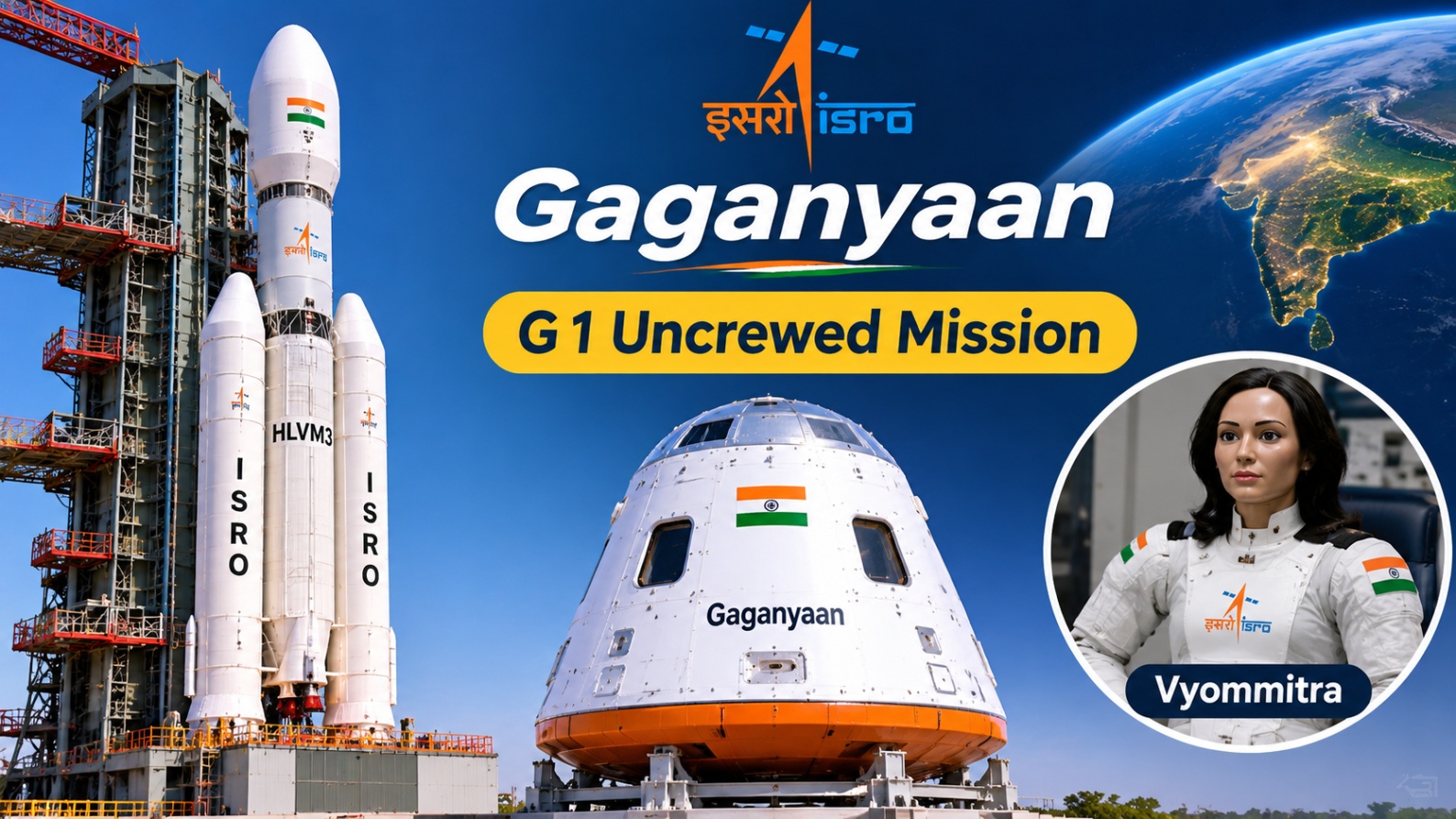
The Indian Space Research Organisation (ISRO) is preparing for the Gaganyaan G1 Uncrewed Mission, an important milestone in India's human spaceflight programme.
The mission will test critical spacecraft systems, including the Human-Rated Launch Vehicle (HLVM3), Crew Module, Service Module and Crew Escape System, before astronauts are sent into space.
According to the Department of Space, the first uncrewed mission is targeted for the fourth quarter of 2026. However, the launch date remains tentative and subject to technical readiness and safety validation.
Background
The Gaganyaan Programme is India's indigenous human spaceflight initiative, developed by ISRO to demonstrate the country's ability to send astronauts into Low Earth Orbit (LEO) and return them safely to Earth.
The programme aims to send three astronauts to an orbit of approximately 400 km for a three-day mission, followed by a safe return and sea recovery.
Before the crewed mission, ISRO plans three uncrewed missions—G1, G2 and G3—to validate the spacecraft's performance and safety systems.
Key Highlights
Mission Name: Gaganyaan G1
Organisation: Indian Space Research Organisation (ISRO)
Mission Type: Uncrewed Experimental Spaceflight
Launch Vehicle: Human-Rated LVM3 (HLVM3)
Launch Centre: Satish Dhawan Space Centre, Sriharikota
Launch Target: Q4 2026 (Tentative)
Launch Date: Not officially confirmed
Humanoid Payload: Vyommitra
Primary Objective: Validation of critical human spaceflight technologies
Future Mission: India's first indigenous crewed orbital spaceflight
Major Objectives of Gaganyaan G1
1. Human-Rated Launch Vehicle Testing
The mission will demonstrate the performance of HLVM3, which has been modified and tested to meet the safety and reliability requirements of human spaceflight.
2. Crew Module Validation
G1 will evaluate spacecraft systems required to support future astronauts, including structural performance, onboard electronics and thermal protection.
3. Crew Escape System
The Crew Escape System is designed to separate the Crew Module from the launch vehicle during certain emergency conditions, improving astronaut safety.
4. Re-entry and Recovery
The mission will help validate spacecraft re-entry, atmospheric deceleration, parachute-assisted descent and recovery procedures.
5. Spacecraft Communication
ISRO will assess tracking, telemetry, command and communication capabilities needed to monitor and control the mission.
Vyommitra: India's Half-Humanoid Robot
Vyommitra is a female-featured half-humanoid robot developed for the Gaganyaan programme.
It is intended to support the evaluation of selected spacecraft systems and human-interaction functions during uncrewed flight testing.
Key Facts:
Developed for India's Gaganyaan human spaceflight programme.
Planned for the G1 uncrewed experimental mission.
Supports testing and demonstration of selected spacecraft functions.
Helps prepare for future human spaceflight operations.
Latest Development and Mission Readiness
Human-Rated LVM3: Development and ground testing of the propulsion stages and structures have been completed.
Orbital Module: Crew Module and Service Module propulsion systems have been developed, tested and qualified.
Life Support Technology: An engineering model of the Environmental Control and Life Support System (ECLSS) has been realised.
Crew Escape System: Five types of escape motors have completed static testing.
Safety Tests: ISRO has successfully completed TV-D1 and two Integrated Air Drop Tests, IADT-01 and IADT-02.
Ground Infrastructure: The Gaganyaan Control Centre, crew training facilities and launch infrastructure have been developed to support the programme.
Important Facts for Competitive Exams
1. Gaganyaan Programme: Gaganyaan is India's indigenous human spaceflight programme designed to demonstrate the capability to launch astronauts into Low Earth Orbit and bring them safely back to Earth.
2. HLVM3: The Human-Rated Launch Vehicle Mark-3 is a modified version of ISRO's LVM3 rocket developed to meet the safety and reliability requirements of crewed spaceflight.
3. Low Earth Orbit (LEO): Low Earth Orbit generally refers to orbits at altitudes below approximately 2,000 km, where many satellites and human spaceflight missions operate.
4. Crew Escape System (CES): The Crew Escape System is a safety mechanism designed to move the Crew Module away from the launch vehicle during certain emergencies.
5. Environmental Control and Life Support System (ECLSS): ECLSS is responsible for maintaining a habitable environment inside a crewed spacecraft by controlling essential life-support conditions.
6. Bharatiya Antariksh Station (BAS): India plans to develop its own space station, with the first module, BAS-01, targeted for launch by 2028 and the full station planned for 2035.
Quick Revision
Gaganyaan G1 is ISRO's first planned uncrewed experimental mission to validate critical technologies before India's indigenous human spaceflight.
Launch Target: The first Gaganyaan uncrewed mission is targeted for Q4 2026, but its exact launch date has not been officially confirmed.
HLVM3: The Human-Rated LVM3 will serve as the launch vehicle for Gaganyaan missions.
Vyommitra: India's half-humanoid robot is planned to fly aboard the G1 mission to support spacecraft technology validation.
Crewed Mission Objective: Gaganyaan aims to send three astronauts into a 400-km orbit for approximately three days and return them safely.
Mission Roadmap: ISRO plans three uncrewed missions before its first indigenous crewed orbital spaceflight.
Bharatiya Antariksh Station: India aims to launch its first space station module by 2028 and establish the full station by 2035.