National Unity Day 2026: History, Significance and Sardar Vallabhbhai Patel’s Contribution to National Integration
Key points
Why in the News?
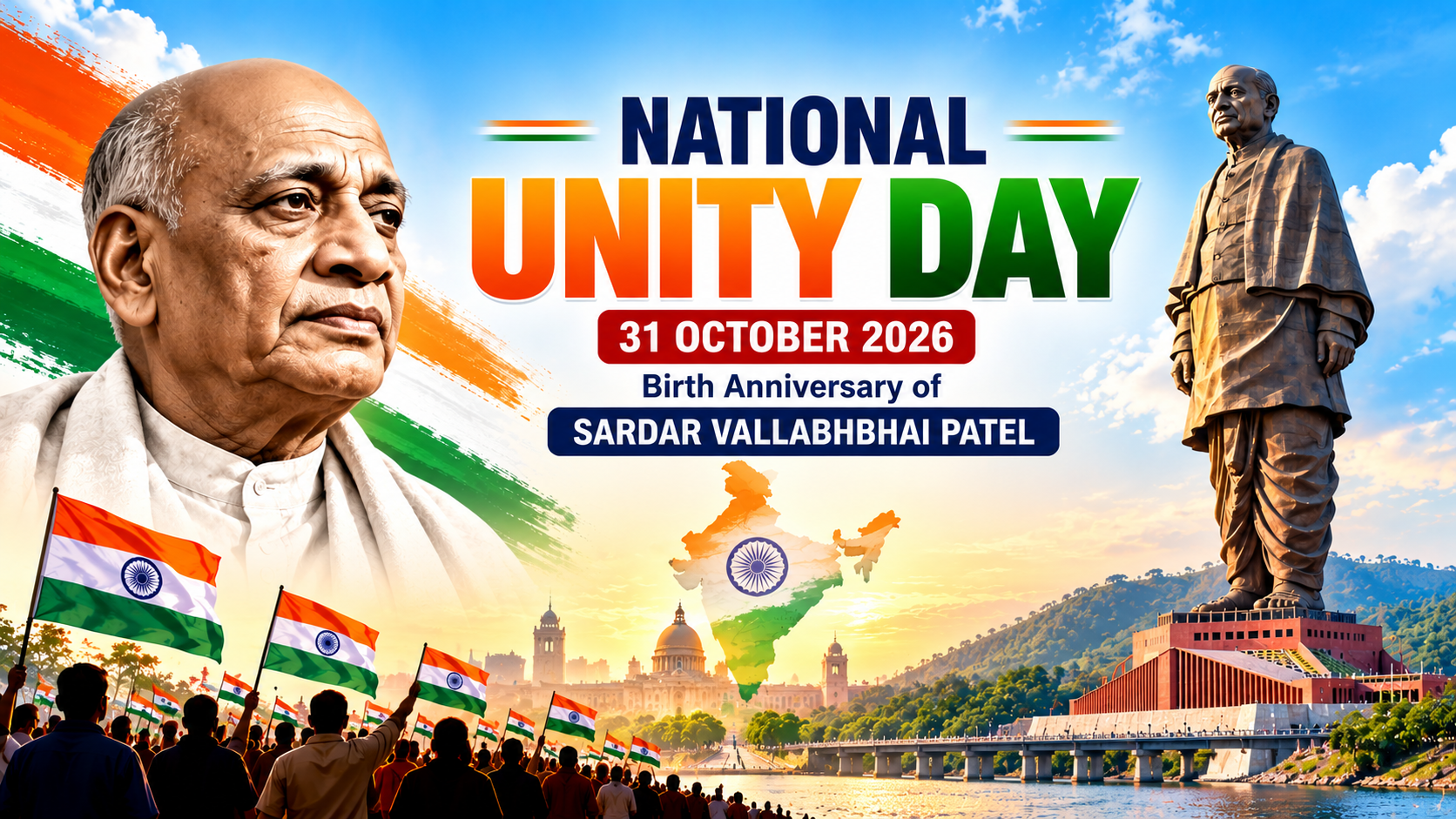
India will observe National Unity Day (Rashtriya Ekta Diwas) on 31 October 2026, marking the 151st birth anniversary of Sardar Vallabhbhai Patel, popularly known as the Iron Man of India.
The main national celebrations are scheduled to take place at the Statue of Unity in Ekta Nagar, Gujarat, with Prime Minister Narendra Modi participating in the commemorative programme.
The 2026 celebrations will feature the Rashtriya Ekta Diwas Parade, cultural programmes and activities highlighting India's national unity and diversity.
Vande Mataram will be the overarching theme of the 2026 Rashtriya Ekta Diwas celebrations.
National Unity Day 2026: Key Facts
Particulars | Details |
|---|---|
Important Day | National Unity Day |
Hindi Name | Rashtriya Ekta Diwas |
Observed On | 31 October |
Day in 2026 | Saturday |
Birth Anniversary | 151st |
Commemorates | Sardar Vallabhbhai Patel |
Birth Date | 31 October 1875 |
Birthplace | Nadiad, Gujarat |
First Observed | 2014 |
Main Venue in 2026 | Statue of Unity, Ekta Nagar, Gujarat |
2026 Celebration Theme | Vande Mataram |
Main Objective | Promote national unity, integrity and security |
What Is National Unity Day?
National Unity Day is an annual national observance dedicated to the memory of Sardar Vallabhbhai Patel.
It recognises his contribution to India's independence movement and the political integration of princely states after independence in 1947.
The day encourages citizens to uphold the values of unity, integrity, security and respect for India's cultural diversity.
History of National Unity Day
The Government of India announced the observance of Rashtriya Ekta Diwas in 2014, choosing 31 October to commemorate Sardar Patel's birth anniversary.
The decision recognised Patel's role in consolidating independent India and bringing numerous princely states into the Indian Union.
Since then, National Unity Day has been observed through programmes such as the Run for Unity, unity pledges, educational activities and commemorative ceremonies.
Why Was 31 October Selected?
Sardar Vallabhbhai Patel was born on 31 October 1875 in Nadiad, Gujarat.
His contribution to political integration and institution-building made his birth anniversary an occasion to emphasise national unity.
Who Was Sardar Vallabhbhai Patel?
Sardar Vallabhbhai Patel was an Indian freedom fighter, lawyer and political leader who played a major role in India's independence movement.
He became independent India's first Deputy Prime Minister and first Home Minister in 1947.
Patel is remembered for his contribution to integrating princely states, strengthening administration and supporting the development of national institutions.
Important Biographical Facts
Particulars | Details |
|---|---|
Full Name | Vallabhbhai Jhaverbhai Patel |
Born | 31 October 1875 |
Birthplace | Nadiad, Gujarat |
Died | 15 December 1950 |
Popular Title | Iron Man of India |
First Deputy Prime Minister | 1947–1950 |
First Home Minister | 1947–1950 |
Important Movements | Kheda Satyagraha and Bardoli Satyagraha |
Political Organisation | Indian National Congress |
Bharat Ratna | 1991, posthumously |
Sardar Vallabhbhai Patel's Contribution to National Integration
1. Integration of Princely States
When India gained independence in 1947, the subcontinent consisted of British Indian provinces and more than 560 princely states.
The political integration of these states was one of the major challenges facing the newly independent country.
Sardar Patel, working closely with V. P. Menon, played a central role in persuading rulers to join the Indian Union.
The process involved diplomacy, negotiations, legal agreements and, in certain cases, the use of military force.
2. Instrument of Accession
The Instrument of Accession was a legal document through which princely states could accede to India.
It initially provided for the transfer of specified subjects, including defence, external affairs and communications, to the Dominion government.
The accession process helped establish a political framework for the integration of princely states.
3. Integration of Junagadh
Junagadh was a princely state in present-day Gujarat.
Its ruler initially chose to accede to Pakistan despite its geographical location and predominantly Hindu population.
Following political developments and Indian intervention, a plebiscite was held in February 1948, producing an overwhelming vote in favour of joining India.
4. Integration of Hyderabad
Hyderabad was one of the largest princely states in India.
Its ruler initially sought to remain independent.
In September 1948, the Indian government conducted a military operation known as Operation Polo.
Following the operation, Hyderabad was brought under Indian control and integrated into the Union.
5. Kashmir and the Accession Process
The princely state of Jammu and Kashmir acceded to India in October 1947 after Maharaja Hari Singh signed the Instrument of Accession.
The accession occurred during an armed conflict following an invasion by tribal forces from Pakistan.
The Kashmir question subsequently became a major international and bilateral dispute.
Patel was an important member of the government during this period, although the handling of Kashmir involved several leaders, including Prime Minister Jawaharlal Nehru.
6. Strengthening India's Administrative System
Sardar Patel strongly supported the creation and continuation of professional all-India administrative services.
He regarded a capable, impartial civil service as essential for maintaining national unity and effective governance.
His support for the administrative services contributed to his reputation as an important architect of India's post-independence administrative system.
Important Princely States and Their Integration
Princely State | Important Historical Event |
|---|---|
Junagadh | Plebiscite held in February 1948 |
Hyderabad | Operation Polo in September 1948 |
Jammu and Kashmir | Instrument of Accession signed in October 1947 |
Travancore | Joined the Indian Union after initially expressing an intention to remain independent |
Bhopal | Merged with India in 1949 |
Patel's Role in India's Freedom Struggle
Kheda Satyagraha, 1918
Patel participated in the Kheda Satyagraha in Gujarat under Mahatma Gandhi's leadership.
The movement opposed the collection of land revenue from farmers facing crop failures and economic hardship.
Bardoli Satyagraha, 1928
Patel led the Bardoli Satyagraha against increased land revenue assessments.
The movement became an important example of organised non-violent resistance.
Following his leadership in Bardoli, he became widely known by the title Sardar.
Indian National Congress
Patel served as President of the Indian National Congress at the Karachi Session in 1931.
The session is remembered for resolutions concerning fundamental rights and national economic policy.
Significance of National Unity Day
National Integration: The day commemorates the historical process of bringing diverse territories into a united political framework.
Unity in Diversity: It encourages respect for India's linguistic, cultural, regional and religious diversity.
National Security: It reinforces the importance of protecting India's sovereignty, integrity and security.
Historical Awareness: It introduces younger generations to the challenges faced during India's political integration.
Civic Responsibility: It encourages citizens to participate in activities promoting cooperation, mutual respect and constitutional values.
National Unity Day 2026 Celebrations
The principal celebrations will be held at Ekta Nagar in Gujarat, near the Statue of Unity.
Planned activities include:
Rashtriya Ekta Diwas Parade featuring security forces.
National Unity Pledge.
Run for Unity programmes.
Cultural performances showcasing India's diversity.
Activities highlighting the role of security forces.
Bharat Parv celebrations.
The 2026 parade will place particular emphasis on the achievements of security forces in countering Left-Wing Extremism.
The national song Vande Mataram will be a central theme of the celebrations.
Statue of Unity: Important Facts
The Statue of Unity is a monument dedicated to Sardar Vallabhbhai Patel.
It is located in Ekta Nagar, formerly known as Kevadia, in Gujarat's Narmada district.
The statue was inaugurated on 31 October 2018.
Key Facts About the Statue of Unity
Particulars | Details |
|---|---|
Dedicated To | Sardar Vallabhbhai Patel |
Location | Ekta Nagar, Gujarat |
River | Narmada |
Height | 182 metres |
Inaugurated | 31 October 2018 |
Sculptor | Ram V. Sutar |
Significance | World's tallest statue |
Conclusion
National Unity Day 2026 commemorates the 151st birth anniversary of Sardar Vallabhbhai Patel and recognises his role in India's political integration.
Patel's leadership during the accession of princely states and his contribution to institution-building remain important parts of India's post-independence history.
Rashtriya Ekta Diwas provides an opportunity to reflect on national unity, constitutional values, cultural diversity and the responsibilities of citizenship.