
RPSC RAS Mock Test 2026: Online Practice for Prelims
Practise for the RAS Prelims with timed tests in the current pattern and section-wise analysis.
Rajasthan Competitive Exams Topic Wise Mock Test Series
⭐ 4.00Free
Rajasthan GK & History: 40 MCQ Practice Test
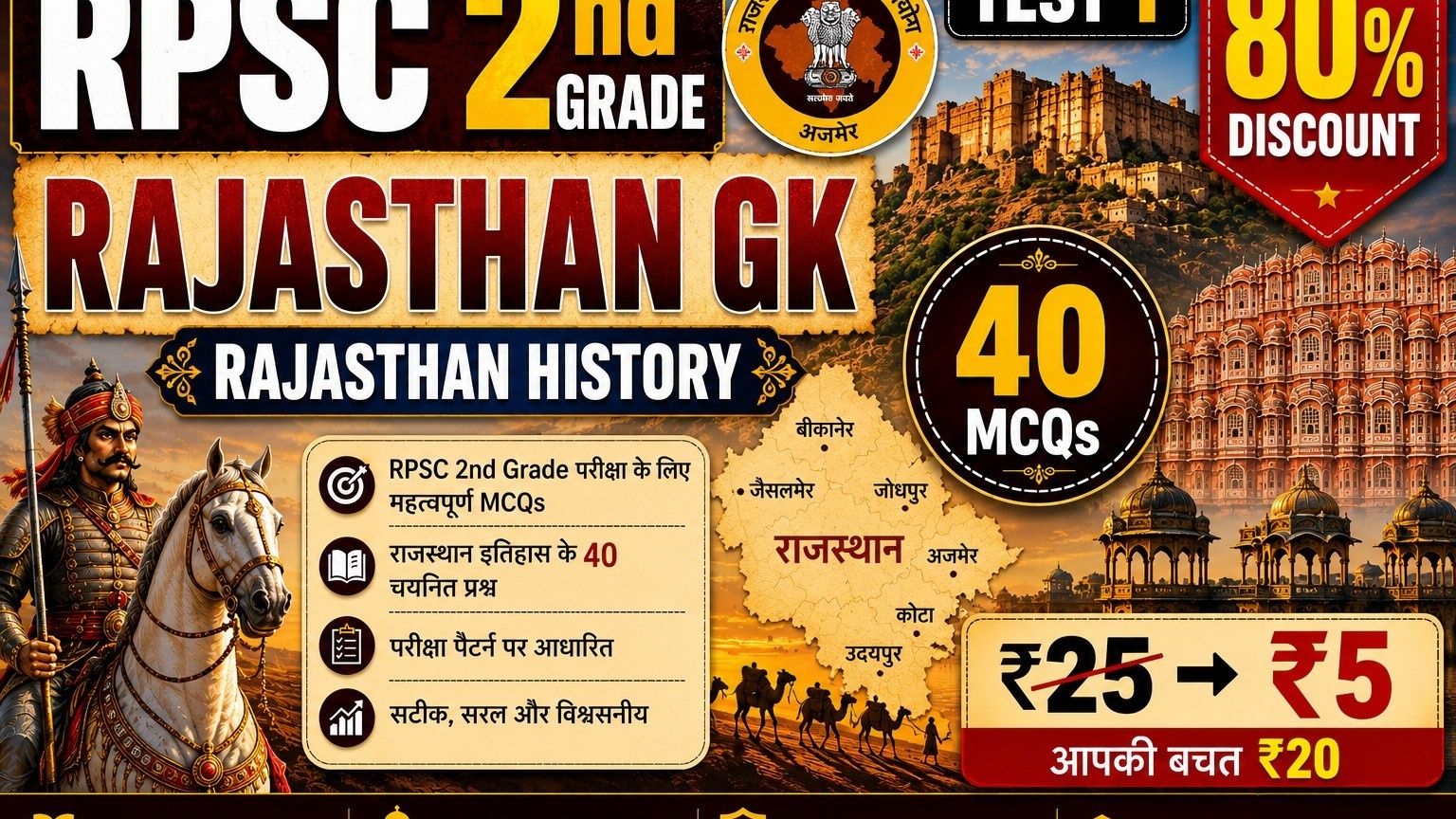
₹25₹5
for Rajasthan ras,psi,reet,patwar and all Rajasthan exam

₹77
RPSC RAS राजस्थान भूगोल: अपवाह तंत्र टेस्ट सीरीज़ (हिंदी)
₹100₹25
RPSC RAS mock tests help you practise the Prelims under real conditions: 150 questions, 200 marks, 3 hours and a one-third penalty for every wrong answer. For a paper this broad, timed practice is how you learn which questions to attempt and which to leave. The RAS 2026 Prelims is scheduled for 6 December 2026, so this is the stage to move from reading to testing.
Table of Contents
Official Practice Material From RPSC
Types of RAS Mock Tests
How to Use RAS Mock Tests
How to Analyse a Mock Test
Benchmarks to Track
Common Mistakes
Official Practice Material From RPSC
RPSC does not publish official online mock tests for the RAS exam. What it does publish is previous question papers and answer keys, which you can find on the RPSC official website. Solve the last few Prelims papers first, because they show the real difficulty level and the share of Rajasthan-specific questions.
Types of RAS Mock Tests
Test type | What it covers | When to take it |
|---|---|---|
Topic-wise test | One topic, such as Rajasthan history or polity | Right after finishing that topic |
Subject-wise test | A full subject area, such as geography or economy | After completing each subject |
Full-length mock | 150 questions in the current Prelims pattern | Weekly in the last two months, then twice a week |
Previous year paper | An actual RPSC Prelims paper | Early on to judge level, and again for revision |
How to Use RAS Mock Tests
Build a base first: Start with topic-wise tests while you are still covering the syllabus.
Move to full-length mocks: Take one a week in the last two months, at the same time as the real exam.
Increase frequency at the end: In the final three weeks, take two or three full mocks a week and revise between them.
How to Analyse a Mock Test
Wrong answers: Note whether each mistake came from a fact gap, a misread question or a guess.
Slow questions: Mark questions that took more than two minutes and practise that type.
Skipped but solvable: Review skipped questions you could have answered, to build confidence.
Net score trend: Track your score after negative marking and compare it with the RPSC RAS cut-off trends.
Benchmarks to Track
Measure | What to aim for |
|---|---|
Net score | A steady margin above the highest recent cut-off for your category |
Accuracy | About 80 percent or higher on attempted questions |
Attempts | A stable number you can answer with confidence, not the maximum possible |
Time | All 150 questions read and OMR marked with 10 minutes to spare |
These are practical targets, not official figures. Adjust them as your scores improve.
Common Mistakes
Taking mocks without review: A test you do not analyse teaches very little.
Chasing attempts: Attempting every question raises the negative marking cost.
Using old-pattern tests: Make sure tests drop Sports and Yoga and follow the revised syllabus.