
RRB JE Mock Test: Why It Matters and How to Use One Effectively
Practice with mock tests built specifically for Railway Recruitment Board Junior Engineer.
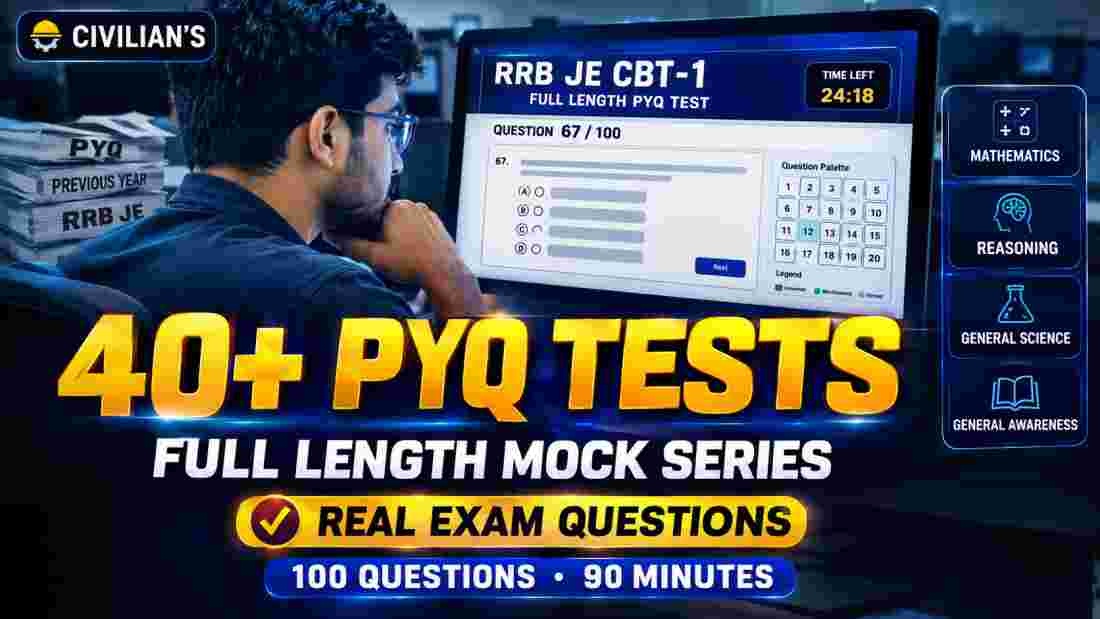
Reading the syllabus and understanding the exam pattern only gets an RRB JE aspirant halfway there. The gap between knowing a topic and scoring on it under real exam conditions a ticking clock, negative marking, and an unfamiliar computer interface is exactly what a mock test is built to close.
This guide covers what an RRB JE mock test actually simulates, how it differs from solving previous-year papers, how many you should attempt, and how to turn a mock test score into a genuine improvement plan rather than just a number to feel good or bad about.
What an RRB JE Mock Test Actually Simulates
A well-built RRB JE mock test isn't just a set of practice questions it replicates the real exam environment closely enough that your CBT-1 or CBT-2 attempt on exam day doesn't feel unfamiliar.
Element | What It Should Match |
|---|---|
Question count | 100 for CBT-1, 150 for CBT-2 |
Duration | 90 minutes (CBT-1), 120 minutes (CBT-2) |
Marking scheme | +1 for correct, −1/3 for incorrect |
Subject split | Same weightage as the actual CBT-1/CBT-2 pattern |
Interface | Computer-based, with an on-screen calculator for CBT-2 practice |
If a mock test skips negative marking, uses a different question count, or ignores the subject-wise weightage, it's testing your topic knowledge in isolation useful, but not the same as testing exam readiness.
Mock Test vs. Previous-Year Papers: Different Jobs
Aspirants often treat these as interchangeable, but they serve different purposes.
Aspect | Previous-Year Papers | Mock Tests |
|---|---|---|
Purpose | Shows actual difficulty level and question style asked before | Simulates full exam conditions for the current pattern |
Best used for | Understanding question framing and recurring topics | Practising time management, attempt strategy, and stamina |
Limitation | Doesn't reflect a new cycle's exact weightage or format tweaks | Requires a well-constructed test to be genuinely representative |
When to use | Early in preparation, to calibrate difficulty | Throughout preparation, with increasing frequency closer to the exam |
The strongest preparation combines both: previous-year papers to understand what's actually been asked, and full-length mock tests to practise performing under the real constraints of the exam.
Why Mock Tests Matter for RRB JE Specifically
They train you for negative marking, not just topic recall. A 1/3 mark penalty for wrong answers changes how you should approach a question you're unsure about. This decision-making skill attempt, skip, or come back later only sharpens through repeated practice under the same penalty structure, not through untimed topic revision.
They reveal your real per-question pace. With roughly 54 seconds per question in CBT-1 and 48 seconds in CBT-2, many aspirants discover through mock tests that they're spending too long on early questions and rushing the last section a pattern that's nearly impossible to notice without timed, full-length practice.
They surface section-wise weak areas you didn't know you had. A candidate might be strong in Mathematics overall but consistently lose marks specifically in Mensuration or Time-and-Work problems. Section-wise mock test reports make this visible in a way that general revision doesn't.
They build familiarity with the CBT-2 on-screen calculator. Since CBT-2 provides a virtual calculator rather than a physical one, practising with a similar interface in advance avoids losing time adjusting to it during the actual exam.
They reduce exam-day anxiety through repetition. Candidates who've already sat through several full-length, timed, negatively-marked tests tend to experience less exam-day stress than those attempting exam-like conditions for the first time on the actual day.
How Many Mock Tests Should You Attempt?
There's no universal number, but a reasonable framework looks like this:
Early preparation phase: 1–2 sectional tests per week, focused on individual subjects, to build topic-level accuracy before attempting full-length papers.
Mid preparation phase: 1–2 full-length CBT-1 pattern tests per week, gradually adding CBT-2 pattern tests as your branch-specific technical preparation progresses.
Final 3–4 weeks before the exam: Increase to 3–4 full-length tests per week, alternating between CBT-1 and CBT-2 pattern papers, with a genuine post-test analysis after each one.
The goal isn't the raw number of tests it's whether each attempt is followed by analysis that changes what you do differently in the next one. Ten unanalysed mock tests teach you less than four tests you've genuinely reviewed.
How to Analyse a Mock Test Properly
Taking a mock test without analysing it afterward wastes most of its value. A useful analysis routine covers:
Accuracy by section, not just overall score. A 70% overall score can hide a section where you're scoring 90% and another where you're barely clearing the qualifying mark.
Time spent per section versus questions attempted. If you spent 40% of your time on a section worth 20% of the marks, that's a pacing problem to fix before your next attempt.
Reasons for wrong answers. Separate "didn't know the concept" from "knew it but made a calculation error" from "misread the question" each needs a different fix.
Questions skipped that you could have attempted. If you're consistently leaving attemptable questions unanswered out of caution, your risk calibration under negative marking may need adjusting.
Comparison across tests, not just within one. A single test tells you where you stand today; a trend across five or six tests tells you whether your preparation is actually working.
Choosing an RRB JE Mock Test Series
When evaluating any mock test resource, look for a few specific things rather than judging by test count alone:
Pattern accuracy: Question count, duration, and marking scheme should match the current CBT-1/CBT-2 structure, not an older or generic format.
Branch-specific CBT-2 coverage: Since Technical Abilities differs by engineering discipline, a mock test series should offer separate tests for Civil, Mechanical, Electrical, and Electronics rather than a single generic technical paper.
Section-wise performance reports: A score alone tells you little; a breakdown by subject and topic tells you where to focus next.
Difficulty variation across tests: Tests that are uniformly easy build false confidence; a good series mixes difficulty levels the way real exam shifts do.
Updated content: Given that RRB occasionally revises normalisation methodology, qualifying criteria, or minor pattern details between cycles, a test series should reflect current-cycle information rather than a static, years-old bank of questions.