
Supreme Court JCA Mock Test 2026: Online Test Series and Practice Plan
Practise the 2026 Supreme Court JCA objective test in the real 100-question, 90-minute format, with section-wise analysis.
Supreme Court Junior Court Assistant Mock Test Series 2026
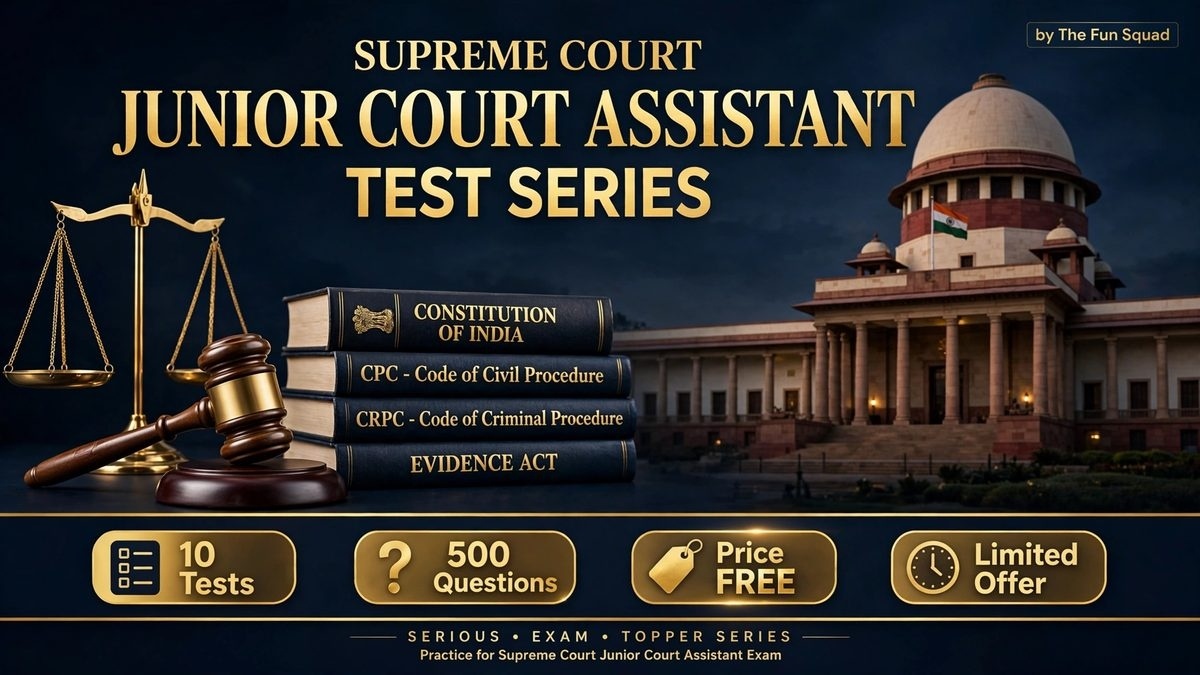
Free
Supreme Court Junior Court Assistant Mock Test Series
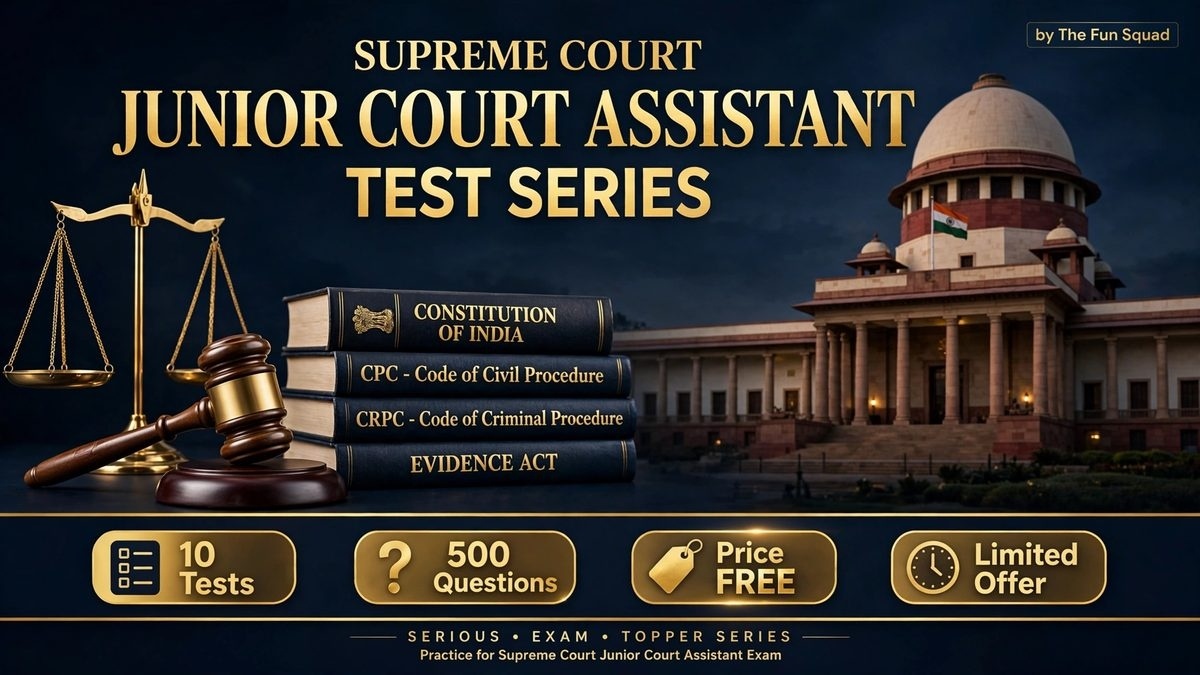
Free
Supreme Court Junior Court Assistant Mock Test Series
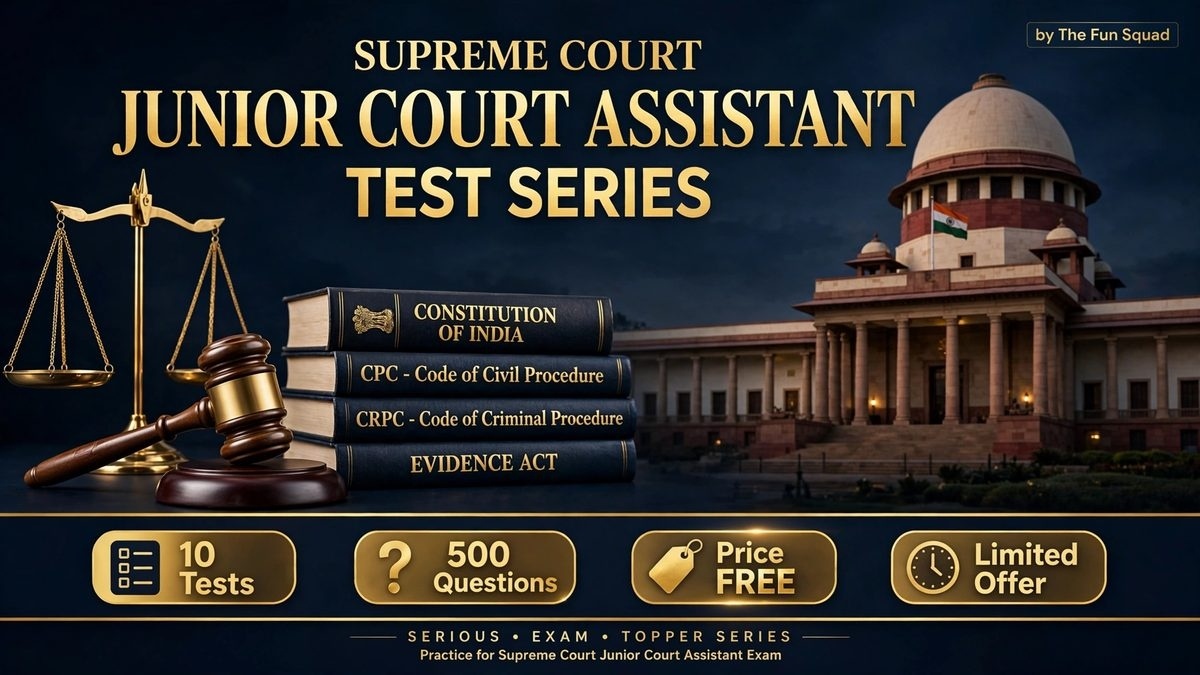
Free
A Supreme Court JCA mock test lets you practise the 2026 objective test under real conditions: 100 questions in 90 minutes, seven sections and 0.25 marks lost for every wrong answer. The Supreme Court of India has scheduled the objective test for 20 November 2026 (tentative), so there is limited time to build speed and accuracy.
Mocks matter more this cycle because the pattern is new. Three law sections now carry 35 marks, and few candidates have a feel for how those questions are framed. Regular timed tests show you which sections cost you time, where guessing is hurting your score and whether you are ready for the typing and descriptive stages that follow.
Types of Tests to Use
Test type | What it covers | When to take it |
|---|---|---|
Topic tests | One topic, such as Articles 124 to 147 or percentages | Right after finishing a topic |
Sectional tests | One full section, such as Supreme Court Rules, 2013 | From the middle of your preparation |
Full-length mocks | All seven sections, 100 questions in 90 minutes | Last four to six weeks, two to three a week |
Previous year papers | Past JCA papers for difficulty level | Early, to see the standard, and again near the exam |
Typing practice | 10-minute English passages at 35 wpm or more | Daily from the start |
The Pattern to Practise In
Practise only in the 2026 format: General English 20, General Aptitude 15, General Knowledge 15, judiciary provisions of the Constitution 15, Supreme Court Rules, 2013 10, Service and Conduct Rules, 1961 10 and Computer Knowledge 15. The qualifying mark is 50 out of 100. Older mocks built on the 2025 pattern, with 50 English questions and no law sections, will give you a misleading picture.
How to Use Mock Tests
Diagnostic phase: Take one full mock before serious study to find your starting score and weakest sections.
Build phase: Take topic and sectional tests two to four times a week as you complete each part of the Supreme Court JCA syllabus.
Simulation phase: In the last four to six weeks, take two to three full-length mocks a week at the same time of day as the real test.
Final week: One or two mocks, then focus on revision from your error log.
How to Analyse a Mock
Wrong answers: Note whether each was a concept gap, a misread question or a careless slip, and add it to your error log.
Slow questions: Mark any question that took more than 90 seconds and find a faster method.
Skipped but solvable: Count the questions you skipped but could have answered. These are free marks.
Negative marks: Total your deductions. If they cost you more than 3 to 4 marks, tighten your guessing rule.
Benchmarks to Track
Metric | Why it matters |
|---|---|
Overall score | Keep it consistently well above the 50-mark qualifying line |
Accuracy | Aim for 85% or more of attempted questions correct |
Law sections score | 35 marks at stake; track them separately |
Time per section | Recall sections should take well under a minute per question |
Typing speed and errors | The 2025 typing cut-off was 43.18 out of 50, so aim for 40 wpm or more with low errors |
Common Mistakes
Skipping the law sections: Leaving 35 marks to guesswork makes the 50-mark line hard to clear safely.
Taking mocks without review: A mock you do not analyse teaches very little.
Ignoring typing until later: Typing speed takes weeks to build and the descriptive paper depends on it.
Blind guessing: With 0.25 negative marking, random guesses lower your score over a full paper.
Supreme Court JCA Practice on Testkart
Testkart lists Supreme Court JCA online tests from educators on this page, including full-length mocks, sectional tests and topic tests in the 2026 pattern. Check the official schedule on the Supreme Court of India recruitment page.