
UGC NET 2026: Exam Date, Eligibility, Syllabus & Pattern
Prepare for UGC NET 2026 with updated exam dates, eligibility, syllabus, exam pattern, subjects, preparation tips and important exam details.
UGC NET Study Material
Courses
View all

Mock Tests
View allUGC NET Paper 1 Mock Test (10 Questions)

Free
UGC NET Free Mock Test 2026 – Practice Online & Boost Your Score
Free
NTA UGC NET Library and Information Science Mock Test Series

₹499₹401
UGC NET December 2026 – Teztarrar Paper 1 Mock Test (10 Full-Length Tests)
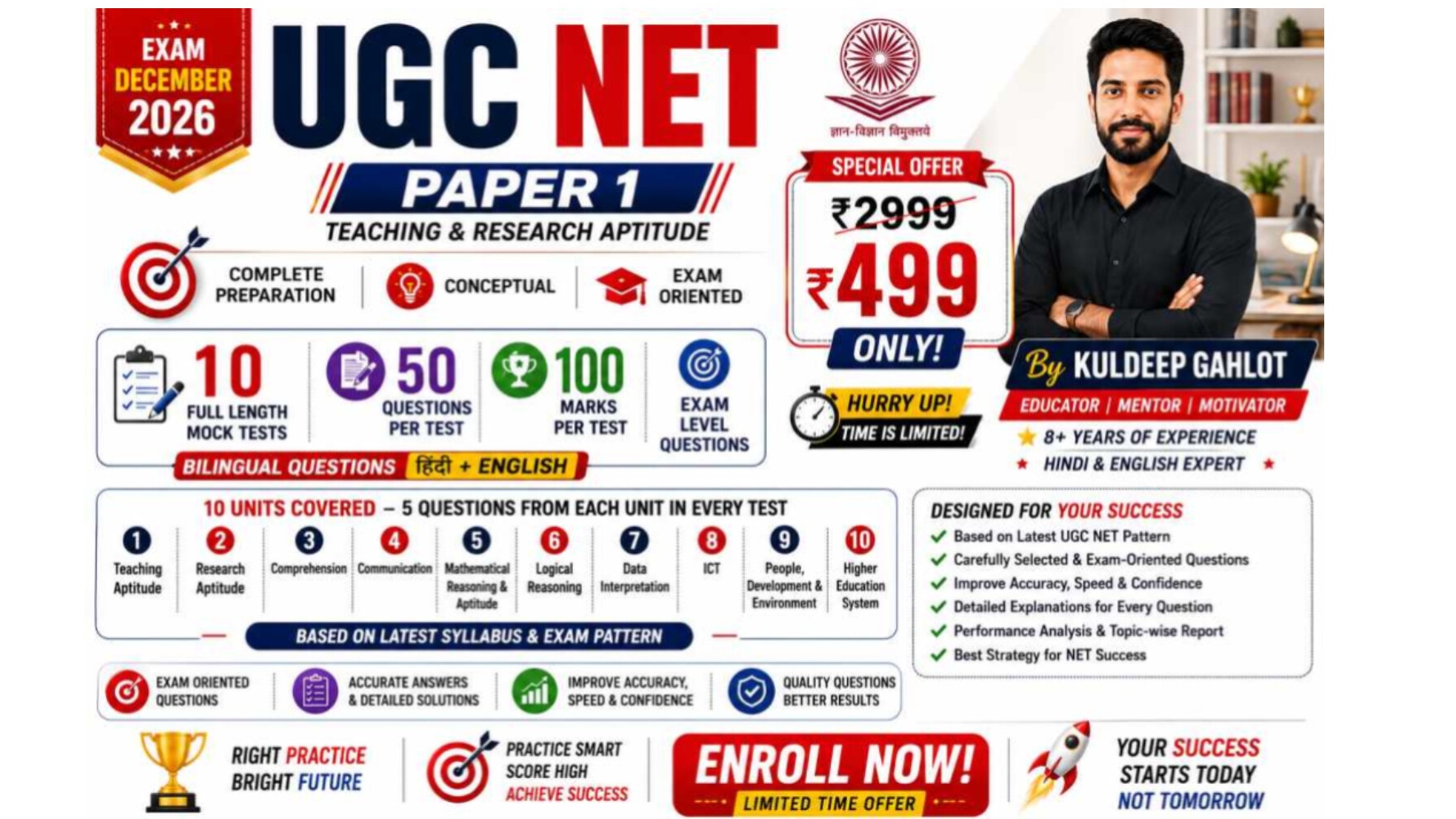
₹2,999₹499
UGC NET Paper 1: 20 Sample Questions (Mock Test)

₹40
Introduction to Taxation: Indian Tax Basics for Exams
₹10₹2
Study Notes
View allUGC NET Paper 1 Complete Book by Dr. Mukesh Goyal ( English )
413 pages · 5 files₹599
UGC NET Paper 1 Book By Dr. Mukesh Goyal (Hindi Medium)
477 pages · 5 files₹599
Classical Mechanics-I Handwritten Notes PDF for BSc MSc Physics
59 pages₹49
History of English Literature: Quick Revision Notes (PDF)
8 pages₹49
Advent of Europeans in India - Quick Revision Notes for UPSC CSE & UGC-NET
17 pagesFree
UGC NET PAPER 1 FULL REVISION
63 pages₹19
Bundles
View allUGC NET Paper 1 Complete Batch with Theory, PYQs & Study Material(English)
3 itemsSave 31%₹3,597₹2,499
UGC NET Paper 1 Theory + PYQs Batch
2 itemsSave 50%₹2,998₹1,499
UGC NET Paper 1 Complete Batch(Theory + PYQ + Notes) with Environmental Science
5 itemsSave 17%₹7,195₹5,999
UGC NET Paper 1 (Theory + PYQ Batch) with Environmental Science Batch

3 itemsSave 17%₹5,997₹4,999
UGC NET Education Paper 1 Recorded Course
2 itemsSave 25%₹3,998₹2,999
UGC NET Paper 1 + Environmental Science Recorded Course + Paper 1 Book
4 itemsSave 35%₹6,196₹3,999
If you hold a master's degree and dream of becoming a college lecturer or pursuing research in India, the UGC NET exam is your gateway. This national-level test determines who qualifies for Assistant Professor positions, Junior Research Fellowships, and PhD admissions across Indian universities. Every year, over 10 lakh candidates appear for this competitive exam, but success comes only with clear understanding and structured preparation. This complete guide covers everything you need to know about UGC NET 2026 from notification dates to the application process to what actually gets tested.
What is UGC NET and Why Does It Matter?
The University Grants Commission National Eligibility Test (UGC NET) is India's official examination for evaluating eligibility in higher education. Conducted by the National Testing Agency (NTA) on behalf of the UGC, this exam serves three critical purposes: determining eligibility for Assistant Professor and Lectureship posts in colleges and universities, awarding Junior Research Fellowship (JRF) to pursue funded research, and enabling PhD admissions at recognized institutions. Unlike many competitive exams, qualifying UGC NET opens doors across academia nationwide.
The exam is conducted twice every year in June and December cycles. With no interview stage and no negative marking, it's designed to test your subject knowledge and teaching aptitude fairly. The certificate issued by UGC is recognised across all Indian universities and remains valid for life (for Assistant Professor eligibility), making it a permanent credential in your academic career.
UGC NET 2026 Quick Overview
Exam Component | Details |
|---|---|
Conducting Authority | National Testing Agency (NTA) on behalf of University Grants Commission (UGC) |
Exam Level | National |
Frequency | Twice a year (June & December) |
Mode | Computer-Based Test (CBT) |
Languages | English & Hindi |
Total Questions | 150 (Paper I: 50, Paper II: 100) |
Total Marks | 300 (Paper I: 100, Paper II: 200) |
Exam Duration | 3 hours (180 minutes) |
Negative Marking | None |
Official Website |
UGC NET December 2026 Notification & Important Dates
The official notification for UGC NET December 2026 is expected to be released by the National Testing Agency in the first week of October 2026. This PDF notification contains all essential information including application dates, exam dates, eligibility criteria, fee structure, and subject list.
To avoid missing deadlines, bookmark the official NTA website and enable notifications. Many candidates lose valuable preparation time waiting for the notification start studying the syllabus now based on the pattern used in June 2026.
Event | Expected Timeline |
|---|---|
Notification Release | First week of October 2026 |
Application Window Opens | October 2026 |
Last Date to Apply | Late October 2026 |
Fee Payment Deadline | Late October 2026 |
Application Correction Window | First week of November 2026 |
City Intimation Slip | December 2026 |
Admit Card Release | December 2026 (4 days before exam) |
Exam Dates | Late December 2026 – Early January 2027 |
Answer Key | January 2027 |
Result Declaration | January/February 2027 |
UGC NET Eligibility Criteria 2026
Before applying, verify that you meet all eligibility requirements. Submitting an application despite not fulfilling criteria can lead to rejection even after qualifying the exam.
Educational Qualification: You must hold a master's degree or equivalent qualification from a UGC-recognised university in any discipline. If you're still in your final year of postgraduation, you can apply provisionally but you must submit proof of passing before certificate issuance.
Minimum Marks Required:
General & EWS categories: 55% aggregate marks or equivalent grade in master's degree
SC, ST, OBC-NCL, and PwD candidates: 50% aggregate marks or equivalent grade
Age Limit: The age limit applies only for Junior Research Fellowship (JRF). If you're applying for Assistant Professor only, there is no upper age limit.
For JRF, the maximum age is 30 years as of the application deadline. Significant relaxations are available for reserved categories and women candidates up to 5 years additional for SC/ST/OBC-NCL/PwD/women/third gender candidates.
Category | Age Limit (for JRF) | Relaxation |
|---|---|---|
General (UR) | Up to 30 years | None |
OBC-NCL | Up to 30 years | Up to 5 years |
SC/ST | Up to 30 years | Up to 5 years |
PwD | Up to 30 years | Up to 5 years |
Women Candidates | Up to 30 years | Up to 5 years |
Third Gender | Up to 30 years | Up to 5 years |
Understanding the UGC NET Exam Pattern
The exam consists of two papers conducted in a single session without any break between them.
Exam Component | Number of Questions | Total Marks | Subject Coverage & Scope | Strategic Weight & Key Highlights |
|---|---|---|---|---|
Paper I (General Aptitude) | 50 MCQs | 100 Marks | • Teaching & Research Aptitude • Reading Comprehension & Communication • Mathematical Reasoning & Data Interpretation • Information & Communication Technology (ICT) • People, Environment & Higher Education System | • Common for all candidates regardless of stream. • Shared combined duration of 180 minutes (3 hours) with Paper II (no break between papers). |
Paper II (Subject-Specific) | 100 MCQs | 200 Marks | • In-depth domain knowledge of your chosen specialization (from 85+ available subjects). | • Carries 2/3rd of total exam weightage (twice the marks of Paper I). • Difficulty scales according to post-graduate level complexity. |
Overall Exam Pattern | 150 MCQs | 300 Marks | • Duration: Single 3-hour session (180 mins continuous). • Format: Computer-Based Test (CBT), Multiple Choice Questions. | • Candidates can allocate time dynamically between Paper I and Paper II during the 180-minute window. |
Key Advantages:
No negative marking: Every blank answer costs you nothing, encouraging you to attempt all questions
No interview stage: Your score alone determines eligibility
Objective format: Clear right and wrong answers with no subjective interpretation
UGC NET Syllabus Overview
Paper I (Teaching & Research Aptitude) covers ten topics:
Teaching Aptitude: Educational objectives, teaching methods, student characteristics, evaluation
Research Aptitude: Research methodology, research ethics, impact factor, citations
Reading Comprehension: Understanding passages, inference, vocabulary in context
Communication: Verbal and non-verbal communication, mass media, presentation skills
Logical Reasoning: Deductive and inductive reasoning, arguments, fallacies
Data Interpretation: Graphs, tables, statistical analysis
Mathematical Reasoning: Basic arithmetic, algebra, geometry relevant to teaching
Higher Education System: UGC structure, NEP 2020, autonomous institutions
Information & Communication Technology: Digital tools, online teaching, cybersecurity basics
People, Development & Environment: Sustainable development, environmental issues
Paper II: You select one subject from 85+ available options including Commerce, History, Political Science, Computer Science, English, Psychology, Economics, Management, Education, Law, Geography, Environmental Science, and many others.
How to Apply for UGC NET 2026: Step-by-Step Process
Applying for UGC NET is entirely online. Follow these nine steps carefully to avoid rejection or delays:
Step 1: Visit Official Website
Go to ugcnet.nta.nic.in and click "Apply Online." Read all instructions before proceeding.
Step 2: New Registration
Click "New Registration" and enter your name, email, mobile number, and date of birth. The system generates an Application Number and temporary password. Save both immediately.
Step 3: Log In to Candidate Portal
Use your Application Number and temporary password to log into the portal. Change your password immediately for security.
Step 4: Fill Personal Information
Enter correct personal details exactly as they appear in official documents—name, father's name, date of birth, gender, category, PwD status (if applicable). Any mismatch can cause rejection.
Step 5: Enter Academic Details
Provide information about your bachelor's and master's degrees including university name, passing year, marks obtained, and aggregate percentage.
Step 6: Select Subject and Examination Centre
Choose your preferred subject for Paper II from the available list. Select up to three examination centre choices in order of preference. NTA allocates centers based on availability.
Step 7: Upload Documents
Upload high-quality scans of:
Passport-size photograph (4x6 cm, white background)
Signature (black ink on white paper)
Category certificate (if SC/ST/OBC-NCL)
PwD certificate (if applicable)
Aadhaar/valid identity proof
Files must be in JPG/PNG format, maximum 100KB each.
Step 8: Pay Application Fee
UGC NET application fees vary by category:
Category | Fee |
|---|---|
General (UR) | ₹1,150 |
General-EWS / OBC-NCL | ₹600 |
SC / ST / PwD / Third Gender | ₹325 |
Payment options include UPI, net banking, debit card, and credit card. Save the transaction receipt for records.
Step 9: Verify and Submit
Review all entered information carefully. Click "Final Submit" only after verification. Download and print the confirmation page. This page is your proof of application.
Common Mistakes to Avoid:
Uploading blurred photographs or signatures
Entering names differently than official documents
Missing the application deadline by submitting in the last hour
Not paying the fee despite filling the form
Selecting a subject unrelated to your qualification
Forgetting to make corrections during the correction window
Losing the confirmation page (keep multiple copies)
Choosing the Right Subject
Your subject choice significantly impacts your preparation intensity and cutoff marks. Choose a subject that matches your master's degree as closely as possible. If your exact subject isn't available, select the most relevant option.
Difficulty Levels (General Pattern):
Lower Cutoff Subjects: Law, Library Science, Commerce (more candidates, competitive)
Moderate Subjects: English, History, Geography, Political Science
Higher Cutoff Subjects: Niche subjects like Folklore, Archaeological Science (fewer candidates, easier to qualify)
The best strategy is choosing a subject where you're strong academically, not where the cutoff appears lower. A subject with lower cutoff but weak preparation leads to poor results.
UGC NET Preparation Strategy
Start preparing immediately without waiting for the official notification. The exam structure and syllabus remain consistent year to year.
Allocate Your Preparation Time:
Paper I: 30% of study hours (teaching & research aptitude)
Paper II: 70% of study hours (subject specialisation)
Paper II carries twice the marks, making subject expertise critical for qualifying.
Core Activities:
Download and study the official syllabus thoroughly
Solve previous year question papers (at least 5 years)
Take full-length mock tests weekly to identify weak areas
Revise concepts through short notes or flashcards
Analyse mock test performance to improve weak sections
Increase mock test frequency to 2-3 tests weekly one month before the exam
With Testkart's comprehensive test series, you can practice subject-wise tests, full-length papers matching the official pattern, and access detailed performance analysis. The platform also provides previous year questions organised by topic, helping you identify high-weightage areas.