
Testkart gives you four ways to add questions to a test. The right option depends on where your questions are already.
If your questions are already written somewhere, you can usually add them much faster than typing them one by one.
Before You Start
You need:
A Test Series
At least one Test Item inside the series
At least one Subject inside the test item
If you haven't created these yet, start with How to Create a Test Series in Testkart.
1. Open the Questions Screen
From the sidebar, click Test Series, find your series, and click Edit.
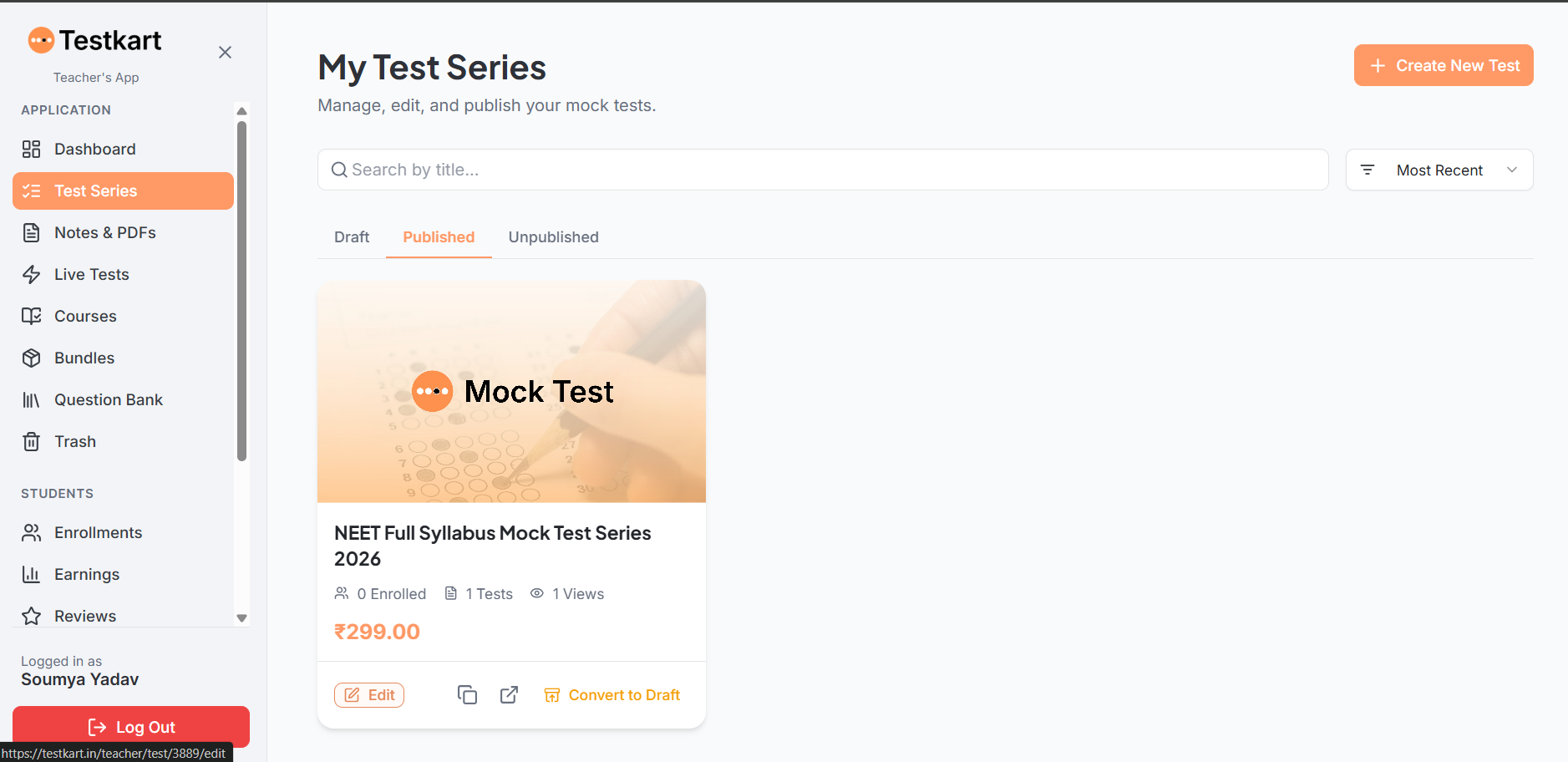
You'll see Manage Test Items, which lists the tests in your series.
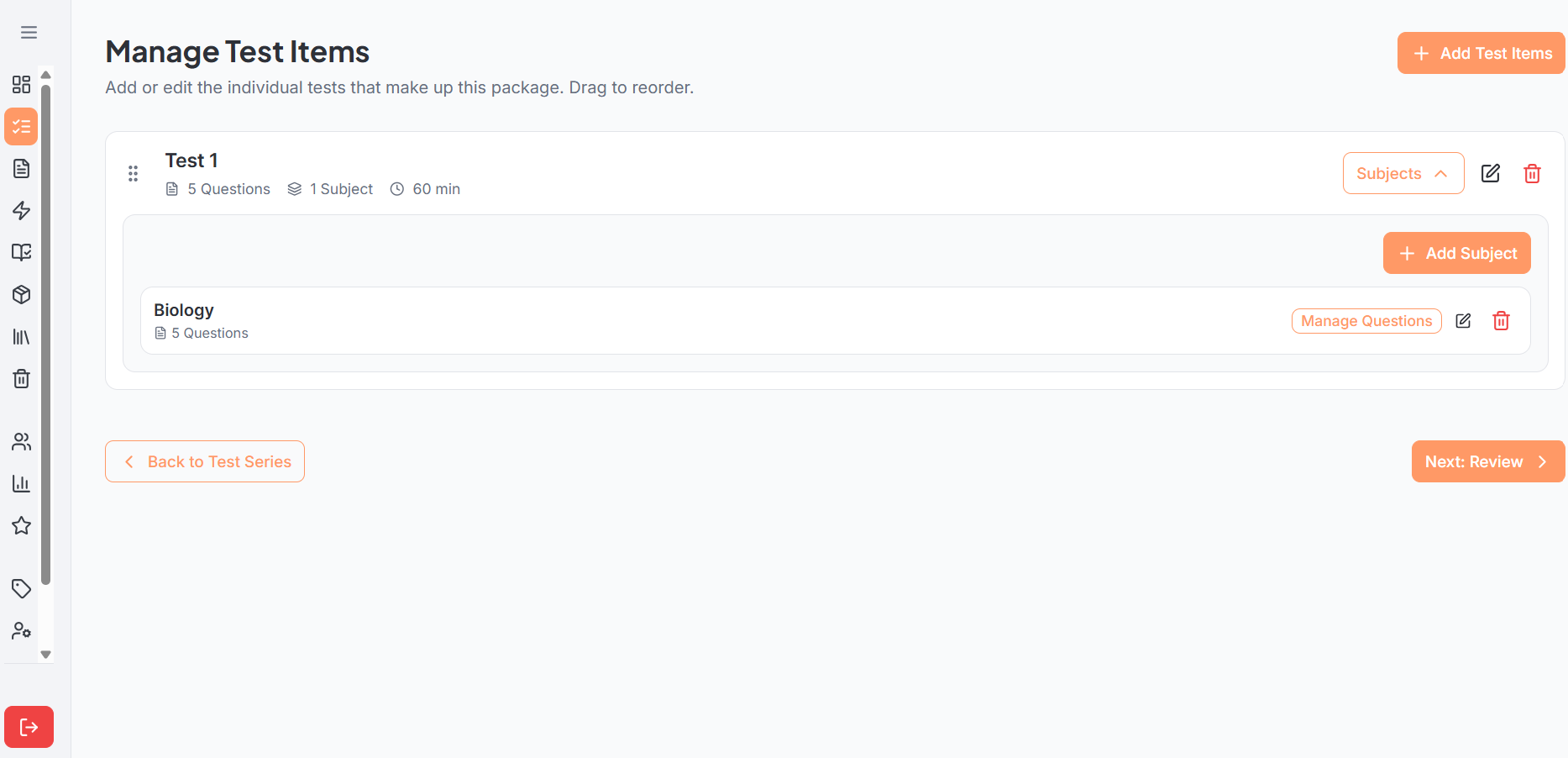
Find the test you want to add questions to and click Subjects. The row expands to show its subjects.
Click Manage Questions next to the subject you want to fill.
2. Choose the Right Way to Add Questions
On the Questions screen, you'll see four options:
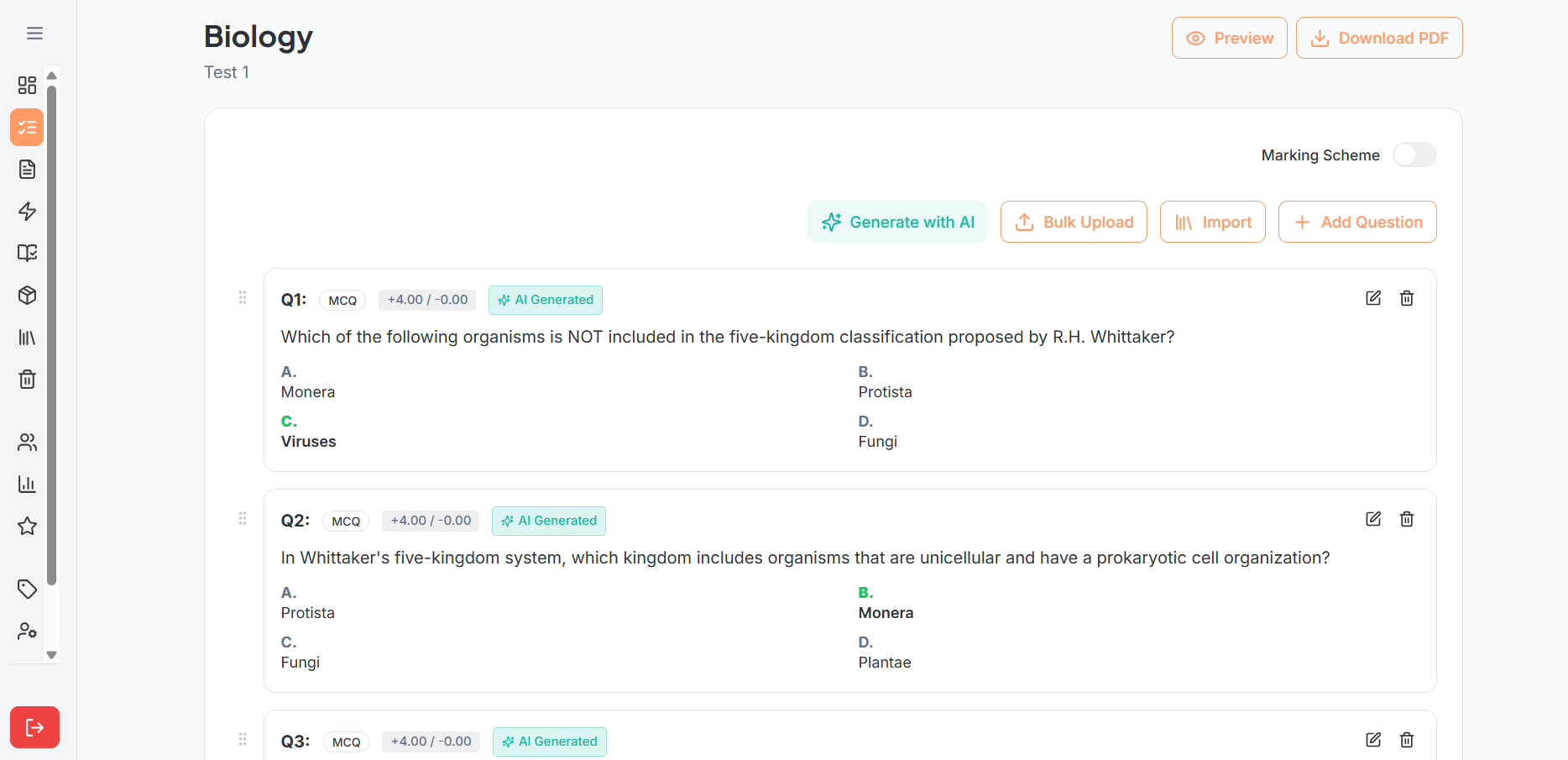
Your questions | Use |
|---|---|
Already written in a document, paper or spreadhseet | Bulk Upload |
Not written yet, but you have a syllabus | Generate with AI |
Already saved in Testkart | Import |
Need images, diagrams, tables or custom formatting | Add questions |
Before you start typing questions manually, check whether Bulk Upload or Import can save you time.
3. Bulk Upload
Best for: Questions already available in a document, paper or spreadsheet.
Bulk Upload is the fastest way to add a large number of questions at once.
Click Bulk Upload. You can upload an .xlsx, .xls or .csv file. Testkart also provides CSV and Excel templates with the required columns.
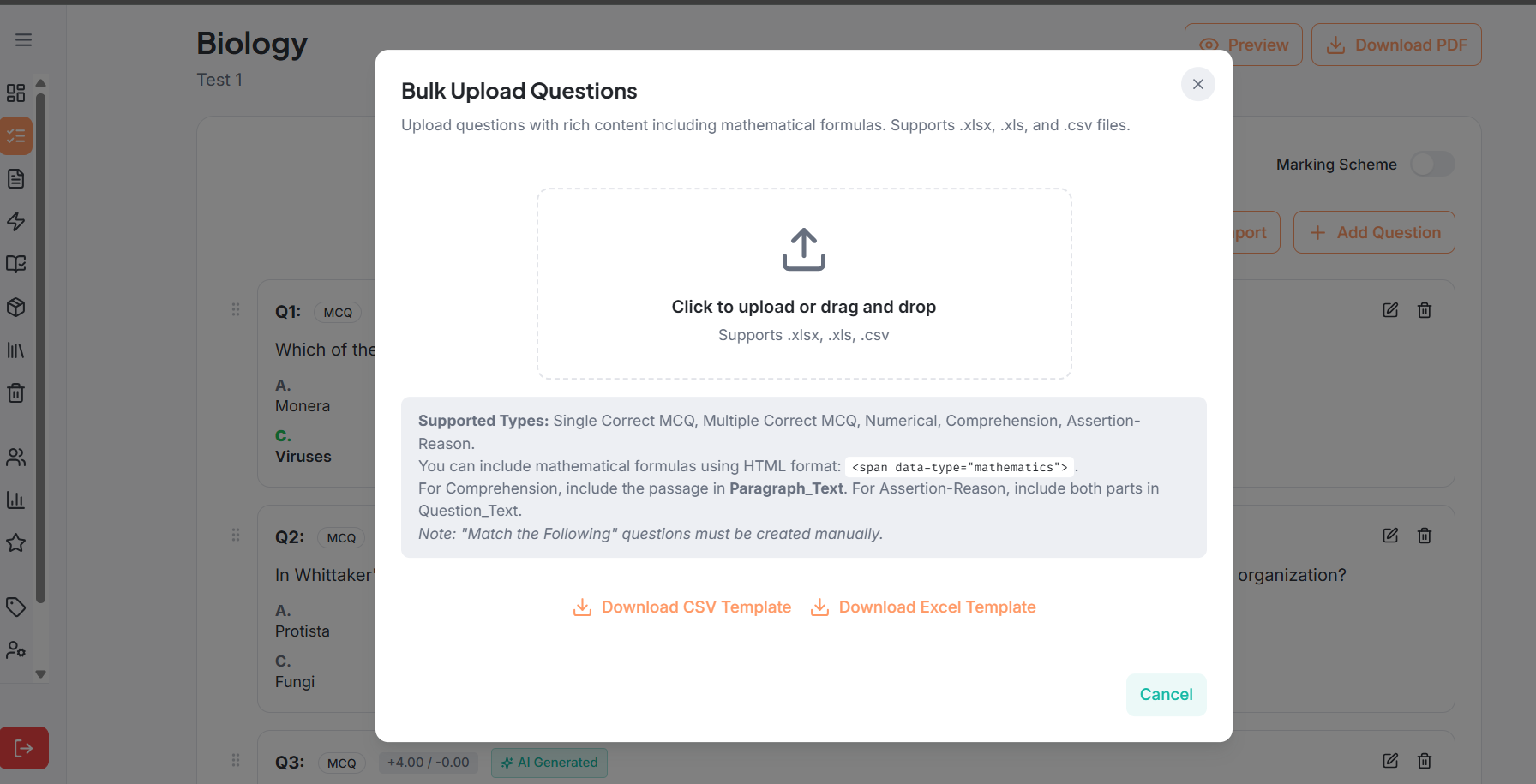
Download a template, look through the five example rows, and then replace them with your questions.
The main columns
Question_Type — single correct MCQ, multiple correct MCQ, numerical, comprehension or assertion reason
Question_Text — The question. For assertion-reason questions, enter both parts on separate lines.
Paragraph_Text — The passage for comprehension questions. Repeat the passage for every question that uses it.
Option_A to Option_E — Up to five answer choices. Leave unused options blank.
Correct_Option — The correct answer letter for single-answer questions.
Correct_Options — Comma-separated answers such as A,C for multiple-correct questions.
Numerical_Answer — The correct number for numerical questions.
Numerical_Tolerance — How much the student's answer can differ from the correct answer.
Positive_Marks — Marks awarded for a correct answer.
Negative_Marks — Marks deducted for an incorrect answer. Use 0 to turn negative marking off.
Explanation — The explanation shown to students after the test.
Mathematical formulas can also be added using HTML with <span data-type="mathematics">.
Match the Following questions cannot be added through Bulk Upload. You'll need to create those manually.
4. Generate Questions with AI
Best for: When you have a syllabus or topic but don't have questions ready.
Select Generate with AI, then provide the topic, difficulty level and exam type.
Testkart generates questions with answer options, distractors and step-by-step explanations.
Always review the generated questions before adding them to a published test. In particular, check:
The question itself
The correct answer
The difficulty level
The explanation
A wrong answer key can make it into the published test if you don't review it.
5. Import from Your Question Bank
Best for: Questions you've already created and saved in Testkart.
Use Import to pull questions from your existing Question Bank into the test.
This is particularly useful when you reuse the same syllabus across multiple test series. Instead of creating the same questions again, save them once and import them whenever you need them.
See How to Build a Question Bank in Testkart.
6. Add Questions Manually
Best for: Questions that need images, diagrams, tables, video or specific formatting.
Click Add Question to create a question from scratch.
You can:
Choose the Question Type
Set + Marks and − Marks
Enter the question
Add the answer options
Select the correct answer
Add any required media or formatting
Save the question
Use Save & Finish when you're done. Use Save & Add Another if you want to continue creating questions.
For a complete walkthrough, go to how to add questions to a test series.
Which Option Should You Use?
Use this as a quick decision guide:
Questions already in a file? → Bulk Upload
Only have a syllabus? → Generate with AI
Questions already in Testkart? → Import
Need diagrams, tables, images or special formatting? → Add Question
Need Match the Following? → Add Question
After adding your questions, preview the test as a student, check the questions and answer keys, and then Review and Submit.